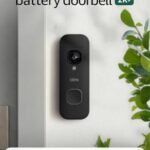
Excellent video quality and features at a competitive price point.
Price vs. rivals
Typical
CheaperTypicalPricier
Priced slightly below the typical mid-range for wired 2K video doorbells, reflecting its wired-only design and lack of advanced smart features found in pricier models, while still being more expensive than basic 1080p options.
Ease of use
Great 70/100
Daily use is straightforward with app-based video and two-way talk, but wired installation may be challenging for average users.
Overview
If you already have doorbell wiring and you want a sharp, reliable camera without worrying about charging batteries, the Ring Wired Doorbell 2K is a straightforward pick. It replaces your old wired button with a speckled gray unit that shoots 2K video, has two-way talk, and works with your existing chime. It’s for people who want the essentials, not the extras that bump up the price on battery models.
At $79.99, it sits right in the sweet spot for a best wired doorbell for rental property situations, or for anyone who just wants a solid security cam at the front door without a recurring battery chore. The catch is that you need existing low-voltage wiring, and you’ll want a Ring Protect subscription to get the most out of it. But for a hardwired setup, it’s a clean, no-fuss option.
Key Features
Retinal 2K resolution with wide-angle video – It captures 1536p video with a 150-degree field of view. You can see a package on the porch and the full height of a visitor, which is more than enough for most front-door setups.
Up to 6x enhanced zoom – The zoom is digital, not optical, but it’s usable. You’ll make out a license plate or a delivery label if the lighting is decent. Push it to 6x and it gets grainy, but for checking who’s at the gate it works.
Two-way talk with noise cancellation – You can tell the UPS driver to leave the box by the side door, and they’ll actually hear you without that hollow echo. It’s clearer than older Ring models, though still not as crisp as a phone call.
Hardwired power, no battery – This is a feature, not a limitation, if you have wiring. No pulling the unit off to charge it. No worrying about the battery dying mid-delivery. It just works, as long as your transformer is 16-24VAC and at least 10VA.
Works with existing mechanical and digital chimes – You won’t need to buy a separate chime or a Ring Chime right away. It triggers your indoor doorbell, which is something the battery models can’t guarantee without extra hardware.
Speckled gray finish – It’s a matte, slightly textured gray that blends into most door frames better than glossy black or white. Less obvious, less of a target for thieves who spot the shiny Ring logo from the street.
Fit for You
You have an old wired doorbell that works fine but you want to see who’s ringing it from your phone.
You rent and you can’t drill big holes or run new wires, but your landlord okayed a swap-in replacement for the existing button.
You live in a cold climate and you’ve had battery doorbells that go flat in January because the cold kills lithium cells.
You want the best wired doorbell for rental property because you can uninstall it in ten minutes and take it to your next place.
You already pay for a Ring Protect plan and want a doorbell that records continuously without subscription interruptions.
You’re the kind of person who likes that the doorbell just works, and you’d rather spend $80 on the device than $200 on a fancier one with features you won’t use.
Uses
It’s 3 p.m. on a Tuesday and you’re at work. The Ring app pings. You see a delivery driver drop a box right in front of the door, blocking the screen. With the Ring 2K wide angle video, you can actually see the package label and the driver’s face at the same time. You use the two-way talk to ask him to tuck it behind the planter. He does. No missed deliveries.
Late at night, the motion alerts kick in. A cat walks across the porch. Another cat. Then a person who is not a cat. The 2K resolution is enough to see the person’s jacket color and shoe style, which is more than the 1080p models show without zooming. You don’t need 4K for a front door. 2K is the sweet spot between file size and detail.
The real win is how it handles the everyday. Kids coming home from school, the neighbor borrowing a tool, the Amazon driver who always rings twice. You get a notification, you peek, and you decide if you need to answer. No more running to the door for someone selling solar panels.
Experience
Installation is where the Ring wired doorbell shines, or fails, depending on your wiring. If you have a standard 16VAC transformer and two wires poking out of your wall, you’ll be done in 15 minutes. The included mounting bracket, screws, and wire connectors are decent, though the screwdriver they give you is too small for human hands. Grab your own.
If your transformer is older or weaker than 10VA, you’ll get a “low voltage” error in the app and the doorbell won’t power on. That’s not a defect, it’s physics. You’ll need to swap the transformer, which is a $15 fix if you’re handy, or a $150 electrician visit if you’re not. A lot of the negative reviews come from people whose existing wiring couldn’t handle it.
Once it’s on, the daily experience is simple. The app shows a live view in about two seconds. Motion alerts are fast, maybe a second after someone steps into the zone. You can adjust the motion sensitivity per zone, but the default is a bit twitchy. Expect a few false alerts from passing cars if your door faces the street. Dial it down and it’s fine.
The two-way talk has a half-second delay. It’s not a walkie-talkie, more like a bad satellite call. Functional, but don’t try to have a conversation with your mother-in-law through it. You’ll end up talking over each other.
The image quality at night is adequate, not amazing. The infrared LEDs illuminate about 15 feet clearly. Beyond that, it’s shadows and guesswork. If your porch light is on, the color night vision kicks in and looks much better. So leave the porch light on.
Cleaning the unit is easy. The speckled gray doesn’t show dust as much as glossy black would. A damp cloth wipes off spider webs and pollen. One small annoyance: the faceplate snaps off for painting, but the plastic tabs feel fragile. Be gentle the first few times.
Pros and Cons
Pros
Sharp 2K video for the price – At $79.99, you get resolution that beats most wired doorbells under $100. You can read a package label from 6 feet away.
True hardwired reliability – No battery anxiety in winter. No taking it off to charge. If the power is on, the doorbell is on.
Works with your existing chime – No need for a separate Ring Chime unless your mechanical chime is ancient and incompatible. The app walks you through compatibility settings.
Compact and discreet – It’s smaller than the Ring Video Doorbell 4 and doesn’t stick out as far. Less likely to get bumped by a delivery box.
Fast motion alerts – The PIR sensor is responsive. You’ll get the alert while the person is still there, not 10 seconds after they’ve left.
Cons
Requires existing low-voltage wiring and a strong transformer – If your wiring is old or your transformer is under 10VA, this doorbell won’t work without upgrades. Check before you buy.
No battery backup – If the power goes out, the doorbell is dead. A wired-only model means no recordings during a blackout unless you have a UPS on your router.
Subscription needed for recording and smart alerts – Without a Ring Protect plan ($3.99/month or $39.99/year), you only get live view and notifications. No saved video, no person detection. That’s a hidden cost.
Limited field of view compared to some battery models – The 150-degree diagonal is good, but the Ring Video Doorbell 4 has a head-to-toe view that catches packages right at your feet. The 2K model misses the ground within about 12 inches of the door.
Digital zoom gets soft past 3x – The 6x enhanced zoom is marketing hype. At 4x and above, the image gets pixelated. Fine for recognizing a face if they’re close, not for reading a distant house number.
Advantages
Compared to the battery-powered Ring models, the wired 2K version wins on reliability and image quality. No battery swaps in the middle of a snowstorm, and the 2K sensor is a step up from the 1080p on the Ring Video Doorbell 4. The trade-off is you lose the battery’s flexibility to place it anywhere without wires, and you give up the head-to-toe aspect ratio that catches packages at your feet.
The key advantage in the Ring Wired Doorbell 2K vs Ring Video Doorbell 4 comparison is simple: if you have wiring, the 2K model gives you better resolution for less money and no battery fuss. The Video Doorbell 4 is better for people who don’t have existing wiring or who want the wider vertical view. The 2K model is better for anyone who wants the clearest picture for the dollar and already has wires in place.
Who Should Buy
Buy it if you have a standard wired doorbell and want a quick upgrade to 2K video with minimal hassle. It’s also a great choice for renters who want the best wired doorbell for rental property because installation is reversible and the price is low.
Buy it if you live in a cold climate or have a door facing direct sun. Battery doorbells fail in extreme temps. This one handles -5°F to 120°F without blinking.
Skip it if you don’t have doorbell wiring or your transformer is too weak. You’ll be happier with a battery model like the Ring Video Doorbell 4, which costs more but doesn’t need wires.
Skip it if you refuse to pay for a subscription. Without a Ring Protect plan, the doorbell is basically a $80 live-view camera with no recording. That’s a dealbreaker for many people.
FAQ
Is the Ring Wired Doorbell 2K worth it?
Yes, if you have existing wiring and you want sharp 2K video without the hassle of charging a battery. At $79.99, it’s priced well for what it delivers, but factor in the subscription cost if you want recorded video.
How does the Ring Wired Doorbell 2K compare to the Ring Video Doorbell 4?
The wired 2K model has a sharper 2K sensor and costs less, but the Video Doorbell 4 offers head-to-toe video and works on battery or wiring. Choose the wired 2K for image quality and the 4 for placement flexibility.
Does the Ring wired doorbell require a subscription?
No, but without a Ring Protect plan you get only live view and notifications. For saved video clips, person detection, and rich notifications, the plan starts at $3.99 per month per device.
Is the Ring Wired Doorbell 2K hard to install?
It’s simple if your existing wiring is standard 16-24VAC with a transformer rated for at least 10VA. If your transformer is weaker, the doorbell won’t power on and you’ll need an electrician or a DIY transformer swap.
Does the Ring Wired Doorbell 2K work with Apple HomeKit or Google Home?
It works with Alexa devices natively for voice announcements and live view on Echo Shows. It does not support Apple HomeKit. Google Assistant support is limited to voice commands to show the feed on a Chromecast or Nest Hub, but setup is not as smooth as Alexa.
What is the wide-angle video like on the Ring 2K doorbell?
The 150-degree diagonal field of view is wide enough to see a person from head to mid-thigh, plus your entire front porch. It’s not a head-to-toe view, so packages directly under the doorbell may be cut off.
Final Verdict
The Ring Wired Doorbell 2K is a no-drama choice for anyone with existing wiring who wants better video than the $50 models and doesn’t need battery freedom. It’s not a game-changer (sorry, I hate that word too), but it does what it sets out to do: capture clear video of your front door, day and night, without making you think about it.
The one thing to keep in mind is the subscription. You can use the doorbell without it, but you’ll only ever see a live feed. If you want recorded evidence of who stole the package, you’ll pay $4 a month. Plan for it, and this is an easy recommendation for a solid, affordable wired doorbell.
Right now, the wired doorbell market is split between people who want the absolute lowest price for a trusted name and everyone else chasing either premium features or subscription-free living. The new Ring Wired Doorbell 2K drops in at $79.99 with a sharp 2K sensor, a wider field of view than most rivals, and a straightforward installation that won’t require an electrician. It’s positioned squarely at the person who already has doorbell wires, doesn’t want to mess with charging batteries, and wants the Ring ecosystem without spending $200. But how does it actually compare against the obvious upgrade, the ecosystem rival, and the privacy-first alternative? Here’s the breakdown.
Product
Price Range
Key Strength
Key Weakness
Best For
Ring Wired Doorbell 2K
$79.99
Best resolution-per-dollar in a trusted smart home platform
Plastic housing; requires existing wired doorbell system
Renters with wiring, budget buyers, Ring ecosystem fans
Homes without doorbell wires; people who want both options
Google Nest Doorbell (Wired, 2nd Gen)
High ($180+)
24/7 continuous recording; excellent HDR and object detection
Paid subscription required for most useful features; taller profile
Deep Google Home users; people who need pre-roll footage
Eufy Security S220 (Wired)
Moderate ($80–$100)
No monthly fees; local storage via HomeBase; 2K video
Notifications can lag; app polish trails Ring and Google
Privacy advocates; anyone refusing a cloud subscription
Ring Wired Doorbell 2K vs Ring Video Doorbell 4: The Upsell Question
The first thing you’ll notice is the price gap—the Wired 2K costs less than half what a Video Doorbell 4 goes for. The reason is simple: battery power costs mone. The Doorbell 4 packs a removable battery pack and works with mechanical chimes out of the box, but it maxes out at 1080p. The Wired 2K gives you sharper video day and night for less mone, and that 150-degree field of view means you’ll see packages slid off to the side that the Doorbell 4 misses. If you have existing wires and you aren’t planning to move anywhere without them, the Wired 2K is the better value, plain and simple. You lose the battery safety net, but honestly, if your doorbell wiring works right now, you’re not going to miss it. The one reason to pick the Doorbell 4 is if you rent a place with no doorbell wiring at all—then the battery flexibility matters more than resolution.
Ring Wired Doorbell 2K vs Google Nest Wired: Ecosystem vs. Value
Google’s wired Nest Doorbell is the smarter device in a lot of ways. The 24/7 continuous recording is genuinely useful—you don’t miss the moment *before* someone pressed the button, which you always do on a Ring. The HDR is better, and the person, package, and animal detection works without constantly barking at cars. But you pay for that intelligence. The Nest costs around $180, and almost everything useful lives behind a Nest Aware subscription. The Ring Wired 2K also needs a Ring Protect plan to unlock recording and rich notifications, but at $79.99 for the hardware, the upfront sting is much lower. If you’re deep in the Google Home ecosystem (Nest Hub on your nightstand, Android phone, Google Assistant everywhere), the Nest is the obvious fit. If you just want a doorbell that works well and leaves you cash for a year of Ring Protect subscription, go with the Ring.
Ring Wired Doorbell 2K vs Eufy S220: The Subscription Tipping Point
This is the most interesting comparison because the hardware is almost identical on paper. Both do 2K, both offer wide-angle lenses, and both support two-way talk. The Eufy S220 typically sells for around $80 to $100, right in the Ring’s neighborhood. The big difference is trust and monthly cost. With the Eufy, your video lives on the HomeBase in your house, not in Amazon’s cloud. You don’t pay a cent for recording or notifications. With Ring, you’re paying $3.99 a month (or $39.99 a year) per device for video history and alerts. Over three years, that adds up to roughly $120 extra on top of the $80 doorbell. The Eufy’s app is slower to send push notifications, and the AI sometimes flags a leaf as a person, but it’s improving. The Ring’s app is snappier and the Instant Activation alerts come through seconds faster. If you absolutely refuse ongoing fees, the Eufy S220 is the better buy. If you want the most reliable, fastest package notification and you’re okay paying for it monthly, stick with the Ring Wired 2K.
Is the Ring Wired Doorbell 2K worth it? Yes, if you have existing doorbell wiring and you want the best 2K video quality for under $100 in a well-established app ecosystem. For rentals specifically—places where you can’t permanently screw things into brick or run new wires—the low profile and standard wiring of this model is a solid bet, plus the Speckled Gray face hides smudges and weather marks better than the shiny black rivals. However, if you live in a house without doorbell wiring, skip this one entirely and get the Ring Video Doorbell 4. And if you’re the kind of person who hates cloud subscriptions more than you hate slow notifications, the Eufy S220 is your real alternative. For everyone else who just wants a sharp image, simple installation, and the widest ecosystem of cheap chimes and accessories, this is the one.
Ready to decide on the Ring Wired Doorbell 2K?
See today’s price, stock and delivery options on Amazon.