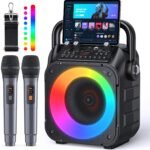
This is an affordable bundle that includes dual wireless microphones and solid user satisfaction, making it a strong value for casual karaoke use.
Price vs. rivals
Cheaper
CheaperTypicalPricier
At $24.99, this mini karaoke machine is priced substantially lower than the majority of comparable portable Bluetooth speaker systems with dual wireless microphones, making it one of the more affordable options available.
Ease of use
Excellent 85/100
The high rating suggests that most users find plug-and-play pairing and dual mics intuitive, though setup and echo adjustments may require a quick look at the manual.
Overview
This Pyle mini karaoke machine review answers the one question you actually care about: is this $25 box worth bringing to a party or just another gadget that gathers dust? Short answer—yes, for the price and portability, if your expectations are realistic. It’s a Bluetooth speaker with two wireless mics stuffed into a case roughly the size of a lunchbox, built for casual sing-alongs, not concert-grade sound. Kids, college dorms, tailgates, and anyone who wants karaoke without hauling a full system will get the most out of it.
What it solves is the awkward gap between “I want to sing right now” and “I own nothing to do it with.” You don’t need an AV receiver, separate mics, or a mixer. You turn it on, pair your phone via Bluetooth, and start yelling into the included wireless mics. That’s the whole deal. It covers the basics and leaves room for improvement only if you’re picky about audio quality.
Key Features
Two wireless UHF microphones – They pair with the speaker out of the box, no extra dongles. Range is about 30–40 feet line-of-sight, which works for a living room or backyard. The mics are lightweight plastic, but they hold up to casual tossing around. Batteries (AA) not included, so have some handy.
Bluetooth 5.0 connectivity – You stream music or karaoke tracks from your phone, tablet, or laptop. Pairing is fast and stable—no dropouts during a song. It also has a 3.5mm aux-in if your source doesn’t do Bluetooth.
Rechargeable battery (1,800 mAh) – Expect around 4–6 hours of moderate use. That’s enough for a full evening of off-and-on singing. Charging takes about 3 hours via the included USB cable. No wall adapter in the box, but any phone charger block works.
Built-in LED light show – A ring of multicolored lights pulses with the music. It’s not subtle—definitely the “look at me” kind of effect. Some people love it; others (like me) find it distracting after a while. You can’t turn it off separately, so be aware.
Handle and compact size – Roughly 8 x 6 x 6 inches and about 1.5 pounds. The handle is sturdy enough to carry it one-handed. It fits in a backpack for picnics or a suitcase for road trips.
Microphone volume and echo controls – Two dials on the front let you adjust how loud the mics are and add a slight reverb effect. The echo isn’t adjustable beyond on/off (it’s a knob, not a digital effect), but it adds a cheap fun roominess to your voice.
Fit for You
You host a weekly game night that keeps turning into an impromptu lip-sync battle. This thing wakes up any group.
You’re a parent of kids aged 5–12 who want to sing along to Disney or pop without you having to set up your main sound system for them.
You’re taking a road trip and need something that packs small but still lets the whole car (parked, obviously) sing together.
You’ve got a small apartment balcony or patio and want to host a mini sing-along without annoying the neighbors with thumping bass.
You’re looking for a portable Bluetooth karaoke speaker with microphones that costs less than a dinner out for two. That’s this.
You run a daycare, summer camp, or youth group and need a durable, low-cost karaoke machine that kids can handle without breaking the bank.
Uses
Picture a birthday party for an 8-year-old. You set the Pyle on the kitchen counter, pull up a kids’ karaoke playlist on YouTube, and hand both mics to the sugar-fueled mob. The music comes through clear enough for the lyrics to be understandable, and the mics pick up their voices—though you’ll need to keep them away from the speaker to avoid feedback. The LED lights turn the room into a mini disco, and nobody cares that the sound isn’t hi-fi. It just works.
College tailgate before a football game. You’ve got a cooler, some snacks, and a spare seat. The Pyle sits on the tailgate, Bluetooth-paired to a phone running a karaoke app. One person sings badly, someone else grabs the second mic for harmonies that are more laughter than notes. The speaker’s volume is loud enough for a group of ten to fifteen people outdoors without distortion. You won’t fill a parking lot, but your immediate circle will hear you.
Adult dinner party where things get loose after the third bottle of wine. Someone pulls out the Pyle, and suddenly the quiet conversation turns into a duet of “Bohemian Rhapsody.” The echo control adds a nice fake roominess that makes average voices sound less flat. The catch: the speaker’s battery starts to dip after two hours of continuous play, so keep the charging cable nearby.
Experience
Unboxing is quick. Speaker, two mics (each needing two AA batteries—no joke, that’s eight AAs total if you include the remote that nobody uses), a micro USB charging cable, a 3.5mm aux cable, and a tiny user manual. You’ll need to supply the phone and the karaoke app. Setup takes under five minutes: pop batteries in the mics, charge the speaker for a couple hours if it’s dead, pair via Bluetooth, and you’re off.
Day-to-day, the speaker lives on a shelf or in a closet. It’s not something you use daily—more like a party tool you grab when friends come over. The handle makes it easy to carry from room to room. The plastic body feels solid enough, though the grille on the front is thin mesh that could dent if you drop it on a corner. Owner complaints tend to mention that the mics are sensitive to battery orientation—you have to line up the plus and minus just right, or they won’t work. Annoying, but a once-you-know-it thing.
The biggest annoyance is that the LED lights have no off switch. If you want a more subtle vibe, you’re stuck either covering the speaker with a cloth (muffles sound) or living with the disco. The dials for mic volume and echo are a little stiff at first but loosen with use. The speaker itself doesn’t get loud enough for a large crowded room—think 20 people max—but for its size, the output is reasonable. Bass is almost nonexistent; it’s a mid-range and treble device, so don’t expect thumping lows for your backing tracks.
Pros and Cons
Pros
Price is absurdly low for what you get – $25 for a Bluetooth speaker and two wireless mics is cheaper than buying a single decent Bluetooth speaker. The value per dollar is the main reason to buy it.
Two mics included, no extra receiver needed – Most budget karaoke machines come with one wired mic or make you buy a second separately. This saves that hassle and cost.
Portable and lightweight – The handle and size mean you can grab it and go without planning. It fits in a beach bag or a large purse.
Simple operation – No menu diving, no pairing each mic individually. Turn on speaker, turn on mics, sing. Even a tech-averse relative can manage it.
Cons
LED lights cannot be turned off – If you want a low-key session, the flashing colors are a distraction. Some people love them; for others it’s a dealbreaker. Know yourself.
Sound quality is thin and lacks bass – Voices come through clearly, but backing tracks sound hollow. Crank it too high and you’ll get distortion. This is not for audiophiles.
Battery life is average, not stellar – 4–6 hours is fine for a party, but if you forget to charge it, you’ll run out mid-song. The charging port is micro USB, which feels dated in 2025.
Mics eat AA batteries quickly – You’ll go through a set of four AAs in maybe 6–8 hours of use. Rechargeable NiMH batteries help, but they’re not included. Factor in the cost.
No separate mic volume control per mic – The dial adjusts both mics together, so you can’t balance a loud singer and a quiet one independently.
Advantages
Compared to most other budget karaoke machines in this price range, the Pyle gives you two wireless mics from the start. The Singing Machine’s cheapest model (under $30) typically includes only one wired mic or a single wireless mic—you have to buy the second one separately, and that adds $15–20. For a Pyle vs The Singing Machine showdown at the low end, Pyle wins on mic count and portability. The Singing Machine often has better sound quality and a more polished look, but those start around $40–50.
Another advantage: the Pyle is genuinely small. Most “portable” karaoke machines are the size of a small suitcase. This one you can stash in a cabinet or under a car seat. If you’re searching for the best mini karaoke machine for parties where space is tight—like a dorm room or a picnic blanket—this is hard to beat for the price. The trade-off is that you give up bass and volume that bigger units offer. That’s a fair exchange for not having to lug a 10-pound box.
Who Should Buy
Buy it if: you want a cheap, portable, no-fuss karaoke setup for kids, casual adults, or outdoor gatherings where you don’t mind modest sound. It’s also a great gift for a family with young children—they’ll wear it out, but you won’t feel bad about the cost.
Buy it if: you run a classroom, daycare, or summer camp and need a durable, low-cost machine that you can replace without a budget fight. The plastic construction and simple design handle rough treatment.
Skip it if: you’re a serious karaoke enthusiast who wants full-range audio, separate mic mixing, and a battery that lasts all day. Look at models from Ion, VocoPro, or The Singing Machine’s higher-end lines ($80–$150). Those have dedicated tweeters, subwoofers, and longer battery lives.
Skip it if: you need the mics to work with your existing sound system. The Pyle’s mics only pair with its own speaker—they aren’t standalone wireless mics you can use with a PA or home theater receiver.
FAQ
Is the Pyle Mini Karaoke Machine worth it?
Yes, if you need a very cheap, portable karaoke setup for parties, kids, or casual use. The sound is mediocre but acceptable for the price, and the dual wireless mics are a real value. For serious singers, spend more on a better speaker.
How long does the battery last?
Expect 4 to 6 hours of mixed use (music playback and occasional mic use). Continuous singing at high volume will drain it closer to 4 hours. Full recharge via micro USB takes about 3 hours. Keep a power bank handy for longer sessions.
Can I connect two Pyle speakers together?
No. The Pyle Mini Karaoke Machine does not support party mode or daisy-chaining via Bluetooth. You can only use one speaker at a time. If you need stereo pairing, look at brands like JBL or Anker, but those don’t come with mics.
Is it safe for children to use?
Yes. The speaker and mics are low-voltage and use standard AA batteries. The volume can go loud, but it’s not dangerously high. Supervise young kids with the small parts (battery covers, charging cable) as they are a choking hazard.
Does it work without a phone or Bluetooth?
Yes, through the 3.5mm aux input. You can connect a tablet, laptop, MP3 player, or even an old iPod. The mics still work independently of the source, so you can use a CD player or other audio device and sing along.
How do the microphones connect to the speaker?
They use UHF radio frequency (not Bluetooth). Each mic has a tiny antenna inside and pairs automatically with the speaker via a pre-set frequency. There’s no pairing button; just turn on the mics and speaker, and they work. If they don’t, check battery orientation and distance.
Final Verdict
The Pyle Mini Karaoke Machine is the kind of product you buy when you want karaoke to happen but don’t want to spend more than a pizza night. It’s not going to impress anyone who cares about audio quality, and the always-on LED lights will drive some people nuts. But for $25 you get a Bluetooth speaker and two wireless mics that work out of the box, pack into a small bag, and survive being passed around a group of enthusiastic amateurs. Is Pyle mini karaoke machine worth it? For that price, absolutely—just keep your expectations tuned to “fun” rather than “fidelity,” and you’ll have a great time.
Pyle Mini Karaoke Machine vs the Competition in 2026
At $24.99, the Pyle Mini Karaoke Machine is aggressively cheap for a wireless karaoke setup with two microphones. That price alone makes it the default pick for anyone on a tight budget who just wants to sing badly at a backyard cookout without wiring hassles. But cheap doesn’t always mean cheerful—build quality and sound limitations are real trade-offs. Below I’ve put it up against four well-known alternatives so you can see exactly where corners get cut and where you might want to spend a little more.
Product
Price Range
Key Strength
Key Weakness
Best For
Pyle Mini Karaoke Machine
Under $30
Two wireless mics included; extreme affordability
Small speaker; thin bass; plastic build feels hollow
Budget party hosts who prioritize having two mics over audio quality
The Singing Machine SML283BT
$40–$60
Better sound clarity; dedicated echo control
Only one wireless mic included; slightly larger footprint
Families who want decent sound without breaking $60
Ion Audio Tailgater Express
$70–$100
Much louder; built-in handle and wheels; battery lasts 8+ hours
Heavy; lacks a second mic; price climbs fast
Outdoor parties where volume and portability matter more than mic count
JBC Kids Karaoke Party Machine
$25–$40
Includes a disco light effect; kid-friendly controls
Speaker distorts at high volume; microphones feel flimsy
Young children’s parties where lights matter more than audio fidelity
Steren KaraoKool 400
$90–$130
Real dual 8″ speakers; separate subwoofer output; line-level DJ input
Large; requires mains power; overkill for most casual use
Serious karaoke hosts who want a mini PA system
Pyle Mini Karaoke Machine vs The Singing Machine SML283BT
If you’re searching “Pyle vs The Singing Machine,” the core difference is the mic count versus sound quality. The Pyle gives you two wireless mics out of the box for $25—that’s honestly impressive for the money. But those mics connect via a simple RF signal, and you’ll notice a slight delay or static if you’re more than 15 feet away. The Singing Machine SML283BT costs about twice as much but includes a single wireless mic that feels denser in the hand, with a proper echo dial on the front. The speaker on the SML283BT also handles vocals at higher volumes without that plasticky rattle the Pyle gets when you push past 70% volume. So here’s the trade-off: do you need two mics right now for a group of four? Get the Pyle. Will you be annoyed that the second mic gets quieter as the battery drains? Then save up for the Singing Machine.
Best mini karaoke machine for parties? The Ion Tailgater Express vs Pyle
When people ask “best mini karaoke machine for parties,” they’re usually picturing a crowd in a backyard or a garage. The Pyle is not that machine. Its 10-watt speaker gets drowned out by two people talking. The Ion Tailgater Express, on the other hand, pushes 50 watts, has a dedicated subwoofer channel, and rolls on a built-in dolly. Yes, it’s $80–$100, and it only comes with one wired mic (you’d need to buy a second wireless one separately). But the audience will actually hear you. If you’re hosting more than six people, skip the Pyle and go for the Ion. If you’re singing in a small bedroom or on a camping trip with just two or three friends, the Pyle’s portability wins—it’s battery-powered and fits in a backpack.
Is the Pyle Mini Karaoke Machine worth it? The JBC Kids alternative
The Pyle and JBC Kids machines cost nearly the same—around $25–$35. The JBC adds a spinning disco ball and colorful LED patterns, which is a huge hit with 5-to-10-year-olds. But the audio is noticeably worse: distortion kicks in at about 60% volume, and the microphones pick up every table tap as a crackle. The Pyle handles cleaner vocals at moderate levels, and its two mics let two kids sing at once without fighting over one. So is the Pyle worth it for a child’s party? Yes, if you want the kids to actually sound intelligible on video. But if the goal is to dazzle them with lights, the JBC does that better—just expect lower audio quality.
Here’s the bottom line: pick the Pyle Mini Karaoke Machine if you need two wireless mics on a strict under-$30 budget and you’re singing in a small indoor space with a few friends. It’s a “fine for the price” portable Bluetooth karaoke speaker with microphones that does the job, as long as you keep your expectations modest. But if you value audio clarity, louder volume for a party, or a more durable build, skip it and spend $50 more on The Singing Machine SML283BT—or go all the way to the Ion Tailgater Express if you’re hosting outdoors. The Pyle isn’t a bad machine; it’s just a machine that knows exactly where to cut costs, and you need to know whether those cuts match your situation.
Ready to decide on the Pyle Mini Karaoke Machine?
See today’s price, stock and delivery options on Amazon.