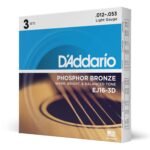
High customer ratings and reputation for consistent quality at an accessible price point make these a strong value choice for acoustic players.
Price vs. rivals
Cheaper
CheaperTypicalPricier
Priced slightly below typical mid-range for uncoated bronze acoustic strings, offering good value relative to popular alternatives.
Ease of use
Great 80/100
Standard guitar strings with clear packaging and consistent quality, making them easy for most guitarists to install and enjoy.
Overview: D’Addario EJ11 Review, the $8 Bright-Tone Answer
D’Addario is the biggest name in aftermarket acoustic strings, and the EJ11 is their standard 80/20 bronze set. It comes in light gauge, 12-53, designed for regular 6-string acoustic guitars. The tone is bright and projecting, which is why so many people describe it as “new guitar” energy.
The problem it solves is simple: you want a crisp, lively sound without paying extra for coated strings or boutique brands. These are the strings that make a modest guitar sound better than it has any right to. It’s for players who want a dependable set without overthinking it. In a D’Addario EJ11 review, the word “bright” comes up early and often. If someone asks about the best acoustic guitar strings for bright tone, the EJ11 belongs in that conversation.
Key Features of D’Addario 80/20 Bronze Acoustic Strings
80/20 bronze wrap is the classic bright-tone recipe. It gives you a cutting top end that works for strummed chords and picked single notes alike.
Light gauge, 12-53 is the middle ground for most players. It bends easier than medium strings and still has enough body for flatpicking.
Uncoated construction lets the metal sing at full volume. The catch is that it also shortens the string’s bright life, so plan to change them more often than coated alternatives.
Standard 6-string fit means no specialty ball ends or unusual sizes. They drop into most acoustic guitars with standard bridge pins.
Consistent D’Addario quality matters when you need a reliable set. A fresh pack should feel and sound like the last one you bought.
Fit for You: Light Gauge Acoustic Guitar Strings 12-53
You play every day and want a set that sounds lively from the first strum without a break-in period.
You’re recording an acoustic track and need a clear, bright part that won’t get buried in a mix.
You’re a beginner building finger strength, and the light gauge makes barre chords less punishing.
You change strings every few weeks and don’t want to spend $15 a set to do it.
You own a mahogany or mid-focused guitar that needs a little extra sparkle on top.
You play open mics where a jangly, present tone helps your guitar stand out.
Uses: Where These Strings Earn Their Keep
Songwriting late at night: a fresh EJ11 set makes a simple chord progression sound like it has a hook. The bright tone adds motion and lift, especially if you’re working on a new part.
Acoustic sets in small rooms: every picked note has attack, and strummed chords stay separate instead of folding into a mushy low-mid. The 12-53 gauge lets you play with some force while keeping the strings comfortable.
Home practice: they’re pleasant enough to leave on for weeks, but the shine fades faster than you might like. That’s the trade-off with an uncoated 80/20 bronze set.
Experience: Living with D’Addario EJ11 Strings
Changing to a fresh set is straightforward. They fit standard bridge pins, and the ball ends stay put while you bring each string up to pitch. Because they are not coated, you’ll need to stretch them well; otherwise, the tuning slips for the first hour.
Daily play feels easy on the hands. The 12-53 tension is light enough for long sessions, and the strings are smooth to the touch. You’ll notice finger squeaks on slides, though, because uncoated bronze has no coating to damp that noise.
Cleaning matters more than you might think. A quick wipe with a dry cloth after playing removes the skin oil that dulls the tone. Keep the guitar in its case when you’re not using it, because stable humidity slows the tarnishing. If you leave these strings on for months, the wound ones can develop a grey tint, and the bright top end disappears. That’s how 80/20 bronze behaves.
Pros and Cons: D’Addario EJ11 Review in Two Lists
Pros
Bright, projecting tone right out of the pack. This is the classic 80/20 bronze sound, with a clear top end that makes a guitar feel more alive.
Friendlier tension than medium or heavy sets. The light 12-53 gauge lets you play longer with less hand fatigue.
Reasonable price for that performance. At about $8 a set, you can keep a fresh pair on hand without guilt.
Reliable manufacturing. D’Addario is a huge string maker, and the consistency across sets is one of the reasons players trust them.
Versatile personality. These work for folk, singer-songwriter, rock, and country, as long as you like bright acoustics.
Cons
They wear out fast. Regular playing and sweat dull the tone after a couple of weeks, and there is no coating to slow that down.
Finger squeaks are noticeable. Uncoated 80/20 strings are honest about slides, and that noise can be annoying when recording.
Too bright for some guitars. On an already crisp instrument, the EJ11 can sound harsh, especially if you mostly play hard strums.
Not a warm or mellow option. If you want a softer, darker sound, these aren’t it. Phosphor bronze strings are a better match.
Advantages: D’Addario EJ11 vs Martin Strings and Other Alternatives
D’Addario EJ11 vs Martin strings: this is the comparison players make, and both deliver a bright, clear 80/20 bronze tone. The EJ11 tends to feel a little more consistent from set to set, while Martin’s strings have their own loyal fanbase. For most people, the D’Addario is the safer everyday choice.
Compared to coated strings like Elixir, the EJ11 sounds livelier right out of the pack and costs less upfront. The trade-off is lifespan; coated strings pay you back by lasting longer, though their tone never quite sparkles the same way.
What makes the EJ11 hard to beat is its predictability. You can buy them in any shop, restring an hour before a gig, and know exactly what you’ll hear on stage. That’s worth more than a subtle tonal edge from a pricier set.
Who Should Buy These Strings
Players who love a bright acoustic tone and don’t mind changing strings every few weeks.
Beginners who need a light 12-53 set that’s easy on the fingers.
Songwriters who record at home and want a fresh, cutting sound for their demos.
Anyone who wants a dependable backup set that costs less than a takeout lunch.
Skip them if you want strings to last months; buy coated like Elixir Nanoweb.
Skip them if your guitar is already bright and you want warmth; look for phosphor bronze like D’Addario EJ16.
FAQ: Is the D’Addario EJ11 Worth It?
Is the D’Addario EJ11 worth it?
Yes, for most acoustic players, the EJ11 is worth it. You get a bright, reliable sound for about $8, and the light gauge makes it comfortable to play. The only reason to skip it is if you want a long-lasting coated string or a warmer tone.
How long does D’Addario EJ11 strings last?
Expect around two to three weeks of good bright tone with regular playing. If you play lightly or wipe the strings down, they can stretch a bit longer. When the top end is gone, that’s the standard warning sign to change them.
What does 80/20 bronze mean?
It’s a blend of 80 percent copper and 20 percent zinc wound around a steel core. That mix produces a brighter, harder tone than phosphor bronze, which is why these strings sound so chimey and present on an acoustic guitar.
Are D’Addario EJ11 strings good for beginners?
Yes, the 12-53 light gauge is a friendly place to start. It’s light enough to make barre chords and bends easier, but still heavy enough to give a full acoustic sound. Beginners who play mostly rhythm won’t feel lost with these.
D’Addario EJ11 vs Martin strings: Which is better?
For most players, the EJ11 is the better value because it delivers the same bright 80/20 bronze character with D’Addario’s consistent quality. Martin strings are fine, but the tone difference is tiny, and the EJ11 is easier to find in everyday music shops.
Can I use D’Addario EJ11 strings on a 12-string guitar?
No, these are built for standard 6-string acoustic guitars. A 12-string needs a dedicated set with different gauges to handle the doubled courses. Putting EJ11s on a 12-string means the tension and intonation will be wrong, and you can damage the instrument. Look for D’Addario’s 12-string sets.
Final Verdict: D’Addario EJ11 Review
The D’Addario EJ11 review verdict is simple: buy them if you want a bright, clear acoustic tone for short money. They aren’t the longest-lasting strings, and they won’t magically fix a guitar with too much treble. But for most players, these are the best acoustic guitar strings for bright tone at this price.
Keep in mind that they’re uncoated, so they like being changed often. Wipe them after playing, store your guitar properly, and they’ll reward you with a sound that makes the strings feel almost free.
D’Addario EJ11 Review: vs the Best Acoustic Guitar Strings for Bright Tone
If you’ve spent any time looking for light acoustic strings, you’ve seen the D’Addario EJ11. It’s the pack your local shop stocks a hundred of, and the set that comes on new guitars from the factory. For good reason—at roughly $8 for a light 12-53 gauge set, it delivers that classic 80/20 bronze brightness without coating, gimmicks, or a premium price. It’s the sound of a strummed acoustic in your head. But the market for light acoustic strings is crowded. Let’s see how the EJ11s hold up against three serious alternatives.
Product
Price Range
Key Strength
Key Weakness
Best For
D’Addario EJ11
Mid (~$8)
Pure, bold, ringing 80/20 tone
Short lifespan compared to coated sets
Players who swap strings often for fresh sound
Martin MA540 Lifespan 2.0
Mid-Prem (~$13)
Coated durability on 80/20 tone
Less high-end sparkle than fresh EJ11s
Bluegrass strummers and road warriors
Elixir Nanoweb PB
Premium (~$14)
Unmatched string life
Polarizing feel and sound
Gigging musicians avoiding frequent changes
Ernie Ball Earthwood 80/20
Budget (~$6)
Classic bright tone on a budget
Rougher feel, less consistent intonation
Beginners or aggressive strummers
D’Addario EJ11 strings vs Martin Strings: The Coated Trade-Off
Let’s talk about the most direct comparison: D’Addario EJ11 strings vs Martin strings, specifically the Martin Authentic Acoustic Lifespan 2.0 MA540. Both are 80/20 bronze, but the Martin set is treated to last longer. The coating on the Martin cuts a tiny bit of that high-end “sizzle” the D’Addario is famous for. Put on a fresh set of EJ11s, and you get this sharp, defined ping on the high E that cuts through a mix immediately. The Martin is smoother, more polite. It lasts two or three times as long, but it never sounds quite as alive in that first week. If you record frequently and love changing strings often, the D’Addario is the clear winner. If you’re playing live sets weekly and hate dead strings, the Martin makes a strong case.
D’Addario EJ11 vs Elixir Strings: Tone vs Longevity
The Elixir Nanoweb Phosphor Bronze pack is the 800-pound gorilla of acoustic strings. So is the D’Addario EJ11 worth it when you could have the longevity of an Elixir? This comes down to what “good tone” means to you. The Elixir is coated, so it almost never rusts. You can leave it on for months. The downside is that many players feel the coating deadens the string right out of the pack. The EJ11 is honest. You get the full glory of the bronze alloy for about two weeks, then it starts to mellow out. I’d argue the D’Addario is the better choice for the “best acoustic guitar strings for bright tone” search—it simply sounds better. The Elixir is the better choice for the player who wants to tune up, play, and forget they even own a string winder.
D’Addario EJ11 vs Ernie Ball Earthwood: The Budget Battle
If you are looking for an alternative purely on price, the Ernie Ball Earthwood 80/20 set is the one to beat. It costs a dollar or two less than the D’Addario. The tone is similar—bright and brassy, plenty loud. The difference is in the build quality and consistency. The D’Addario EJ11 strings have remarkably precise intonation across the set. The G and B strings feel balanced. The Ernie Ball set sometimes feels a bit rough in the same gauge, and the intonation isn’t always as spot on. If you are a hard strummer playing a beat-up guitar, the Ernie Balls give you 90% of the tone for less money. If you play fingerstyle or bend strings, the D’Addario’s smoother feel and tuning stability is worth the extra two bucks.
So, who is the D’Addario EJ11 for? It’s for the player who chases that specific, ringing, uncoated bronze sound and doesn’t mind swapping strings every few weeks to keep it alive. It’s the definitive example of a bright acoustic guitar string. On the other hand, if the durability of a coated set matters for your live sets, grab the Martin MA540. If long life is the only metric, get the Elixir. And if your wallet is screaming at you, the Ernie Ball Earthwood will give you a similar vibe. Just know that the EJ11 is the benchmark these other strings are trying to beat for that classic bright acoustic tone.
Ready to decide on the D'Addario EJ11 strings?
See today’s price, stock and delivery options on Amazon.