Exceptional value for a low-priced yet highly rated household necessity.
Price vs. rivals
Typical
CheaperTypicalPricier
Priced slightly below typical mid-range for this type of short indoor extension cord.
Ease of use
Excellent 95/100
This extension cord is extremely easy to use with a simple plug-and-play design, making it accessible for any average person.
Overview
This Generic 16/3 extension cord review gets straight to the point: for six bucks, this black 6-foot cord is nearly impossible to dislike if all you need is a short, safe indoor extension. It’s not a heavy-duty outdoor tool. It’s the cord you plug a lamp, a phone charger, or a desk fan into when the outlet is just a little too far. It solves the “four inches short” problem without the bulk of a 14-gauge cord you’d rather store than use.
The real audience here is anyone who owns a house built before 1990 when outlets were placed with cruel intentionality behind furniture. Or renters who keep rearranging the living room and need one more reach from the wall. It’s cheap enough to buy three without guilt.
Key Features
16/3 gauge, 6 feet long – That’s standard for lamps, phone chargers, and most small electronics. The wire is flexible enough to bend behind a nightstand without fighting you.
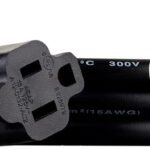
Molded plug and female end – The whole thing is one solid piece of rubbery plastic. No cheap rubber that cracks after a year. It’s stiff but not brittle. You’ll feel the difference from a dollar-store cord.
Flat blade, space-saving design – The plug is a standard flat two-prong with a grounded round pin. It sits flush against the wall. If you have a tight gap behind a dresser, that matters.
Black jacket blends in – White cords show every speck of dust. Black disappears against most baseboards and dark furniture. That’s not a major feature, but it’s one you’ll notice when you don’t have to look at it.
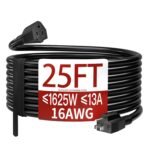
Rated 13 Amps, 125 Volts, 1625 Watts – That’s the standard 16/3 load. Enough for a small space heater on low (most are 1500W). But don’t push it. More on that below.
Fit for You
You have a lamp on one side of the bed and the outlet is on the other side, behind the nightstand.
You’re tired of crouching behind the TV stand to plug in a streaming stick because the cord is 2 inches short.
You’re setting up a small desk and the computer power brick sits on the floor, but the outlet is 4 feet away and you don’t want a 10-foot orange extension cord snaking across.
You travel with a CPAP machine and the hotel headboard plug is always 5 feet from the bedside table. This cord is small enough to toss in a bag.
You have a Christmas tree in the corner and the nearest outlet is, of course, hidden behind the couch.
You need a grounded cord for a 3-prong plug on a space heater or a small shop vac indoors. (Just check wattage.)
Uses
Plug in a floor lamp that’s perpetually one step away from the wall. The cord reaches without stretching taught or dangling across the walkway. You’ll forget it’s there because it hides behind furniture.
Use it behind an entertainment center where you have a tangle of power strips. The 6-foot length lets you run a cable box or game console plug over to the strip without adding another 15-foot loop to the mess. Stick the extra cable behind something, and it stays put.
For a desk setup, it’s perfect for monitors that have short built-in cords. A 6-foot cord is exactly the right length to reach from the power strip under the desk to the monitor arm above. No coil, no trip hazard.
It works for holiday lights inside, but don’t take it outside. It’s not rated for wet locations.
Experience
You unbox it. It’s a cord. The smell is neutral, not that chemical plastic burn you get with cheapies. The plug fits into a standard outlet with a firm click—no loose wobble. The female end has a grip ridge, so you can pull it out without yanking on the wire.
The first thing you’ll notice is the flexibility. It bends enough to route behind a toaster or a microwave without kinking. But it’s not floppy like an audio cable. It holds a gentle curve, which actually helps it stay where you tuck it.
After a month of use, the plug doesn’t get warm to the touch with a lamp or a phone charger. With a space heater on 1500W, it gets faintly warm, but that’s expected for a 16-gauge cord at max load. Don’t pile on more devices; this is a single-use length, not a power strip.
The small annoyance is the white label wrapped around the cord. It’s stuck on tight. If you try to peel it off, it leaves a sticky residue. Use a dab of rubbing alcohol and it comes clean. Not a big deal, but worth knowing.
Storage? You coil it up in a fist-sized loop and toss it in a drawer. It doesn’t fight you. No memory like a stiff outdoor cord that wants to stay coiled forever.
Pros and Cons
Pros
Price is trivial – $5.99 for a cord you’ll use daily for years. You spend more on a coffee.
Grounded plug without being bulky – Many 6-foot extension cords use a fat right-angle plug that blocks the second outlet. This one uses a flat straight plug that leaves the other socket free.
Molded ends hold up – No cheap rubber boots that slide off. The strain relief is all one piece. It’s hard to break accidentally.
Color actually hides – Black is the smart move for indoor use against dark floors, furniture, or baseboards. You’ll appreciate it once you stop tripping over a white cord.
Correct length for small jobs – Most “short” extension cords are 3 feet (too short) or 9 feet (too long for a nightstand). 6 feet hits the sweet spot.
Cons
16/3 gauge limits your load – This is not 16/3 vs 14/3 extension cord in favor of the smaller gauge. For a space heater on high or a window AC, you need 14-gauge. The cord itself is fine; the load capability is the limit.
No power surge protection – It’s just a cord, not a power strip. That’s obvious, but if you expected a built-in protector, nope.
Sticky label – The white wrap-on label is a hassle to remove cleanly. Minor, but for a six-dollar cord it’s a bit cheap.
No built-in right-angle plug – Some people prefer a 90-degree plug for tight furniture. The straight plug is fine, but if your nightstand is flush to the wall, this will stick out an inch.
Only 6 feet – That’s a pro for many, but if you need a 6 ft extension cord indoor and you thought “I’ll just buy a 6-footer” and then realize your outlet is 7 feet away, you’ll be annoyed. Measure first.
Advantages
Beats any dollar-store cord. Those have flimsy plugs, thin insulation, and usually aren’t UL-listed. The Generic cord is molded and feels like it will last through years of plugging and unplugging.
Compared to a black extension cord 6 ft from a hardware store that costs $8–$10, this is about half the price for essentially the same product. The materials look identical to the store brand.
It’s a better buy than a 3-foot cord for most furniture gaps. Three feet is almost never enough unless you’re plugging something right next to the outlet. Six feet gives you the slack to move the lamp six inches left.
If you’ve been using a 25-foot orange outdoor cord indoors (guilty), this is a huge improvement. No coiling a fire hose behind the couch. Just tuck it and done.
Who Should Buy
Buy it if you need a best short extension cord for indoor use for lamps, phone chargers, monitors, or any device under 1500W. It’s the right length, the right wire gauge, and the price is silly-low.
Skip it if you plan to run a microwave, a toaster oven, a space heater on high, or any power tool with a motor that draws over 12 amps. For those, step up to a 14/3 cord (thicker wire, handles 15 amps safely).
Skip it if you need an outdoor cord. This is indoor only. Use a yellow or orange 16/3 with a moisture-resistant jacket for outside.
Buy two if you have multiple tight spots. At $6 each, you can keep one in the living room, one in the bedroom, and one in your travel bag without feeling wasteful.
FAQ
Is the Generic 16/3 extension cord review positive or negative overall?
It’s strongly positive for what it is: a cheap, reliable short indoor cord. It doesn’t try to be more. If you need a 6-foot grounded extension for a lamp or a charger, this is the one.
Is 16/3 extension cord worth it compared to a more expensive one?
Yes. For indoor use under 13 amps, there’s no functional advantage to spending $10 on a “premium” cord. This meets the same UL safety standards. The extra money buys branding, not durability.
How long does it last?
With normal indoor use—plugging and unplugging maybe once a week—expect five years or more. The molded ends won’t crack, and the wire itself doesn’t wear unless you constantly twist it. Just don’t run it under a rug or staple it to a wall.
Is it safe for a space heater?
Only on low setting (750–900W). On high (1500W), the cord runs near its 13-amp limit. A 14/3 cord is safer if you blast the heater all night. For occasional use on low, it’s fine—but don’t push it.
Can I use it for Christmas lights indoors?
Yes. Standard indoor mini lights draw very few amps. One strand uses maybe 0.3 amps. You could connect several strands safely, but chain no more than the manufacturer limit (usually 3–5 sets) to avoid overloading the cord.
What is the difference between 16/3 and 14/3 extension cords?
16/3 vs 14/3 extension cord means wire thickness. 16-gauge handles 13 amps (1625W). 14-gauge handles 15 amps (1875W). The 14/3 is thicker, less flexible, and costs more. For most indoor lamps and electronics, 16/3 is enough. For power tools or space heaters, get 14/3.
Final Verdict
This Generic 16/3 extension cord review ends with a simple recommendation: buy it if you need a short, black, grounded indoor cord for low-wattage devices. It’s cheap, it works, and it won’t surprise you with a cracked plug or a melted socket. The only real catch is the gauge—remember that 16/3 is not heavy-duty, so don’t ask it to power a construction saw or a portable air conditioner.
For six bucks, this is the kind of cord you keep one of in a drawer and forget you own it until you need it. That’s exactly what a good extension cord should do.
16/3 Extension Cord 6 FT vs the Competition in 2026
The short indoor extension cord market is crowded with cheap options, but the Generic 16/3 Extension Cord 6 FT sits right in the middle of the budget zone—$5.99, black, and basic. It doesn’t try to be fancy. It’s a simple cord for simple jobs: lamps, phone chargers, a WiFi router that’s three feet too far from the outlet. But when you stack it against real alternatives like Woods, GE, and the heavier Southwire, the trade-offs become clear. You’re not paying for premium, and you’re not getting it. The question is whether that matters for what you actually plug in.
Product
Price Range
Key Strength
Key Weakness
Best For
Generic 16/3 Extension Cord 6 FT
Budget (~$6)
Low price, slim plug profile
Very light-duty jacket, no strain relief
Low-power indoor devices (lamps, chargers)
Woods 16/3 6ft Indoor Cord
Budget (~$6-8)
Ultra-flat plug that lies flush against the wall
Same gauge limitations, slightly stiffer vinyl
Tight spaces behind furniture
GE 6ft 16/3 Indoor Extension Cord
Budget (~$7-9)
Molded strain relief at both ends, better grip
Bulky head compared to Generic or Woods
Appliances that get moved around (clocks, small fans)
Southwire 14/3 6ft Extension Cord
Mid-range (~$10-13)
Thicker 14-gauge wire handles higher draw
Heavier, less flexible, bigger plug
Space heaters, shop vacs, power tools (short runs)
16/3 Extension Cord 6 FT vs Woods: Flat vs Straight
The Woods 16/3 cord looks almost identical to the Generic at first glance—same black PVC, same six feet, same 16-gauge rating. The difference? The plug. Woods uses a flat, right-angle head that sits almost perfectly flush against the outlet. The Generic has a standard straight blade that sticks out an inch and a half. If your nightstand is pushed tight against the wall, that inch matters. With the Generic, you’ll either bend the cord awkwardly or pull the stand away from the wall. The Woods slides in and disappears. On the other hand, the Generic’s plug is easier to grasp and pull out—the Woods flat head can be a pain if your fingers don’t fit behind the cord. So if you value a clean fit behind furniture, spend the extra dollar on Woods. If you just need a cheap cord for something out in the open, the Generic works fine.
16/3 vs 14/3 Extension Cord: When the Gauge Actually Matters
A lot of shoppers see “16/3” and think it’s the same as any other cord. It’s not. The Generic 16/3 can handle about 10 amps safely—that’s a standard lamp, a phone charger, maybe a small fan pulling 0.5 amps. But plug a 1500-watt space heater into it, and you’re flirting with a warm wire and a tripped breaker. That’s where the Southwire 14/3 comes in. The thicker 14-gauge wire (bigger number? Actually smaller gauge is thicker—14 is thicker than 16) handles 15 amps without breaking a sweat. The trade-off is bulk: the Southwire is stiffer, the plug is larger, and it costs nearly twice as much. If you’re running a vacuum across the living room or powering a soldering iron on your workbench inside the house, stick with 14/3. But for the lamp by your couch? The Generic 16/3 is perfectly fine and a lot easier to coil up and store.
GE 16/3 6ft: The Slightly Better Build
The GE 6ft 16/3 cord costs about a dollar more than the Generic. What you get for that extra buck is molded strain relief where the cord meets the plug and the socket. The Generic just has the vinyl jacket wrapped around the metal pins—pull on it hard enough, and you’ll eventually separate the wire from the plug. GE adds a rubbery collar that flexes instead of tearing. It’s a small thing, and for most people plugging a lamp in once and leaving it, it won’t matter. But if you’re the type who moves the cord around every day—say, plugging in a floor lamp that gets relocated between rooms—the GE will last longer. The Generic is fine for a permanent setup. For constant plugging and unplugging, the GE earns its extra dollar.
So who should buy the Generic 16/3 Extension Cord 6 FT? If you need a cheap, no-nonsense indoor cord for a low-power device that sits in one spot—a table lamp, a clock radio, a phone charger behind a desk—it’s the right call. You’ll save a couple bucks and the cord will work for years. But if you need a flat plug to fit behind a piece of furniture, grab the Woods instead. And if you’re plugging anything that draws more than 700 watts, skip both and get the Southwire 14/3. The Generic is not a heavy-duty cord, and pretending it is will just leave you frustrated—or worse, with a cord that smells like melted plastic.
Ready to decide on the 16/3 Extension Cord 6 FT?
See today’s price, stock and delivery options on Amazon.