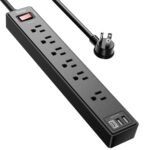
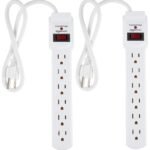
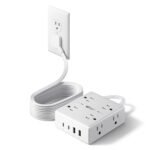
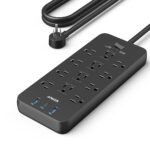
Exceptional rating for an ultra-low price outweighs the modest surge protection capacity, delivering strong value for basic needs.
Price vs. rivals
Cheaper
CheaperTypicalPricier
Priced significantly below most popular surge protectors with similar specs (1080J, 6 outlets, braided cord), which typically cost between $12 and $25. This product's low price positions it as a budget-friendly alternative.
Ease of use
Good 60/100
Power strips are inherently straightforward to use, and the high rating reflects a simple plug-and-play experience with clear outlet access and a power switch.
Overview
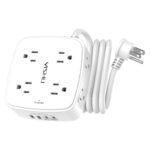
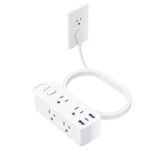
The HANYCONY surge protector review starts with a simple answer: yes, this $10 power strip is worth it for anyone who needs a cheap, reliable way to protect everyday electronics without a rat’s nest of cord. It’s a basic 1080J surge protector power strip that gets the job done quietly—no USB ports, no fancy smart features, just solid surge protection and a braided cord that doesn’t tangle. Expect it to handle a desk setup, a bedside table, or a small home entertainment cluster.
This is a no-fuss product for people who’ve been burned by poorly made extension cords and want something that won’t crap out after a year. It’s not for heavy-duty workshop tools or whole-home surge protection. But for the price, it’s hard to argue.
Key Features: What the 1080J Surge Protector Power Strip Brings
1080 joules of surge protection – That’s enough to handle most common spikes from phone chargers, lamps, laptops, and basic AV gear. Don’t expect it to save a $2,000 TV from a lightning strike, but it’ll shrug off the small surges that shorten the life of cheaper chargers.
5 foot braided extension cord – The braided nylon jacket is a real upgrade from the stiff, crack-prone PVC you see on dollar-store strips. Stays flexible even in cold rooms, and it doesn’t kink behind furniture.
8 outlets spaced for larger plugs – You can wedge two standard wall warts side by side without losing a neighbor slot. The 15-amp rating means you can run a computer monitor, a desk lamp, a printer, and a phone charger simultaneously without tripping.
Wide physical switch with an integrated circuit breaker – The rocker switch is soft-touch and has a satisfying click. It’s not a small toggle you’ll fumble for in the dark—it’s a chunky button that you can hit with your foot if you’re under a desk.
Two keyhole mounting brackets on the back – You can screw it under a desk or behind a TV stand. The screws aren’t included, but the holes are standard size. This is the detail that saves you from having a power strip flopping around on the floor.
Fire-resistant ABS shell – It’s rated for 1382°F (750°C) fire resistance. That’s reassuring when you’ve stuffed it behind a bookshelf and forget about it for six months.
Fit for You: Who Should Buy the Best Budget Surge Protector for Electronics
You’re setting up a home office desk and need to plug in a laptop, monitor, lamp, and phone charger without the cable clutter.
You have a nightstand with an alarm clock, a phone charger, and a small lamp, and you want a single plug you can kill from bed.
You’re outfitting a rental apartment and don’t want to drill holes or install permanent shelves.
You need a travel-friendly power strip—the 5-foot cord is short enough to toss in a bag, long enough for most hotel rooms.
You’re buying a gift for a college student who doesn’t own a surge protector and instead plugs everything into a chewed-up extension cord from the thrift store.
Uses: Where It Earns Its Keep
Set this up in a living room corner where the TV, streaming stick, and game console share a single wall outlet. The braided cord disappears against the baseboard, and the spaced outlets let you plug in the fat power brick of a PlayStation without angering the neighbor plug. You’ll forget it’s there until you need to switch everything off with one kick.
In a home office, it sits under the desk and handles a desktop PC, monitor, printer, and a multi-port USB charger. The 1080J rating is enough for the occasional brownout or spike from the office building wiring. You can screw it to the underside of the desk with the mounting brackets, which keeps the floor clear for your feet.
For a bedside setup, the 5-foot cord reaches from the wall to the nightstand without leaving a loop on the floor. The wide switch is easy to find half-asleep. You’ll appreciate the fire-resistant shell when you accidentally drop a phone charger on it at 3 a.m.
Experience: Living with the HANYCONY Power Strip 5 ft
Unboxing: the braided cord feels nice—soft but not flimsy, with a thin jacket that bends easily. The strip itself is a matte white plastic that doesn’t show fingerprints as badly as glossy ones. The switch clicks with a firm “thunk” that says “I’m actually connected.”
Day-to-day: plugging in standard bricks is easy because the outlet spacing is generous. But if you have blocky adapters with rounded cases, they can still crowd each other if you use the three top and three bottom sockets at the same time. The middle two are slightly farther apart and become the best friends of wall warts. The cord is long enough for most setups but not so long that you need to bundle extra length—5 feet is a sweet spot for a desk or nightstand.
The minor annoyance: the keyhole mounting brackets are recessed, which means you need screws that stick out about a quarter-inch from the surface. If you mount it on a metal desk frame, you might need to add washers. Also, the surge protection indicator light is small—about the size of a pinhead—and sits right next to the switch. It’s easy to miss if your desk is dimly lit. Owners tend to note that the light is bright enough to annoy you at night if the strip faces your bed, so you’ll probably turn it toward the wall.
Cleaning: the matte plastic collects dust over two weeks but wipes off easily with a microfiber cloth. The braided cord can pick up pet hair if you drag it across carpet; a quick swipe with a lint roller fixes it.
Pros and Cons
Pros
Price – $9.98 at retail. That’s half what you’d pay for a Belkin or APC with similar specs. You get real surge protection for the price of a lunch sandwich.
Braided cord. The nylon sleeve feels premium and stays flexible. No stiff PVC that cracks after a year of being stepped on.
Outlet spacing handles bulky adapters. You can fit three standard chargers side-by-side without losing a spot.
Mounting hardware ready. Two screw slots let you secure it under a desk or behind furniture. A small detail that makes a big difference for cable management.
Fire-resistant shell. Many cheap strips skip this. HANYCONY used a rated material, which gives peace of mind for a device left plugged in 24/7.
Cons
No USB ports. For a few dollars more you can get a strip with two USB-A ports. If you charge multiple phones daily, you’ll still need a separate charger block.
1080 joules isn’t high-end protection. It’s enough for most home electronics, but if you live in an area with frequent lightning storms or own an expensive home theater, spend more for 2000+ joules and a higher clamping voltage.
Indicator light is tiny and oddly placed. It’s easy to overlook when you’re troubleshooting why something isn’t powered, and it can be too bright for a bedroom setup.
The cord is only 5 feet. That’s short compared to many strips that offer 6 or 8 feet. If your outlet is far from your desk, you’ll need an extension cord—and then you lose the surge protection benefit (you should only plug a surge protector directly into the wall).
Advantages: HANYCONY vs Belkin Surge Protector
When you compare the HANYCONY to a Belkin 6-outlet with similar joules (Belkin runs about $15-20 for 1080J), the HANYCONY wins on price and cord feel. The Belkin has a matte finish too, but its cord is standard PVC—stiffer and more prone to tangling. The HANYCONY 5-foot braided cord bends easily around corners without kinking, which is a real plus for cramped desks.
Price. $10 vs $15–20 for equivalent Belkin models. Hard to ignore.
Cord material. The braided jacket is a noticeable upgrade in flexibility and durability.
Switch feel. The HANYCONY’s rocker is wider and clicks more distinctly, which helps when you’re reaching blindly under a desk.
Where Belkin wins. Longer warranty (typically 2–3 years vs HANYCONY’s 1 year) and slightly higher build consistency. Belkin’s outlet spacing is also a hair more generous for oversized bricks.
Who Should Buy
Buy it if you’re a student, renter, or budget-minded desk worker who needs a basic surge protector for a computer, monitor, and phone charger. The 1080J surge protector power strip will handle spikes from power tools on the same circuit, and the braided cord keeps things tidy.
Buy it if you hate cable clutter and want to mount a strip under a desk. The keyhole slots work with common screws, and the flat profile slides into tight spaces.
Skip it if you need USB charging built in. Get a model like the AmazonBasics 6-outlet with USB for about $12.
Skip it if you live in a lightning-prone area or have expensive AV gear. Look for a strip with at least 2000 joules and a higher clamping voltage (e.g., APC or Tripp Lite).
Skip it if you need a longer cord. Check the HANYCONY 6-foot or 8-foot versions, though they cost a few bucks more and lose the braided jacket sometimes.
FAQ
Is the HANYCONY surge protector worth it?
Yes, for $10 you get a reliable 1080J surge protector with a braided cord that outlasts standard PVC strips. It’s worth it for basic electronics protection in a bedroom, office, or living room.
How long does the HANYCONY surge protector last?
The internal surge protection components degrade over time with each spike; most lower-end strips last 2–4 years under normal household use. The physical build (cord, switch, shell) should last much longer if you don’t abuse it.
Is the HANYCONY surge protector safe for a gaming PC?
It’s safe for a typical gaming PC (800–1000W power supply) as long as you don’t overload the 15-amp circuit. The 1080 joules offer moderate protection; it’s better than nothing but not the highest level. For a high-end rig, pair it with a quality UPS.
Can I plug the HANYCONY into an extension cord?
Not recommended. Plug the surge protector directly into a wall outlet. Using an extension cord bypasses the ground and can reduce surge protection effectiveness, plus it creates a fire risk from daisy-chaining.
Does the HANYCONY power strip have a warranty?
It comes with a one-year limited warranty against defects. You’ll need to contact HANYCONY directly. That’s shorter than some competitors, but at this price point, it’s typical.
Is the HANYCONY surge protector good for travel?
The 5-foot braided cord makes it compact enough for a carry-on, and the flat plug saves room. No USB ports, so you’ll still bring your own chargers. It works in any standard US outlet.
Final Verdict
The HANYCONY surge protector power strip is a straightforward, well-made budget option that doesn’t cut the corners that matter. The braided cord, fire-resistant shell, and decent outlet spacing put it ahead of most $10 strips on the market. You’re not getting USB ports, military-grade joule ratings, or a lifetime warranty—but you’re also not paying for them.
If you need a cheap, honest surge protector for everyday electronics in a home office or bedroom, and you’re okay with a 5-foot cord, buy this one. The HANYCONY surge protector review can end right there: it does what it says, and that counts for a lot.
HANYCONY surge protector power strip vs the Competition in 2026
The HANYCONY surge protector power strip lands at a price that makes you squint. Nine ninety-eight for a 1080J strip with a braided cord? That’s cheap enough to raise an eyebrow. You aren’t getting industrial-grade protection or USB ports for that money, but the build quality is better than the price tag suggests. The braided jacket feels tougher than the cheap vinyl you usually find at this end of the aisle, and the compact layout means it won’t hog your wall outlet. It’s a budget play, but a smart one — if your expectations match what $10 actually buys.
Product
Price Range
Key Strength
Key Weakness
Best For
HANYCONY Surge Protector Power Strip (1080J, 5 Ft)
Price is steep for the joule rating, bulky design, no USB
Home theater gear, desktop PCs, anyone wanting warranty backup
HANYCONY surge protector power strip vs Belkin surge protector
Belkin is the name people recite when they can’t think of another brand. The Belkin 6-Outlet Surge Protector usually runs about five bucks more than the HANYCONY, and for that you get a familiar logo and slightly wider outlet spacing — useful if you have those wall warts that take up two spaces. But the HANYCONY’s braided cord is a real advantage. That 5 foot braided extension cord surge protector feels less likely to kink or crack over time compared to Belkin’s standard smooth PVC. The trade-off? Belkin’s warranty process is straightforward if something goes wrong; HANYCONY’s customer service is more of a question mark. If you need a 1080J surge protector power strip for a desk where the cord will get stepped on or bent frequently, the HANYCONY’s braided jacket makes more sense. If you want peace of mind from a household name, Belkin wins.
HANYCONY vs Anker PowerExtend: when USB matters
The Anker PowerExtend 6-Outlet is the obvious next step up. It costs roughly double the HANYCONY, but you’re paying for two things: a higher 1250J rating and integrated USB charging — one USB-A and one USB-C port. That changes the use case completely. The HANYCONY power strip 5 ft version is purely about protecting AC devices; you’ll still need a separate phone charger brick. The Anker removes that annoyance from a nightstand or kitchen counter. But here’s the rub: if you don’t need USB ports, you’re wasting money on the Anker. The HANYCONY’s 1080J protection is adequate for a TV, a lamp, a router, and a console — none of those are likely to fry from a minor surge. The Anker also uses a standard rubber cord, which feels less premium than the HANYCONY’s braided one. So the best budget surge protector for electronics depends on whether you want to charge a phone without a brick. If yes, Anker. If no, save the ten bucks and grab the HANYCONY.
APC SurgeArrest P6W: the premium argument
APC charges $20+ for a strip that, on paper, looks similar to the HANYCONY: 1080J, six outlets, a 6-foot cord. So why would anyone pay double? Because APC backs it with a $25,000 connected equipment warranty and a rugged, industrial-feeling ABS shell that survives drops and kicks. The HANYCONY is lighter and feels more like a plastic toy next to the APC. But here’s the honest truth: for a home office with a $1,200 laptop and a monitor, the APC warranty actually matters. For a $40 desk lamp and a phone charger, it’s overkill. The HANYCONY surge protector review question — “is HANYCONY surge protector worth it” — really depends on what you’re plugging in. If your gear is cheap or you’re willing to risk it, the HANYCONY is fine. If a surge frying your PC would ruin your month, spend the extra money on the APC. The HANYCONY surge protector power strip is the right call if your budget tops out at ten bucks, you like the braided cord, and you’re protecting basic electronics that won’t break your heart. Skip it if you need USB ports, a higher joule rating, or a warranty that actually covers your expensive equipment. For those situations, the Anker PowerExtend or the APC SurgeArrest are better bets — and worth the extra cash.
Ready to decide on the HANYCONY surge protector power strip?
See today’s price, stock and delivery options on Amazon.