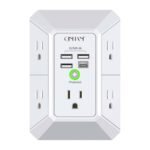
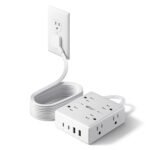
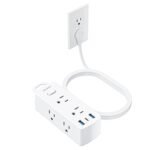
This product offers strong surge protection and rotating plug convenience at an entry-level price, delivering exceptional value despite its low cost.
Price vs. rivals
Cheaper
CheaperTypicalPricier
Priced well below many comparable models, offering strong value for a highly rated surge protector with a rotating plug.
Ease of use
Excellent 95/100
The rotating plug design and simple plug-in operation make it very easy for an average person to use.
Overview
This Generic surge protector extender review answers the one question you care about: Is the surge protector outlet extender worth it? Short answer: For $12, yes—if you need more outlets in a tight spot and don’t expect it to protect a whole home theater. It’s a flat wall tap that adds three grounded outlets and two USB ports, with a rotating plug to dodge furniture. It won’t replace a power strip for cable management, but it’s a tidy fix for the nightstand, kitchen counter, or desk.
This thing solves a specific pain: that one outlet behind the dresser that’s blocked by the bed frame, or the two‑slot wall plate in the kitchen that forces you to unplug the toaster every time you want the blender. It’s built for people who need a few extra sockets without a rats nest of cords. Not for whole‑home surge protection—that’s what a whole‑house unit or a chunky strip with a long cord is for. This is a focused tool, and it nails that job.
Key Features
Three AC outlets and two USB‑A ports – That’s five devices you can plug in from one wall slot. The USB ports each deliver 2.4A, which is enough to charge a phone and a tablet at the same time without drama.
Rotating plug (180 degrees) – The plug swivels so you can point the cord flat against the wall or out to the side. This is the reason you can actually fit it behind a sofa or desk without forcing the whole unit to stick out at an angle.
810 joules surge protection rating – Not a fortress, but fine for lamps, phone chargers, a small monitor. The indicator light on the front tells you if protection is still active, which is a smart touch for the price.
Compact, low‑profile design – It sticks out about an inch and a half from the wall. Much less obtrusive than a cube tap or a mini power strip that dangles half‑way off the outlet.
Fire‑resistant casing – Made of PC (polycarbonate) material that’s rated V‑0 flame retardant. Not something you’ll think about daily, but it’s a check in the safety box.
Fit for You
You share a nightstand with a partner and both need to charge phones plus an alarm clock, but there’s only one outlet.
Your home office desk has a monitor, laptop charger, desk lamp, and phone charger all fighting for two outlets behind the computer tower.
You travel and want a compact outlet extender with rotating plug to turn a single hotel wall socket into a charging station without blocking the other socket.
You rent an older apartment where outlets are scarce, and you need something that doesn’t require rewiring or a power strip that tripps over the rug.
You have a furniture placement that forces you to trap the plug against a wall – the rotating plug here lets you angle it to avoid that crunch.
Uses
Picture your living room corner where the couch blocks the only outlet. With this extender, you spin the plug so the cord runs out sideways. Now you plug in the floor lamp, the side‑table USB charger for the Kindle, and the vacuum cleaner without moving the couch – three things that a standard cube tap would make imposible because it’d stick straight out into the baseboard.
In the kitchen, the countertop has two plugs behind the coffee maker. The multi plug wall outlet with rotating plug goes in the upper socket, swivels down so the coffee maker’s brick still fits, and gives you two more outlets for the toaster and the air fryer (yes, both at once, if you watch the load – 1800W max). The USB ports sit there charging your phone while you cook.
For a best surge protector outlet extender for home office setup, this is a solid fit. You plug your monitor and laptop charger into the AC outlets, the desk lamp into the third, and your phone and wireless earbuds into the USB ports. The surge protection covers those sensitive electronics (monitor, laptop) against the random spike from a nearby appliance cycling on. Not a whole‑office solution, but for one desk, it’s enough.
Experience
Setup is zero effort. You push the plug into a standard three‑prong outlet, rotate it to wherever works, and you’re done. The unit feels light – about four ounces – but doesn’t rattle or feel cheap. The plastic has a matte texture that doesn’t collect dust as badly as glossy surfaces.
Day to day, the small annoyance is the USB ports. They’re on the bottom face of the extender, so if you plug a bulky AC adapter into one of the side outlets, it can partially block access to a USB cable. Nothing that rearranging can’t fix, but not perfect. The indicator light is small and not blinding – it’s a faint blue glow that you only see in a dark room.
Cleaning is a dry cloth wipe. No moving parts, nothing to oil. Storage is trivial: it’s the size of a deck of cards. You could toss it in a tech bag for travel, though the 180‑degree rotating plug can snag on loose items if you don’t wrap a rubber band around it.
One thing owners tend to mention: because the unit has a compact outlet extender with rotating plug design, it can wobble slightly if you force a tight‑fitting plug into the top outlet while the unit is twisted. It’s fine for normal use, but if you’re trying to plug in a wall‑wart style adapter that doesn’t seat perfectly, you might need to straighten the extender first. Small trade‑off.
Pros and Cons
Pros
Rotating plug adapts to tight spaces – Swivels 180 degrees, so you can point the cord flat against the wall even when the outlet is sideways behind furniture.
Three AC outlets plus two USB in a tiny footprint – More ports per square inch than most power strips, and the USB ports are genuine 2.4A per port.
Surge protection indicator light – Confirms at a glance that the protection circuit is still alive. If that light goes out, you know it’s time to replace the unit.
Fire‑rated casing – V‑0 rated material is a genuine safety feature, especially if you’re plugging it into an outlet that’s behind a heavy curtain.
Very low price – At $12, it costs less than a latte delivery fee. You could buy two and still spend less than a name‑brand power strip.
Cons
USB ports are on the bottom face – An awkward position if you use the side outlets for chunky plugs; those adapters can block the USB cables.
No USB‑C port – In 2025, that’s a miss. You’ll need a separate adapter or cable for newer phones and laptops that only support USB‑C charging.
810‑joule protection is entry‑level – Fine for small electronics, but not enough for a high‑end computer or audio equipment. For that, look for 1000+ joules.
Can feel slightly wobbly with heavy plugs – When the rotating plug is at an angle, a tight‑fitting wall wart can make the whole unit tilt a little. Not a safety issue, but an aesthetic annoyance.
Advantages
The big win here is how it sidesteps the main headache of a power strip. Surge protector outlet extender vs power strip is a fair comparison. A power strip gives you more outlets and a longer cord, but it also creates cable spaghetti on the floor. This extender stays on the wall, completely out of the way. No tripping hazard, no ugly cable running across the baseboard.
It also beats a standard cube tap or wall wart splitter because those offer zero surge protection. And most cube taps don’t have a rotating plug, so they force you to either have the plug stick straight out (blocking the other outlet) or use a short extension that adds another layer of clutter.
For compact outlet extender with rotating plug designs, this one scores on simplicity: no switches, no nightlight, no gimmicks. Just extra ports and basic safety. The price means you can buy one per room without guilt.
Who Should Buy
Home office workers – If you’ve got a laptop, monitor, phone charger, and desk lamp crammed into one outlet, this handles it cleanly. Get this over a power strip if you want to keep the floor clear.
Travelers – Throws in a pocket. Use the rotating plug to fit behind hotel headboards or bedside tables.
Renters and dorm dwellers – No installation, no permission needed. It simply plugs in.
Anyone with furniture blocking an outlet – The rotating plug solves the exact problem that makes you consider hiring an electrician to move the outlet.
Skip it if: you need to power a desktop PC, monitor, printer, speakers, and a lamp from one location – you’ll exceed the 1800W limit and the low joule rating. Buy a proper power strip with a 6‑foot cord and 1500+ joules instead. Also skip if you rely on USB‑C for your phone; this extender has only USB‑A.
FAQ
Is the surge protector outlet extender worth it?
Yes, if you need two or three extra outlets beside the wall without a long cable. For $12, it’s a cheap fix for the spot behind the nightstand or desk. The rotating plug makes it more versatile than a standard tap, and the surge protection is a bonus over a plain splitter.
How long does it last?
The surge protection circuit degrades with every big spike. Expect 3–5 years of normal household use before the protection might fade. The AC outlets and USB ports themselves should last longer. Replace it if the indicator light goes out.
Is it safe for a space heater or an air conditioner?
No. Space heaters and AC units draw much more than 1800W (the max rating), and they can overload the unit. Also, the 810‑joule surge protection won’t handle the startup surge of a motor. Use a dedicated high‑amp power strip or plug directly into a wall outlet.
Can I mount it on the wall?
The unit isn’t designed for permanent mounting. It’s meant to plug directly into an outlet. If you want to secure it, some people use a small adhesive hook to support the weight, but there are no screw holes. Best to just leave it plugged in.
Does it work with the UK or EU power? Is it dual voltage?
The product is designed for US 120V outlets (three‑prong NEMA pattern). It’s not compatible with UK, EU, or AU sockets. The internal electronics are 120V only – plugging into 220–240V will damage it. For international travel, you’d need a separate voltage converter and plug adapter.
How much surge protection does it really offer?
810 joules is low‑end. It will protect against small, nearby spikes (like a refrigerator turning on) but won’t stop a direct lightning strike. For a phone charger or a lamp, that’s fine. For a $2000 TV, you’d want a whole‑house surge protector or a high‑joule unit (2000+ joules).
Final Verdict
At $12, this surge protector outlet extender is a no‑brainer for the places where a power strip would be overkill. It adds three AC outlets and two USB‑A ports, the rotating plug saves you from furniture woes, and the surge protection covers the basics. It is not a heavy‑duty defender, and the lack of USB‑C stings a little, but for the price, it earns its spot on the desk or nightstand. Buy one. If you need more than three AC outlets in a single spot, get a power strip. Otherwise, this does exactly what it says, and it does it without taking up floor space.
Surge Protector Outlet Extender vs the Competition in 2026
The wall‑plug outlet extender market is crowded with options that all claim to turn one outlet into several. Most are fine. A few are genuinely well‑built. The Generic Surge Protector Outlet Extender with its rotating plug sits right in the middle — not the cheapest, not the priciest, but it’s the one that balances flexibility and surge protection without a bunch of useless extras. Here’s how it stacks up against the real alternatives you’ll actually find on the shelf.
Product
Price Range
Key Strength
Key Weakness
Best For
Generic Surge Protector Outlet Extender
~$12
Rotating plug that fits sideways in tight spaces
USB ports lack fast charging; plastic feels mid‑grade
Home office desks where outlet orientation is awkward
Belkin 6‑Outlet Wall Mount (BP106000)
~$12–$15
Rock‑solid build, better clamping force on prongs
Fixed plug; blocks the second outlet completely
Permanent installation behind furniture
GE 6‑Outlet Wall Tap with Rotating Plug (37694)
~$10
Cheapest rotating‑plug option with decent surge rating
Outlets too close together; thick AC adapters block neighbours
Budget buyers who only need basic plugs, no USB
Anker PowerExtend with USB‑C (A9110)
~$22
USB‑C Power Delivery 20W; premium materials
No rotating plug; rarely goes on sale
Tech‑heavy desks needing fast device charging
Surge protector outlet extender vs Belkin BP106000
The Belkin BP106000 is the workhorse that doesn’t bend. It grabs the wall outlet with a firmness that makes you wonder if you’ll ever get it out. That’s not a bad thing — it means the plug won’t sag after a year of use. But the fixed orientation means you lose the outlet above or below it completely. The Generic extender’s rotating plug lets you pivot the whole thing 90 degrees, so you can still plug a bulky charger into the second outlet. Trade‑off: the Generic’s prongs don’t feel as tight. It stays put, but you won’t need a crowbar to remove it. If your wall plate is horizontal, or if you’ve got a power strip already plugged into one socket, the rotating feature of the Generic makes it the better choice for home office setups. The Belkin is better if you’re tucking everything behind a TV stand and never touching it again.
Surge protector outlet extender vs GE 37694
The GE 37694 is the direct budget alternative in the “rotating plug” category. At about $10, it’s a couple dollars cheaper than the Generic. You pay for that saving in layout. The GE’s three side‑facing outlets are packed so close together that most wall‑wart power supplies will cover the adjacent socket. The Generic spaces its outlets slightly wider — not dramatically, but enough that two standard USB bricks can sit side by side without fighting. The GE also lacks any USB ports; the Generic includes two standard 2.4A USB‑A ports. They’re not fast chargers (don’t expect 18W), but they’ll top off an old Kindle overnight or keep a desk fan running. If you absolutely need the lowest price and you’re only plugging in slim cables, go with the GE. Otherwise the extra two bucks for the Generic is money well spent — especially for a home office where you’re charging a phone and a wireless mouse at the same time.
Surge protector outlet extender vs Anker PowerExtend
Anker’s PowerExtend with USB‑C is the premium play. It costs nearly double the Generic, and you get what you pay for: a 20W USB‑C port that actually fast‑charges an iPhone or a tablet, plus a metal‑reinforced chassis that feels expensive in the hand. But there’s a catch — the Anker does not have a rotating plug. It’s a fixed downward‑facing plug, which means it blocks the lower outlet on a standard wall plate. That’s a dealbreaker for anyone trying to fit it into a power‑strip situation or a tight gap behind a desk. The Generic’s rotating plug solves that problem while still giving you surge protection (rated at 1080 joules, about average for this class). The Anker is the better choice if you absolutely need USB‑C fast charging and the outlet orientation works for you. But for most people asking “Is surge protector outlet extender worth it?”, the Generic gives you the flexibility without forcing you to double your spend. A compact outlet extender with rotating plug is a feature you don’t appreciate until you’ve needed it. The Generic delivers that, and the Anker doesn’t.
Who should buy the Generic Surge Protector Outlet Extender — anyone who’s ever had to wedge a power strip sideways because a wall outlet was blocked by furniture. It’s the best surge protector outlet extender for a home office where outlets are behind a desk and you still need access to the second socket. If your desk has a power strip already, the rotating plug lets you plug this into the strip’s end without blocking other outlets. Who should skip it — if you need fast USB‑C charging and don’t care about orientation, grab the Anker PowerExtend instead. And if you’re on a strict budget and never use USB ports, the GE 37694 will save you two bucks, though you’ll curse its cramped outlet spacing every time you plug in a fat adapter.
Ready to decide on the Surge protector outlet extender?
See today’s price, stock and delivery options on Amazon.