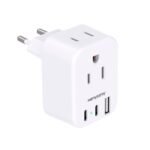
The adapter is straightforward to use—just plug it in—making it highly accessible for any traveler familiar with standard electronics.
Overview
If you’re a US traveler heading to Europe, you’ve seen the wall outlets—those round, two-pin sockets that accept a Type C plug. The TESSAN European Travel Adapter is a simple, compact way to make your American chargers and small appliances work over there. It’s really for anyone who wants a solid, no-fuss adapter that doesn’t cost a fortune or take up half your carry-on.
At $23.99 for two, this pack covers a couple of travelers or lets you leave one in your bag and another at the hotel. It converts your US plug (the two-flat-pin kind) into the European Type C shape. No voltage conversion—just a shape change. So your phone charger, laptop brick, camera battery charger—anything that already handles 100–240V—will work fine. For things like hair dryers or straighteners that only run on 110V, you’d still need a separate converter. That’s the one catch you need to know going in.
Key Features
Two-pack value: You get two adapters for the price of one from many competitors. That means a spare for a partner or one for the room and one for the bag.
Type C plug design with recessed sides: The prongs are slender and fit snugly into European receptacles. The recessed grip makes pulling it out easier than the flat-sided versions you’ll find on cheaper brands.
Compact and lightweigtht: Each adapter is roughly the size of a matchbox and weighs under two ounces. It slips into any pocket or the tiny front zip of a backpack without adding noticeable bulk.
Grounded prong (side pin) for grounded US plugs: If your laptop charger or power strip has a third round prong (the ground pin), this adapter has a small side hole that accepts it. Many budget competitors skip this entirely.
Side USB-C and USB-A ports (optional): The top of the adapter has a recessed USB-C and a USB-A port. These let you juice up a phone or earbuds directly without occupying the main socket—handy when the hotel only has one outlet and you have a partner.
Solid build with matte finish: The shell is polycarbonate with a matte texture that doesn’t slide around in your hand. It feels denser than the hollow, glossy adapters that often crack after a few trips.
Fit for You
You’re a US traveler flying to France, Germany, Italy, Spain, Netherlands, or any of the dozens of countries using the European Schukooo Type C/F outlets.
You carry a laptop, phone, tablet, and a portable battery—and you hate fighting over the one outlet in a hotel room.
You want a simple, no-switch adapter that just works when you plug it in, without having to fiddle with multiple plug types or sliding parts.
You’re buing for a couple—one for you and one for a travel buddy, or one for the room and one for the airport lounge.
You’re on a tight packing list and can’t spare space for those bulky universal adapters with moving prongs that sometimes feel flimsy.
Uses
You land in Paris after a red-eye, get to the hotel, and your phone is at 15%. The only outlet is behind the nightstand, but it’s the round European kind. You pull the TESSAN out of your bag’s side pocket, push it into the socket (firmly—it seats with a nice click), then plug your US charging brick into the adapter. That’s it. No grinding, no wiggling. You’re charging in under five seconds.
Another scene: you’re in a hostel in Berlin with one outlet per bunk. You have a laptop, phone, and a power bank that all need juice. The TESSAN’s built-in USB-C and USB-A ports let you charge the phone and the power bank while the main socket handles the laptop brick. Suddenly one outlet becomes three devices. That’s the kind of everyday flex that makes a $12-per-adapter price feel like a steal.
Or you’re on a train between Barcelona and Madrid. You find a seat with a European outlet under the window. The TESSAN plugs in flush enough that the seat’s armrest doesn’t push it out. You charge your phone the whole trip without worrying about the adapter falling loose on every bump.
Experience
Living with the TESSAN European Travel Adapter is mostly “forget it’s there until you need it.” It’s so small you’ll probably keep it permamently attached to your main charging brick—just leave it on the end and toss the combo in your bag. That’s what most buyer feedback suggests: it becomes one piece with your charger, not a separate thing to hunt for.
The first time you use it, you’ll notice the fit. It goes into the socket with a definite click, not a loose wobble. European outlets vary a bit country to country—some are tighter, some looser—but this adapter seems to hit the Goldilocks zone. It’s not so tight you need pliers, not so loose it droops out. If you have a heavy laptop brick (the old big ones), the adapter might sag a tiny bit under the weight, but it’s held by the prongs’ friction. For most modern compact chargers (the little Gan ones), it’s solid.
The built-in ports on top: they’re recessed, which is clever—less dust, less accidental bendig of a cable. But they’re not fast-charging beasts. The USB-A is standard 5V/2.4A (12W max), fine for overnight charging. The USB-C is 5V/3A (15W)—slow for modern phones that can do 25W or more, but enough to top up overnight or during a long dinner. If you need fast charging, use your own USB-C cable into the main socket with your own brick.
The one small annoyance: the package comes with nothing else. No pouch, no instructions beyond a tiny card. That’s fine—you don’t need instructions for an adapter—but if you like keeping things organised, you might want a small ziplock bag or a tech pouch. The matte shell does pick up lint and pocket fluf fairly easily, though a quick wipe on your jeans cleans it off.
Overnight, you’ll plug it in and forget it. It doesn’t get warm unless you’re pulling near its 10A (2500W max) rating—like charging a laptop and a tablet simultaneously through the ports. For normal use (phone and laptop), it stays cool enough to touch. No buzzing or crackling sounds, thank goodness. Cheap adapters sometimes hiss or emit a high-pitched whine on inductive loads; this one is quiet.
Pros and Cons
Pros
Two adapters for under $24:strong> Compare to single-unit universal adapters that cost $15–20 each. You get two, perfect for couples or backups.
Solid, non-wobbly fit: The recessed sides and well-machined prongs mean it stays put in outlets across Europe. Owners occasionaly mention that it works even in the tighter Italian “third hole” receptacles.
Includes ground-pin compatibility: Many cheap alternatives skip the side hole for grounded US plugs. If your laptop has a three-prong cord, you need this. The TESSAN has it.
Built-in USB ports add convenence: They’re not fast, but they free up the main socket for bigger devices and let you charge multiple things without extra bricks.
Light enouth to leave permenently on a charger: At 1.5 oz, it doesn’t add noticeable weight or size to your daily carry.
Cons
No voltage conversion:strong> This is purely a plug-shape adapter. If you bring a US-only 110V hair dryer or curling iron, it won’t work (and might fry the device). You’d need a separate step-down converter.
USB ports are slow:strong> The USB-C outputs only 15W max. For fast-charging a modern phone or tablet, you’ll still want to use the main socket with your own brick.
No surge protection:strong> For basic phone and laptop charging that’s fine, but if you’re plugging expensive gear into dodgy hotel wiring, you might want a small surge protector. The TESSAN doesn’t offer that.
Not universal for all Europen outlets: Works in most Type C/F (Schukoo) sockets. Some countries (e.g., Denmark, Switzerland, Italy) have slight variants where the fit can be less secure. Most travelers say it’s fine, but not perfect for every single outlet type.
No locking mechanism: It relies purely on friction. With a very heavy power strip attached, an accidental tug on the cable can pull it out. Light devices are fine.
Advantages
Compared to typical alternatives, the TESSAN has three clear edges over the crowd. First, the two-pack price—most single adapters from Ceptics or Belkin cost around $12–15 each. So you’re essentially getting two for the cost of one, and they’re built the same or better. That’s a big deal if you’re traveling with family or running two devices in one outlet.
Second, the ground-pin hole is absent on many sub-$15 adapters. Ceptics, for example, has models that skip it entirely, meaning your grounded US plug won’t fit. The TESSAN takes both two-prong and three-prong plugs, which removes that headache.
Third, the recessed-side design makes removal simple. Some Ceptics adapters have flat sides that become slippery when you need to yank them out after a week’s use. The TESSAN’s grips are subtle but efective. If you’ve ever wrestled a cheap adapter out of a tight Euro outlet, you know the value of that.
Who Should Buy
US travelers going to Europe for a week or more: You’ll be charging multiple devices, and the two-pack covers you and a companion. It’s a no-brainer at this price.
Anyone who travels light and hates carrying bulky “world” adapters: The TESSAN is tiny, so you can toss it in your jacket pocket and not think about it.
People with grounded (three-prong) laptop chargers: Many budget adapters force you to break off the ground prong. This one accepts it, so your laptop’s charging is as safe as at home.
Skip it if you need surge protection or voltage conversion: For hair tools or high-power electronics that only work on 110V, get a proper converter instead. Also skip if you need fast USB-C PD (Power Delivery) — the built-in ports are too slow for that.
FAQ
Is the TESSAN European Travel Adapter worth it?
For $23.99 for two, it’s absolutely worth it for most US travelers. The build quality is solid, it fits well, and the included ground-pin hole saves you from a common compatibility headache. The only catch is you still need a separate converter for high-wattage 110V devices.
How does the TESSAN vs Ceptics travel adapter compare?
TESSAN generally gives you better build (matte finish, recessed grips) and the ground-pin hole that some lower-end Ceptics models omit. Ceptics does offer more variants (like Swiss or Italian specific plugs), but for the standard Type C/F outlet, TESSAN is the better value at two-for-one.
Is the TESSAN Type C plug adapter safe for laptops?
Yes, as long as your laptop charger is rated for 100–240V (nearly all modern laptop bricks are). The adapter itself is rated for 10A / 2500W max, well above what a laptop draws. Just ensure the adapter sits firmly in the outlet—it can handle the load without overheating.
Does it work in the UK or Ireland?
No. The UK uses Type G plugs with three rectangular prongs. The TESSAN is designed only for continental Europe (and countries that use the Type C / Schuko standard like France, Germany, Spain, Italy, Greece, Portugal, Netherlands, etc.). You’d need a separate UK adapter for Britain and Ireland.
How long does it last?
Barring physical abuse (crushing in luggage, immersion in water), the adapter should last through many trips. The polycarbonate shell is tough, and the prongs are nickel-plated brass. Owners report using the same TESSAN for years with no looseness or cracking.
Can I plug a power strip into the TESSAN?
Yes, if the power strip has a US plug (two- or three-prong) and its total wattage stays under 2500W. But note: the adapter is held by friction, so a heavy strip with multiple cables may tug it loose. Safer to plug one or two light devices directly.
Final Verdict
The TESSAN European Travel Adapter is exactly what a smart packer wants: cheap enought to buy without overthinking, well-made enough to trust, and so small you’ll forget you have it untill you need it. The TESSAN European Travel Adapter review I’d give a friend is simple: buy the two-pack, leave one on your laptop charger permamently, toss the other in your partner’s bag, and don’t think about adapters again until your next trip.
The one thing to keep in mind: it does not convert voltage. So if you bring a hair dryer or a curling iron that’s only rated for 110V, this adapter alone will not help. But for phones, tablets, laptops, camera chargers, and anything with a “100–240V” label—which means basically every modern electronic device—this is the best European travel adapter for US travelers at this price point.
TESSAN European Travel Adapter vs the Competition in 2026
The TESSAN European Travel Adapter 2 Pack lands at a solid mid-range price of $23.99, and it’s easy to see why it’s a top seller for US travelers heading to Europe. It’s a stripped-down Type C plug adapter—no USB ports, no frills—but what it does, it does with a satisfyingly compact build and a dual-pack that covers you and a travel buddy. That said, you’ve got real alternatives from Ceptics, Orei, and Epicka, each with their own trade-offs in price, features, and bulk. Here’s how they stack up so you can decide which one actually belongs in your carry-on.
Product
Price Range
Key Strength
Key Weakness
Best For
TESSAN European Travel Adapter 2 Pack
Mid (~$24)
Very compact, dual pack, solid build with folding prongs
No USB ports, only Type C (no multi-country heads)
US travelers who just need a basic, pocket-friendly Europe adapter for two devices at once
Ceptics European Travel Adapter 2 Pack
Mid–Budget
Includes 2 USB-A ports on each adapter for charging extra devices
Bulkier and wider; USB ports are slow (2.1A shared)
Travelers who want to charge a phone and a power bank without carrying separate USB bricks
Feels flimsy, prongs don’t fold, no USB, single pack
Backpackers on a strict budget who only need one adapter for a few days
Epicka Universal Travel Adapter (with USB-C)
Premium (~$30+)
Works in 150+ countries, includes USB-C PD up to 30W for laptop charging
Much larger in the hand, heavier, might block adjacent outlets
Frequent world travelers who need one adapter for multiple regions and fast device charging
TESSAN European Travel Adapter vs Ceptics Travel Adapter — the port trade-off
If you compare the TESSAN European Travel Adapter vs Ceptics Travel Adapter side by side, the first thing you’ll notice is size. TESSAN’s body is noticeably slimmer—the prongs fold flat into the body, so it slides into a coin pocket without bulging. Ceptics keeps its prongs exposed and adds two USB-A ports on the face, which inflates the width. That extra USB can be handy if you’re charging a phone and a Kindle at the hotel, but the shared 2.1A output means neither device will charge quickly. For a best European travel adapter for US travelers who already carry a small GaN charger, TESSAN wins because you can plug your own fast-charging brick into it and keep the profile tiny. Ceptics makes sense if you absolutely don’t want to bring a separate USB wall charger, just know the USB ports are slow and the adapter won’t fit well in a tight power strip.
TESSAN vs Orei — is cheap worth it?
Orei’s single adapter runs about $10, so it’s tempting for a one-off trip. The plastic feels noticeably thinner though, and the prongs are fixed—they stick out permanently, which annoys you every time you shove it into a bag. On the other hand, TESSAN’s dual pack at $23.99 gives you two adapters that each feel more solid, with a slightly grippy texture and a satisfying click when the prongs lock open. If you’re asking “is TESSAN travel adapter worth it” over the Orei, the answer is yes if you value durability and packability. If you’re on a weekend trip with a single device and don’t mind the rattly feel, save the $13 and grab the Orei. But for anyone who travels even twice a year, the TESSAN 2 pack will last longer and won’t leave you hunting for the other adapter you forgot at the hotel.
TESSAN vs Epicka Universal — when you need more than Europe
Epicka’s universal adapter is a different beast. It covers the UK, Australia, China, and more, plus it has a built-in USB-C port with Power Delivery up to 30W. That’s enough to keep a MacBook Air running on a single adapter. But the trade-off is bulk—it’s twice as heavy and long as the TESSAN, and if you only need Type C sockets in Europe, you’re hauling around plastic you’ll never use. TESSAN Type C plug adapter features are deliberately minimal: just one grounded Type C socket, a slim profile, and a second unit in the box. For a US traveler whose itinerary is Paris, Rome, and Berlin, the TESSAN 2 pack Europe adapter is the smarter buy. Go with Epicka only if you’re hitting multiple continents on the same trip, or if you need to charge a laptop without carrying a separate power brick.
Here’s the short version: pick the TESSAN European Travel Adapter if you want a compact, no-nonsense solution for Europe that fits two people (or two bags) without clutter. It’s the best European travel adapter for US travelers who already own fast USB chargers and don’t need a universal head. But if you’re charging a laptop and phone from one outlet, or bouncing between the UK, Japan, and Europe, the Epicka Universal will earn its extra size. For everyone else on a tight budget, the Orei works—just don’t expect it to survive a dozen trips. The TESSAN hits the sweet spot between price, build, and portability, and that’s why it’s the one I’d grab first.
Ready to decide on the TESSAN European Travel Adapter?
See today’s price, stock and delivery options on Amazon.