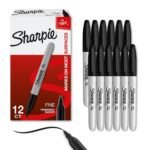
The Sharpie Ultra Fine Markers review you’re about to read can be summed up quickly: yes, the 12-count black set is worth it, with caveats. You get a true permanent marker that writes fine enough for margins, labels, and coloring, dries fast, and doesn’t smear once down. The catch is the fine tip can feel scratchy on rough paper.
The high customer rating and trusted Sharpie brand indicate strong quality that justifies the moderate price for a 12-pack of ultra-fine permanent markers.
Price vs. rivals
Pricier
CheaperTypicalPricier
Sharpie is a premium brand, and this ultra fine tip 12-pack is priced slightly above typical mid-range alternatives, reflecting its stronger brand recognition and fade-resistant quality.
Ease of use
Excellent 90/100
The markers are very easy to use for the average person due to the familiar pen-like grip, consistent ink flow, and quick-drying, fade-resistant formula that requires no special handling.
Overview: Sharpie Ultra Fine Markers review, in One Box
This Sharpie permanent markers black 12 count review focuses on the all-black set, the one people keep in a kitchen drawer rather than the art bin. The ultra fine tip is the important part here: it writes like a firm pen instead of a marker, so you can label a pill bottle or fill a month page in a planner without ugly thick lines.
These Sharpie Ultra Fine Markers are for anyone who has tried to write a return address on a plastic mailer with a ballpoint and watched it skip, or tried to label a freezer bag with a chisel-tip Sharpie and ended up with a blob. That is the exact problem these solve.
Key Features on the Sharpie Ultra Fine Markers
Ultra-fine tip. The nib is narrow enough for journal margins, calendar boxes, and small labels. Because it lays down a thinner line, the Sharpie Ultra Fine markers bleed through paper less than the chisel-tip version.
Quick-drying ink. A few seconds after writing, the ink is dry. You can close a notebook, stack envelopes, or slide a label into a binder without smudging the text.
Stays on non-porous surfaces. Plastic, glass, metal, and packing tape all take the ink. It holds up to condensation and a bit of wiping, which is why it works for freezer meals and pantry jars.
Fade-resistant black. The color stays dark after weeks in sunlight or months in storage. Labels you write today will still be readable at the end of the year.
A dozen pens for the price. $8.99 for 12 works out to about 75 cents a marker, which is under what many single art pens cost.
Fit for You: Situations the Sharpie Ultra Fine Markers Handle Well
You keep a bullet journal and write dates in tiny boxes, where a normal marker eats the whole square.
You pack lunches or freezer meals and need a label that survives a cold pull from the fridge.
You run a small shop and write addresses on poly mailers that have to stay legible through postal sorting.
You like to color detailed pages and are tired of the black line spreading out from the pattern.
You’ve lost count of how many single Sharpies you’ve bought at the checkout lane and want a box of them, finally.
Uses: Best Ultra Fine Permanent Markers for Journaling
People who hunt for the best ultra fine permanent markers for journaling usually land here because the tip fits the job. A date in the corner, a tiny star next to a task, a margin note that stays out of the text: all readable, all dry within seconds.
Packing and mailing is another sweet spot. A ballpoint skips on poly mailer plastic, but this Sharpie bites in and stays. You can even write on the clear address window of an envelope without smearing.
Kitchen labeling is the quiet winner. Press a strip of tape onto a takeout container, write the date, and it stays. A chisel-tip would have turned that into a smudge.
Coloring and craft work use the same precision. The tip reaches into spaces a regular marker can’t, and the permanent ink holds on glossy paper where gel pens skip or smear.
Experience: Living With the Sharpie Ultra Fine Markers
Living with the Sharpie Ultra Fine Markers starts with the familiar routine: pull the cap, touch the page, go. There is no priming or shaking, and the ink starts immediately. What you’ll notice first is the feedback. On slick paper the nib glides; on textured paper it makes a faint scratch, like a good ballpoint rather than a felt marker.
The permanence is the real pleasure. Write a label, close the book, put it in a damp bag, and the line won’t move. That solvent smell, though, is real. It’s not overwhelming in quick doses, but a long writing session in a closed room will have you cracking a window.
Small annoyances add up. The caps are small, easy to drop, and once one rolls under the couch, the marker is living on borrowed time. And on thin printer paper you’ll see ghosts of your lines on the back. Not a wet bleed, but a definite shadow, so two-sided writing on cheap paper isn’t this pen’s strength.
Pros and Cons: Sharpie Ultra Fine Markers review
Pros
Tip precision. The ultra fine nib holds its shape instead of mushing out after heavy use, so you keep writing a clean line weeks later.
Fast drying. You can close a notebook, stack envelopes, or bag a label a few seconds after writing and never smudge.
Stays put. Freezer bags, glass jars, packing tape, and plastic lids all take the ink and keep it.
Good per-pen price. At $8.99 for 12, each marker comes to about 75 cents, and these last longer than most gel pens.
Fade resistance. The black doesn’t turn gray in sunlight or after months in a pantry.
Cons
Permanent is permanent. A slip off the page will mark your table, your pants, or your favorite hoodie, and nothing washes it out.
Ghosts on thin paper. Standard notebook pages show a shadow on the back, so two-sided writing on cheap paper gets messy.
That marker smell. Solvent ink has an odor. A long writing session in a small room will make you want a window.
Black only in this box. The 12-count set offers no color. If you want a palette for coloring, you’ll need to buy a different pack.
Small caps, easy to lose. Drop the cap in a bag and it disappears; a Sharpie without its cap dries out fast.
Advantages: Sharpie Ultra Fine vs Paper Mate InkJoy Gel Pens
The Sharpie Ultra Fine vs Paper Mate InkJoy gel pens comparison comes up because both write thin, clean lines at a similar price. The honest difference is where each one stops working. InkJoy pens are smoother on paper, have no smell, and never ghost. But they are not permanent. Water, condensation, or a scrape will smudge them. The Sharpie writes once, and it stays.
Surfaces. The Sharpie marks plastic, glass, and packing tape, where gel pens just skip.
Smudge safety. Close your journal a second after writing and the line stays; gel ink can smear on coated paper for a while.
Permanence in the real world. Freezer, rain, or a quick wipe won’t remove it.
No leak worries. A gel pen can leak in a bag or backpack; these are capped, dry, and reliable.
Who Should Buy the Sharpie Ultra Fine Markers
Buy them if you need one marker to handle labels, packages, jars, and small journal writing without a second thought.
Buy them if your bullet journal margins are too narrow for a normal marker and you resent thick lines.
Buy them if you want ultra fine tip permanent markers for coloring detailed pages without bleeding over the lines.
Skip them if you write on both sides of thin paper and can’t stand any ghosting; a good gel pen will treat the page better.
Skip them if you want colors. This box is strictly black.
Skip them if a kid’s school project needs washable ink. This is permanent, and it means it.
FAQ: Sharpie Ultra Fine Markers review Questions
Is the Sharpie Ultra Fine Markers worth it?
Yes, at about $8.99 for a dozen black pens. You get permanent, fine writing on plastic, glass, and paper. The trade-offs are the solvent smell and some ghosting on thin sheets. If you label and journal, the value is hard to beat.
Do Sharpie Ultra Fine markers bleed through paper?
They ghost on regular paper but rarely soak through completely. You’ll see a faint shadow on the back of a standard notebook page, not a wet line. On thicker journaling paper you’ll be fine. If you write on both sides of cheap paper, this isn’t the pen for that.
How long does a Sharpie Ultra Fine marker last?
Expect a few solid weeks of daily margin notes and labels from one pen. The ink runs down gradually, so the line lightens before it stops entirely. A lost cap is the real killer; an exposed tip dries out within hours.
Can Sharpie Ultra Fine markers write on plastic, glass, and metal?
Yes, and that’s the main reason to choose them over gel pens. The ink grabs onto plastic lids, glass jars, and metal surfaces and stays through condensation and light wiping. It won’t survive a dishwasher or heavy scrubbing, so relabeling is part of the routine.
Are Sharpie Ultra Fine markers good for coloring?
Yes, mainly for detailed pages with small spaces. The nib gets into tight areas without covering the lines around them. The catch is the ink is permanent, so slips outside the lines stay visible. Slide a scrap paper under your hand to avoid smudging the page.
What’s the difference between Sharpie Ultra Fine and Paper Mate InkJoy gel pens?
Sharpie Ultra Fine writes permanently on most surfaces and handles labels and packages; InkJoy gels are smoother on paper, odorless, and don’t ghost. It’s not one winner, it’s two tools. Keep the Sharpie for anything that needs to survive, and the InkJoy for everyday writing.
Final Verdict: Is the Sharpie Ultra Fine Markers Worth It?
The bottom line of this Sharpie Ultra Fine Markers review: buy the 12-count black set if you want one marker for labels, journaling, packing, and crafts. At $8.99, the price is right, and the permanence solves problems most pens simply can’t.
The one thing to remember is that permanent is both the point and the catch. Use it where the world will treat the surface roughly and the ink needs to hold. For smooth writing on both sides of thin paper, keep a gel pen in the same drawer.
Sharpie Ultra Fine Markers vs the Competition in 2026
In the ultra-fine permanent marker arena, Sharpie’s 12-count black set sits at a sweet spot: $8.99 gets you a dozen markers that dry fast, resist fading, and write on nearly anything. But the category is crowded with both gel pens and fiber-tip alternatives, each with its own trade-offs in bleed, color intensity, and tip durability. Here’s how the Sharpie Ultra Fine stacks up against three real contenders you’ll find on the shelf right now.
Product
Price Range
Key Strength
Key Weakness
Best For
Sharpie Ultra Fine Markers (12ct)
Mid (~$9)
Quick-drying, fade-resistant permanent ink on most surfaces
Can bleed through thin paper; plastic tip can fray with heavy pressure
Labeling, mailing, journaling on glossy or slick materials
Paper Mate InkJoy Gel Pens (12ct)
Mid (~$7–$9)
Smooth, skip-free gel flow with vivid black ink
Not permanent; smears on non-porous surfaces; slower dry time
Daily note-taking, bullet journaling on standard notebook paper
Bic Mark-It Fine Point Permanent Markers (12ct)
Budget (~$6–$7)
Low price per marker; decent opacity on cardboard and paper
Ink is thinner and more prone to feathering; tip less precise than Sharpie
Budget classroom labeling, basic crafts on porous surfaces
Sakura Pigma Micron (06, 6-pack)
Premium (~$10–$12 for 6)
Archival ink, no bleed, consistent line width, waterproof
Not permanent on plastic/glass; slower drying; smaller pack for higher price
Fine art drawing, technical sketches, acid-free journaling
Sharpie Ultra Fine vs Paper Mate InkJoy Gel Pens
You’ll see this comparison a lot, and it’s worth getting straight. The InkJoy gel pens write like butter on standard copy paper—no skipping, no pressure needed. That makes them a joy for long journaling sessions. But the moment you try to write on a plastic binder, a CD, or any glossy surface, the gel smears and refuses to dry. Sharpie Ultra Fine markers, by contrast, lay down a solvent-based ink that bonds to slick materials in seconds. The trade-off? On thin copier paper, that strong solvent soaks through. If you’re buying a set purely for a Moleskine notebook with 80gsm paper, the InkJoy is the better daily driver. If you need one marker that works on everything from cardboard to coated labels, the Sharpie wins.
Sharpie Ultra Fine vs Bic Mark-It Fine Point
Bic’s fine-point permanent markers cost a couple bucks less per dozen, and you feel it. The tip is softer and less precise—fine enough for writing an address, but frustrating if you’re trying to hit a tiny grid on a shipping label. The ink is thinner too: on corrugated cardboard, it feathers noticeably, while Sharpie’s black stays crisp and dense. Where the Bic makes sense is the school supply bin. Kids lose markers, they dry out from caps left off, and at $6 a dozen you don’t curse. For adults who want a sharp, consistent line on packaging, photo storage boxes, or vinyl labels, the extra $2 for Sharpie is an easy choice.
Sharpie Ultra Fine vs Sakura Pigma Micron
Sakura Pigma Microns have a cult following among artists for a reason: they don’t bleed, the line weight is absurdly consistent, and the ink is archival. But look at the price—a 6-pack costs more than Sharpie’s 12-pack. And even the “06” tip (0.45mm) feels thinner than Sharpie’s ultra fine. More importantly, Pigma Micron ink is not truly permanent on plastic or metal; it’s waterproof on paper but can wipe off a glass surface with a little moisture. If your use case is intricate line art or professional illustration, pick the Micron. If you need a marker that stays on a polyethylene bag, a freezer tape label, or a shipping envelope in the rain, Sharpie’s permanent formula is the one that actually delivers on its claim.
So who should buy the Sharpie Ultra Fine 12-count? You, if you want one reliable pack that covers labels, mail, journal entries on semi-glossy paper, and quick craft projects without second-guessing the surface. You don’t mind a hint of bleed on cheap office paper, and you value dry time over buttery smoothness. But if your handwriting lives almost exclusively in a quality notebook—or you do fine-line art—skip the Sharpie and grab the Paper Mate InkJoy for daily notes, or the Sakura Pigma Micron for drawings. The Sharpie is a utility tool, not a luxury, and that’s exactly what makes it worth its $9.
Ready to decide on the Sharpie Ultra Fine Markers?
See today’s price, stock and delivery options on Amazon.