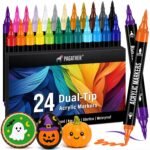
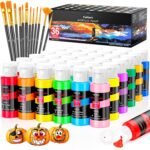
Competitively priced for a 24-color dual-tip marker set, delivering solid quality and versatility for fabric and craft projects at a fraction of comparable kits.
Price vs. rivals
Cheaper
CheaperTypicalPricier
This set is priced below typical mid-range options for similar dual-tip acrylic markers, offering good value without being the absolute cheapest on the market.
Ease of use
Excellent 95/100
These dual-tip markers are designed for straightforward use, allowing average users to easily switch between fine and broad strokes on fabric without complex preparation.
Overview – What the Betem acrylic paint markers set delivers
Right off the bat, the Betem 24 colors paint markers set gives you a dual-tip acrylic kit for under ten bucks. It’s aimed at weekend crafters who want to doodle on fabric, rocks, wood, or glass without buying five different kinds of paint. You get both a fine tip and a chisel tip in each marker, which reduces the “wrong tool” frustration. The real audience is casual makers, not studio artists – if you’re painting a birthday tee or labelling garden stones, this is your lane.
What problem does it solve? The hassle of setting up brushes and palettes for a small project. Paint markers remove that barrier. You uncap, shake, and go. The trade‑off is that they’re not archival quality, and lighter colors need a second coat. But for the price, they’re a practical shortcut.
Key Features – what actually matters when you’re working
Dual tips (fine + chisel) – The fine end handles outlines and lettering; the chisel fills larger areas. No swapping pens or waiting for paint to dry between passes.
Waterproof acrylic paint markers for clothing – Once heat‑set with an iron, the paint stays on through machine washes. Test on a scrap first – some colors need a longer set time than others.
24 colors in one box – You get a solid rainbow plus earth tones, a white, and a black. Pastels like beige and light blue are thin, but the primaries and metallics (gold, silver) are punchy out of the gate.
Non‑toxic, low odor – Safe enough for a kid’s craft table. The smell is mild acrylic, nothing that’ll send you outdoors. Still, keep the room ventilated if you’re doing a lot of layering.
Works on porous and smooth surfaces – They grab onto canvas, unglazed ceramic, wood, and rock. Glass and glazed tile need a sealant to stop the paint from flaking later.
Fit for You – when this set makes sense
You want to doodle on a pair of canvas sneakers without paying for custom artwork.
You’ve collected a dozen smooth river rocks and need permanent garden labels.
You’re prepping fabric gift tags for a birthday party and don’t want to clean brushes.
You keep buying fabric paint bottles but hate stirring and brush cleanup every time.
You’re a bullet journal addict who wants opaque writing on black paper without marker ghosting.
Uses – where these markers earn their keep
Rocks. These are some of the better Betem dual tip markers for rocks at this price. The fine tip follows the contours of river stones without skipping, and the paint dries matte. You won’t get the super‑opaque layering of a Posca marker, but two passes give you solid coverage even on darker stones.
Fabric. If you’re hunting for the best acrylic paint markers for fabric under ten dollars, this set is a strong contender. On a cotton tee or a canvas tote the paint flows smoothly. The catch? You have to heat‑set with an iron for about three minutes per side, or the design will fade after a wash or two. Skip that step at your own risk.
Clothing customisation. People looking for waterproof acrylic paint markers for clothing will get decent results here – the paint holds up in a machine wash on gentle cycle, though dark colours can bleed slightly into the fabric grain. Do a small test patch on the inside hem before you commit.
Glass and ceramic. They work on mason jars and mugs, but the adhesion is mediocre. A clear acrylic sealer spray after drying makes them dishwasher‑safe for occasional use. Without sealant, expect scratches.
Experience – living with the Betem markers
First thing you’ll notice: each marker needs a good shake – about fifteen seconds – and you have to press the nib down on scrap paper until the paint flows. That’s normal for any paint marker, but the Betem caps have a small clip that holds the nib down during storage, so you don’t have to do the “first prime” every time. Handy detail.
The fine tip is a true 1mm, great for line work. The chisel tip is 6mm, which covers fast. You can tilt it for thinner strokes. The paint consistency is medium‑thick, similar to a standard craft acrylic. It doesn’t run or bead up on fabric, but on non‑porous surfaces like glass you’ll see brush marks if you overwork it.
Cleaning mistakes? If you catch a stray line on fabric within a minute, you can scrub it out with a wet rag and dish soap. After that, it’s set. On skin, the paint washes off with soap and warm water – no need for solvent.
Storage: store them horizontally, or nib‑up if you have to stand them. Leaving them uncapped for more than a couple minutes will dry the tip. The caps are plastic and stiff; they can crack if you force them. Annoying, but a small price for the low overall cost.
The main annoyance is that lighter shades – especially yellow, white, and pink – need a second coat for full opacity. On dark fabric, you’ll definitely want to base with white first or accept a muted look. The white marker itself is decent for a budget set; it covers lighter colours in one pass but struggles over black.
Pros and Cons
Pros
Aggressive price for the count – Under $10 for 24 dual‑tip markers. That’s less than 45 cents per pen.
Dual tips save time – Switching between fine and chisel without digging through the box.
Good adhesion on fabric and rock – Heat‑set properly and they stick through multiple washes.
Low odor, non‑toxic – You can use them indoors with the window cracked.
Washable mistakes on fabric – Fast action with soap saves a project.
Cons
Opacity inconsistency – Pastels and yellow need two or three coats to look solid.
Not truly opaque on black surfaces – Even the white marker requires layering and a steady hand.
Tips dry fast when left uncapped – Forget to recap and you’ll waste a pen.
Slightly rubbery finish – The dried paint has a plastic‑like feel, not flat like a premium marker.
Cardboard box only – No storage case; you’ll need a pouch or a pencil case to keep them from rolling loose.
Advantages – Betem vs Ohuhu paint markers and other budget options
Betem vs Ohuhu paint markers is a common comparison because both sit in the same price range. Betem edges ahead on tip variety – Ohuhu tends to offer one tip per marker, while Betem gives you two in one barrel. That matters if you switch between outlining and filling a lot. On the flip side, Ohuhu markers often have more consistent pigment flow out of the box; Betem’s lighter colours can be watery. If you’re a one‑tip person, Ohuhu’s slightly more reliable. But for versatility, the Betem dual tip system wins.
Against premium brands like Posca or Molotow, Betem loses on opacity and colour pay‑off. Poscas cost three times as much but deliver opaque single‑coat coverage on nearly any surface. The real advantage of the Betem set is that it lets you try acrylic markers on a handful of different materials for the price of two or three Poscas. If you ruin a project, you’re out a dollar’s worth of paint.
Who Should Buy
Buy it if: you’re new to paint markers and want a low‑risk way to test them on fabric, rocks, and paper. Great for classroom projects, scout groups, or a craft night with friends.
Buy it if: you need a bunch of colours for a one‑time event – custom Halloween costumes, personalised birthday shirts, or painted favours for a wedding.
Skip it if: you work on dark fabric or black paper exclusively and need one‑coat opacity. Look at Posca or Montana markers instead.
Skip it if: you hate prepping – shaking, priming, waiting for paint to flow. Betem markers need that every time you switch colours.
FAQ
Is the Betem paint markers worth it?
Yes, for casual crafters on a budget. The Betem paint markers set gives you 24 dual‑tip markers for under $10, and they perform well on fabric and rock after heat‑setting. You sacrifice opacity in lighter hues, but that’s a fair trade for the price.
How long does Betem paint take to dry on fabric?
It dries to the touch in about two minutes on canvas or cotton. Let it cure for 24 hours before heat‑setting for best wash durability. Rushing the cure leads to fading.
Are Betem markers waterproof on their own?
They are water‑resistant once dry, but not fully waterproof without heat‑setting. On fabric, washing without heat‑fixing will cause flaking. On non‑porous surfaces like glass, they are not waterproof at all without a sealant.
Can you use Betem markers on glass and make it permanent?
Yes, but you need to bake or seal. Write on a glass jar, let it dry, then bake at 350°F for 30 minutes or spray with a clear acrylic sealer. Without that step the paint will scratch off.
Do Betem markers work on dark t‑shirts?
They work, but much less opaque than on white. Light colours like yellow and pink barely show unless you apply multiple thick layers. The white marker is your best bet: two coats over a black tee give a visible grey‑white result.
Are Betem acrylic paint markers safe for kids?
They are labelled non‑toxic and low‑odor, so older children (eight and up) can use them with supervision. That said, the caps are a choking hazard for toddlers, and the paint is permanent on many surfaces once dry, so watch the furniture.
Final Verdict – Is the Betem acrylic paint markers worth it?
For ten bucks, this Betem acrylic paint markers review lands on a clear “yes” for the right user. It’s a versatile starter set that handles the three most common craft surfaces – fabric, rock, and paper – without a fuss. The dual tips add real convenience, and the color range covers the basics. You’ll bump into the usual budget‑marker trade‑offs: thin pastels, a need for heat‑setting, and tips that punish forgetfulness. But if that sounds manageable, you’ll get more than your money’s worth.
The one thing to keep in mind: don’t expect pro‑level results on dark fabric or glass without extra effort. Buy this set for the fun projects, the ones where a small flaw adds character. For serious permanent work, upgrade later.
Betem acrylic paint markers vs the Competition in 2026
You’ve landed on the Betem 24 Colors Dual Tip set. At $9.99, it sits squarely in the budget zone—but cheap doesn’t always mean cheerful in the paint marker world. The trick is knowing exactly what you’re trading off. The Betem set leans hard into versatility: two tips per marker (fine bullet and medium chisel), a fabric-friendly formula that stays put after heat-setting, and a low price that makes it easy to stock up. But it’s not the only option at this price point, and if you’re after something for fine art or heavy-duty outdoor use, you might need to spend more. Here’s the honest breakdown against the three real contenders you’ll actually find on the shelf next to it.
Product
Price Range
Key Strength
Key Weakness
Best For
Betem 24 Colors Dual Tip
$9.99
Dual tips + fabric-ready formula at a low price
Limited opacity on dark surfaces; brush tip is a chisel, not a flexible nib
Budget-conscious beginners, clothing customizers, rock painting
Ohuhu 30 Colors Acrylic Markers (Fine & Brush)
$12 – $16
Softer brush tip that mimics a real paintbrush
Fabric performance is mediocre; tips can fray faster than Betem
Artists who want brush-like strokes for journaling and mixed media
Arteza Acrylic Paint Markers (24 Colors, Fine Tip)
$20 – $25
Strong pigmentation and excellent consistency across colors
Single tip only; pricier per marker than Betem
Detail work on canvas or paper where color payoff matters most
Professional-grade lightfastness, waterproof, works on glass and metal
Expensive, single tip, no dual-ends; overkill for fabric
Street artists, industrial DIY, permanent outdoor labeling
Betem acrylic paint markers vs Ohuhu paint markers
Ohuhu’s 30-color set is the closest direct rival at a similar price. Both brands promise dual tips, but they mean different things. Ohuhu gives you a fine bullet on one end and a flexible brush tip on the other—the brush nib is soft and springy, great for varied line width. Betem gives you a fine bullet and a flat chisel tip. The chisel is better for coloring large areas quickly (think filling in a letter or a rock), but it doesn’t hold a fine point. If you is Betem paint markers worth it for lettering, the answer depends: Betem’s chisel edge can do nice uniform strokes for blocky text, but for script with thick-thin variation, Ohuhu’s brush wins. On fabric, though, Betem takes the lead—the paint seems to bond better after heat setting, while Ohuhu’s colors have a tendency to crackle on cotton after a few washes.
Betem vs Arteza: when you want the color to pop
Arteza’s acrylic markers are the mid-range kings for one reason: pigment load. Open a blue Arteza and open a blue Betem side by side—the Arteza is noticeably denser and covers dark paper in a single coat. Betem needs two passes sometimes, especially on black t-shirts. That’s the trade-off for saving half the money. But Arteza only gives you a single fine tip per marker. You don’t get a chisel or brush. So if you’re doing large fields of color on a rock or a denim jacket, you’ll burn through Arteza markers faster because you’re constantly filling with a tiny nib. Betem’s chisel tip is a real time-saver there. For detailed linework on canvas or paper, especially if you’re selling art, Arteza’s consistency justifies the higher cost. For casual crafting best acrylic paint markers for fabric? Betem, because heat-set durability and dual tips beat sheer pigment intensity.
Molotow One4All: the premium alternative you don’t need for most projects
Molotow markers cost about what you’d pay for a single good fountain pen. They’re refillable, use real artist-grade acrylic, and the paint is truly lightfast and waterproof—leave a Molotow-painted rock in the rain for a month, and it’ll still look fresh. The Betem set will fade in direct sunlight after a few weeks, and its “waterproof” claim holds up to hand-washing but not a pressure washer. So when does Molotow make sense? If you’re painting outdoor signs, customizing tools, or doing mural work. For fabric and rocks and kids’ craft projects, paying $6 per marker is silly. The Betem 24-color set costs less than three Molotow pens. The real question is whether you need the longevity. Most people don’t. Molotow is the right choice only when you’re absolutely sure the item will be outdoors or in frequent contact with water and abrasion. Otherwise, Betem is more than fine.
So who should pick the Betem 24 Colors Dual Tip set? You, if you’re customizing t-shirts, sneakers, or canvas totes; painting rocks for the garden; or just getting into acrylic markers without wanting to spend more than ten bucks. The dual tips handle filling and fine details well enough, and the fabric adhesion beats anything at this price. But if you primarily work on paper or canvas and care about one-coat opacity, skip the Betem and grab Arteza—the extra $10 gets you colors that really sing. And if you need markers that survive the apocalypse? Molotow. For everything else, this Betem set is a perfectly honest tool that doesn’t pretend to be more than it is, and that’s refreshing.
Ready to decide on the Betem acrylic paint markers?
See today’s price, stock and delivery options on Amazon.