Offers exceptional value by combining top-rated quality with an extremely affordable price point.
Price vs. rivals
Cheaper
CheaperTypicalPricier
Priced well below typical mid-range options for a 12-pack of permanent markers, offering a budget-friendly alternative to popular brands while maintaining a strong rating.
Ease of use
Excellent 95/100
The markers are extremely easy to use for almost anyone due to their simple twist-off cap, reliable fine tip, and versatility on common surfaces, as reflected in their near-perfect user rating.
Overview
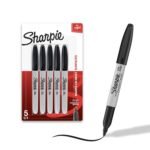
If you want a straight answer in this Sharpie permanent markers review, yes, the Sharpie Fine Tip is worth it. For just $3.42, you get twelve markers that write indelibly on almost anything without smearing or fading halfway through a label. It is the reliable choice.
The Sharpie Fine Tip Permanent Marker solves a simple problem: getting a bold, lasting mark onto surfaces where a ballpoint pen or a pencil gives up. Plastic bins, metal tools, glossy paper—it all works. The 12-count black pack is the standard kit for moving day, garage organization, and the office supply drawer. It just works, and it has been working the same way for decades.
Key Features
Fine tip point — The 0.8mm tip is the sweet spot. Thin enough for writing an address on a package, thick enough that the letters are bold and readable from across a room.
Quick-drying ink — Smudging is a dealbreaker for a permanent marker. The ink sets in seconds on most surfaces, so you can stack boxes or close the lid right after writing.
Fade-resistant formula — Labels on bins stored in a sunny garage stay legible for years. This is one of the best fade resistant markers for wood and plastic you can buy off the shelf.
Permanent on multiple surfaces — It works on wood, plastic, metal, paper, rubber, and glass. The ink bonds to slick, non-porous surfaces that ignore regular pens.
Bold black color — The black is deep and opaque. It shows up well on light and medium surfaces and holds its intensity until the ink runs dry.
Value pack of 12 — At this price, you can scatter them around the house. One in the toolbox, one in the junk drawer, one in the car for the next flea market trip.
Fit for You
You run a small shop and need to ship packages with a label that won’t wash off in the rain.
You are organizing a shared pantry and want labels that stay legible even when someone grabs the wrong bin.
You work in a warehouse or workshop and need to mark metal or plastic surfaces that ignore regular pens.
You have kids heading back to school and need to label water bottles and lunch boxes in a way that survives a full semester.
You are moving and need to number boxes in a way that is visible from a distance and hardy enough for a storage unit.
Uses
The most common use for these is labeling moving boxes. You draw a big number, write “Kitchen” or “Books,” and you can read it from three feet away. The ink dries fast enough that you can stack boxes right after writing.
It also shines in the garage. Marking measurement lines on a tape measure that has worn off, labeling the dial on a welding machine, or writing on a plastic gas can. Any surface that is slightly oily, textured, or shiny is where a Sharpie beats a pen.
Art directors and scrapbookers use the fine tip for detail work on foam core and mat board. The line is crisp without bleeding into the fibers of the board.
Let’s talk about the comparison. If you search for Sharpie vs Expo markers, the difference is simple. Expo markers are for temporary marks on whiteboards. Sharpie is for permanent marks on everything else. Do not write on a whiteboard with a Sharpie unless you enjoy scrubbing it off with rubbing alcohol. They are not substitutes. They are opposites.
One note on the fade resistance—it is not magic, but it is very good. Wooden crates stored near a bright window are often still perfectly readable years later. A cheap marker would be a pale ghost by then.
Experience
Out of the box, the caps are on tight. You will hear a solid click when you recap them, which is both satisfying and important. A loose cap is the number one cause of a dried-out Sharpie.
No Sharpie permanent markers review can skip the topic of the smell. It hits you the first minute you have the cap off. It is a strong solvent smell. You either associate it with productivity, or you find it obnoxious. There is no middle ground. If you are sensitive to smells, this might be a problem in a small room without ventilation.
The tip holds up well. It does not develop a rough edge or start fraying like some fine tip permanent markers from other brands. You get a consistent line until the ink runs out.
The main annoyance is bleed-through. On standard printer paper, the ink goes right through to the next page. Do not use these in a notebook if you need to use both sides of the page. Use cardboard or thick packing paper instead.
Storage is simple. Keep the caps on. Store them horizontally or point down. If you leave one uncapped overnight, it is usually dead by morning.
Pros and Cons
Pros
Writes on almost any surface — Plastic, metal, glass, wood, rubber. It does not skip or smear on slick materials.
Quick drying permanent markers — The ink sets in seconds, which saves you from smudging your work when you set the box down or stack it.
Fade resistant — Labels stay legible in sunlight and fluorescent light for years. A real advantage over cheap store-brand markers.
Cheap enough to buy in bulk — At roughly 28 cents per marker, there is no reason to ration them. Keep one in every drawer.
Consistent quality — Every marker in the pack writes the same. No duds. No dry ones.
Cons
Bleeds through thin paper — Do not use these in a softcover notebook. The ink goes straight through to the other side.
Strong solvent odor — The smell is powerful. Work in a ventilated area if you are labeling a lot of things at once.
Not reversible — If you make a mistake, it is permanent. You cannot erase it. You have to cover it or live with it.
Dries out if left uncapped — It only takes a few minutes of being uncapped for the tip to start drying. Always recap immediately.
Single-use packaging — The plastic body is not refillable. You use it until it runs dry and then you toss it.
Advantages
The Sharpie Fine Tip beats the alternatives in a few specific ways:
Generic markers — The ink flow is more predictable. You don’t get a weak mark halfway through the second pack of labels.
Ballpoint pens — A pen skips on plastic and glass. The Sharpie bites into the surface and stays.
Expo markers — Expo is for temporary marks. Sharpie is for lasting ones. If you need the label to survive a wet box or a hot garage, Sharpie wins.
Label printers — No batteries, no loading sheets, no warm-up time. Just uncap and write.
If you look for the best permanent markers for labeling, the Sharpie comes up every time. The reason is simple: it is the most predictable option. You know it will write on plastic. You know it will dry fast. You know the label will still be there next year.
Who Should Buy
Buy it if you are moving, packing shipments, organizing a garage, or labeling anything that needs to stay labeled for a long time.
Buy it if you work in a warehouse, a workshop, or a retail stockroom and need a reliable way to mark inventory.
Buy it if you are a student or parent who needs to label binders, lunch boxes, and gear that gets knocked around.
Skip it if you are looking for a whiteboard marker. That is what Expo is for.
Skip it if you need an ultra-fine line for technical drawing. A drafting pen like the Sakura Pigma Micron gives you more control on paper.
Skip it if you hate solvent smells and need to mark things in a sealed environment. Look for a low-odor permanent marker like the Sharpie Pro or a water-based marker.
FAQ
Is the Sharpie Fine Tip Permanent Markers worth it?
Yes. Any Sharpie permanent markers review that does not recommend this set for basic labeling is overcomplicating it. For $3.42, you get twelve markers that write on almost every surface, dry quickly, and resist fading.
How long does a Sharpie fine tip last?
It depends on how much surface area you cover, but for typical labeling use—writing a few dozen addresses or labels—a single marker can last for months. The ink level is visible through the barrel, so you are never caught off guard.
How does Sharpie compare to Expo markers?
They serve opposite purposes. Expo markers are dry-erase, designed for temporary marks on whiteboards. Sharpie is permanent, designed for lasting marks on most surfaces. Do not use a Sharpie on a whiteboard unless you want to scrub it with solvent.
Is the Sharpie fine tip safe for kids?
The ink is AP-certified non-toxic, so it is safe for general use by children under supervision. The caps are also ventilated to meet safety standards. Keep in mind it is permanent, so supervise younger kids during craft time.
Does it work on plastic and metal?
Yes. Plastic and metal are where the Sharpie fine tip shines. The ink bonds to slick, non-porous surfaces that reject ballpoint pens and pencils. It is the standard tool for marking toolboxes, gas cans, and storage totes.
Will these markers fade in direct sunlight?
They are fade resistant, not fade proof. They hold up significantly better than cheap no-name markers, but no ink is completely immune to years of direct UV exposure. Labels on a garage shelf will stay readable for years. Labels on a car window might fade in a few months.
Final Verdict
The Sharpie Fine Tip Permanent Markers are the baseline against which all other permanent markers are measured. They are not the cheapest, not the finest, and not the most specialized, but they are the most reliable. You know what you are getting.
This Sharpie permanent markers review gives the set a full recommendation for anyone who needs to label, mark, or write on surfaces that demand permanence. The one thing to keep in mind is simple: “permanent” means what it says. You cannot erase a mistake. If you are careful with the cap and careful with your marks, there is no better tool for the price.
Sharpie Fine Tip Permanent Markers vs the Competition in 2026
You already know the Sharpie name. It’s the default, the baseline, the marker you picture when someone says “permanent marker.” This 12-pack of fine tips sits right in the middle of the market at around $3.50, which puts it in a weird spot—cheaper than the fancy art brands, pricier than the generic office-store bulk packs. It’s the safe choice, but safe doesn’t mean boring. The ink dries fast, holds onto slick surfaces without smearing, and the fine tip actually writes like a pen rather than a blunt crayon. The question isn’t whether Sharpies are good—they are—but whether they’re the right marker for what you’re doing today.
Product
Price Range
Key Strength
Key Weakness
Best For
Sharpie Fine Tip Permanent Markers (12ct)
$ (~$3.50)
Bold, crisp lines on nearly every surface; dries in seconds
Meetings, classrooms, any surface you need to erase
Bic Mark-It Fine Point
$ (~$1.50–$2.50 per 12pk)
Cheap, reliable, decent color selection
Ink is thinner and less opaque; fades faster in sunlight
Budget labeling, craft projects where price trumps longevity
Staedtler Lumocolor Permanent (Fine)
$$ (~$1.00–$2.00 per marker)
Dry-safe ink (can be left uncapped), precise metal-cased tip
Smaller ink capacity; price adds up for bulk use
Precision work, engineering, lab labeling, anyone who forgets caps
Sharpie Fine Tip Permanent Markers vs Expo Markers
This comparison isn’t really apples-to-oranges—it’s apples-to-basketballs. Expo markers are dry-erase. Sharpies are permanent. If you accidentally use a Sharpie on a whiteboard, you’ll spend twenty minutes scrubbing with rubbing alcohol and still end up with a faint gray ghost of your mistake. The ink is designed to bond, not to be erased. So why even compare them? Because a lot of people need both and don’t want to carry two sets. If you’re a teacher or run meetings, the Expo Low-Odor line is the right tool for the whiteboard. But for writing on name tags, labeling a lunch bag, or marking a plastic storage bin, the Sharpie wins—Expo ink smears the second your finger grazes it. The real answer: buy both. They cost less than a coffee each.
Sharpie Fine Tip Permanent Markers vs Bic Mark-It
Bic is the budget alternative that feels like a budget alternative. A 12-pack of Mark-It fine points costs about half what Sharpie charges—maybe $1.50 on sale. The ink is fine. It writes on paper and plastic. But here’s the thing: Bic’s ink is noticeably thinner. On a glossy surface like a DVD case or a poly mailer, the line looks washed out, and if you write over it twice, it smears. Sharpie’s ink lays down darker and adheres better to non-porous surfaces. The trade-off is price and, oddly, color selection—Bic offers more shades in their fine-point line. For heavy-duty labeling of boxes you’ll stack in a garage, the Bic will fade on you in six months. The Sharpie holds its black. If you’re just marking clothes for a kid’s camp or labeling jars, save the dollar and grab the Bic. But for anything you want readable a year from now, don’t skimp.
Sharpie Fine Tip Permanent Markers vs Staedtler Lumocolor
Staedtler is the quiet professional in this category. The Lumocolor permanent fine tip is a German-engineered tool with a metal-cased tip that doesn’t flex, doesn’t soften, and can be left uncapped overnight without drying out. That’s a real feature if you’re the type to set a marker down mid-thought and lose the cap. The line is slightly finer than Sharpie’s, which makes it better for writing small text on electrical panels or labeling vials in a lab. But here’s the catch: the Lumocolor holds less ink, and at about $1.50 to $2 per marker, a 12-pack runs you close to $20. For most people—labeling a pantry, signing a package, marking a cut line on wood—the Sharpie is the better value. Buy the Sharpie for volume. Buy the Staedtler if your work involves tiny, precise marks or you have a habit of leaving caps off.
So who should pick the Sharpie? Almost everyone, honestly. It’s the best all-around permanent marker for general use in 2026. The ink dries fast enough that you won’t smudge it on shiny plastic, it resists fading on wood better than anything near its price, and the 12-pack will last you months. It’s the right choice for labeling, crafting, and shipping. But if you’re a teacher, the Expo markers are non-negotiable for your whiteboard. And if you find yourself grinding markers into rough lumber until the tip mushrooms, spend the extra money on the Staedtler Lumocolor—the metal tip outlasts Sharpie’s by a long shot. Otherwise, don’t overthink it. The Sharpie works, it’s cheap, and you’ll probably find three of them rolling around your junk drawer anyway.
Ready to decide on the Sharpie Fine Tip Permanent Markers?
See today’s price, stock and delivery options on Amazon.