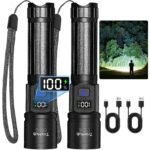
Packed with premium features at a price that undercuts most competitors, this set delivers exceptional bang for the buck.
Price vs. rivals
Cheaper
CheaperTypicalPricier
Priced well below most similar solar security light sets with comparable brightness and features, positioning it as a budget-friendly option in the market.
Ease of use
Excellent 85/100
The lights are straightforward to install without wiring and easy to operate with the remote and motion sensor, though some users may find the mode settings slightly confusing at first.
Overview
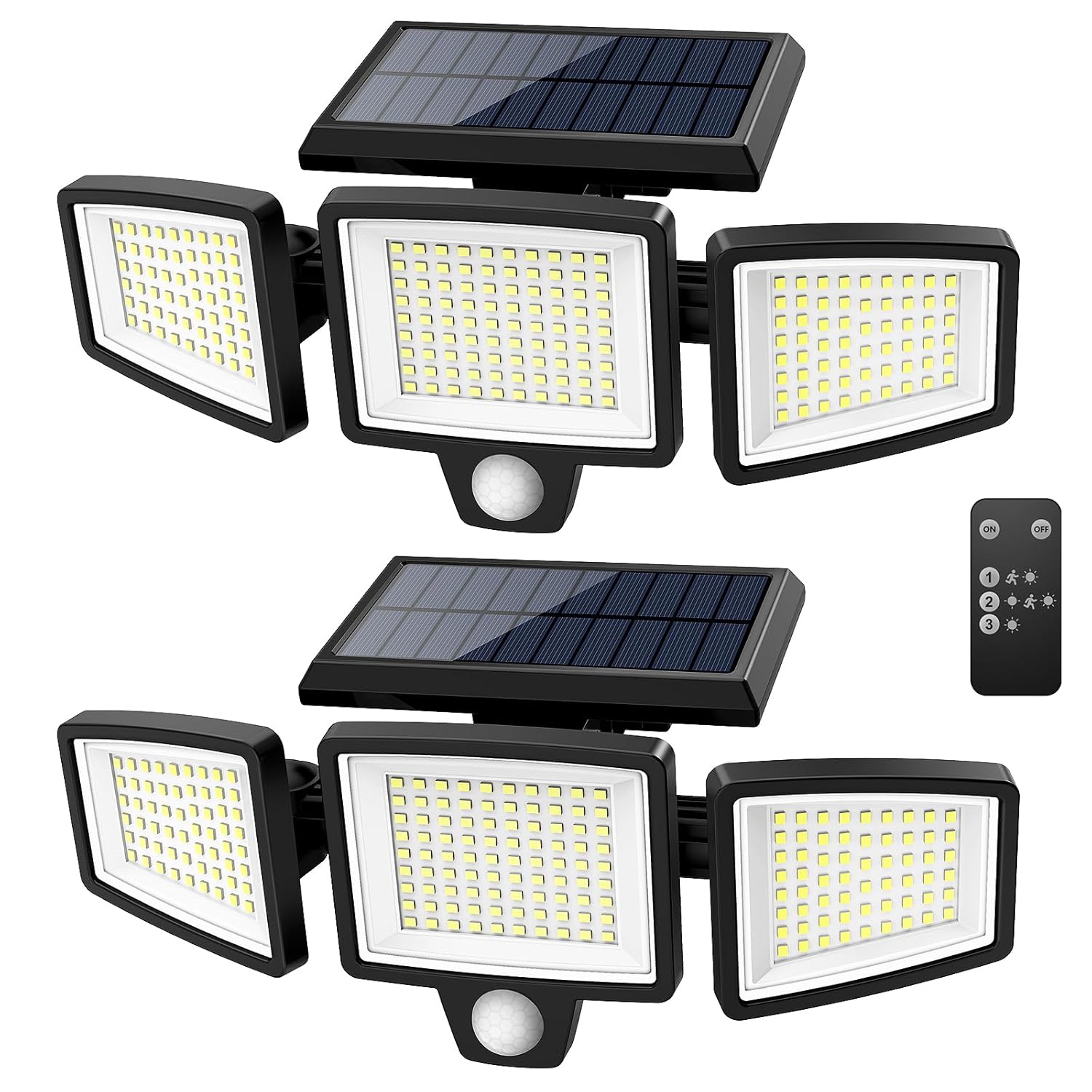
The Tuffenough solar lights review you’re about to read gets straight to the point: these are a solid, budget-friendly option for lighting up dark corners of your property without running wires. For around $25 for two packs, you’re getting 210 LEDs, three adjustable heads, a remote, and motion detection. They won’t replace a hardwired floodlight, but for a driveway, back gate, or shed, they’re a practical shortcut to extra security.
People who hate messing with electrical boxes or paying an electrician will appreciate how simple these are to mount. You screw the bracket, snap the light on, and let the sun do the rest. The catch is that solar lights have limits—winter sun and shaded spots will cut performance. But if your spot gets decent daylight and you want motion-triggered light for a few hours each night, these deliver.
Key Features
210 LEDs with 2500 lumens total output – That’s a lot of light for a solar fixture. You’ll get three panels (70 LEDs each) that cover a wide area. It’s bright enough to clearly see who’s walking up your driveway or rummaging near your garage.
Three adjustable heads + 270° wide angle – Each head rotates and tilts independently, so you can aim one at the door, another at the path, and another at the trash cans. That flexibility is rare at this price.
Remote control included – You can change modes or turn the lights on/off without climbing a ladder. The remote works from about 20 feet away, which is handy for adjusting after installation.
Three lighting modes – Constant dim light, motion-activated bright light, or always-on bright. The motion mode is the smartest: stays off until something triggers it, then blasts full power for 30 seconds.
IP65 waterproof rating – Rain, snow, and dust won’t bother them. Owners tend to report they survive storms fine, as long as the solar panel stays clean.
Monocrystalline solar panels – More efficient than polycrystalline panels, meaning they charge better in cloudy or partial shade. Still, they need direct sun for a full charge.
Fit for You
You need light in a spot that gets 4–6 hours of direct sun but has no nearby outlet.
You want motion-activated lighting for your driveway without wiring a thousand feet of cable.
You’re tired of cheap solar lights that die after three months—these have a reputation for lasting a couple of seasons.
You have a dark corner by the back door where packages get dropped and you’d like to see who’s stealing them.
You want a remote so you can turn the light on from the kitchen window instead of walking out into the rain.
You’re outfitting a shed, detached garage, or fence line where running electricity isn’t worth the hassle.
Uses
Picture this: you come home after dark, and as you pull into the driveway, the two lights on the garage wall snap on within a few feet of your car. You see the steps, the recycling bins, and the cat that’s about to dart under the wheels. That’s the best use case—motion-activated security for entry points.
Another realistic moment: you’re grilling at dusk and want the patio lit without blinding your neighbors. Set the lights to the constant dim mode (about 20% brightness) and they give a warm glow that’s enough to see the tongs but soft enough to keep the mood. Then switch to bright mode when you’re cleaning up.
They also work well for illuminating a dark pathway between the house and the shed. The three heads let you angle one down the path, one toward the shed door, and one back toward the house. You won’t trip over the hose again.
Experience
Installation is genuinely easy—probably the first thing you’ll notice. The brackets screw into wall or wood with the included anchors, and the light body clicks onto the bracket with a satisfying snap. You don’t need to be handy; just a drill and 15 minutes for both units.
Charging takes a full day of good sun to get a full battery, which gives you about 6–8 hours of light on motion mode. On the always-on bright setting, expect maybe 2–3 hours before they dim. The remote is simple: three buttons (mode, on/off, timer). One annoyance: the remote’s range is fine outside but drops if you point it through a window—go figure.
The motion sensor is sensitive enough to catch a person walking 20–30 feet away, but it can trigger on a car passing or a swaying tree if you mount it in a windy spot. You can adjust the angle to reduce false alarms. One minor gripe: the solar panels collect dust and bird droppings over time, and if they get grimy, the light dims noticeably. A quick wipe every couple weeks keeps them happy.
Pros and Cons
Pros
Impressive brightness for the price – 2500 lumens (total) is more than most cheap solar lights offer. You’ll actually illuminate a driveway, not just cast a faint glow.
Three adjustable heads are genuinely useful – Unlike fixed-panel lights, you can aim each head separately. It makes a big difference when you have a corner or a long wall.
Remote control adds real convenience – Changing modes or turning them off without a ladder is a small win that you’ll appreciate every night.
Good build quality for the money – The plastic housing feels solid, the brackets are metal, and the IP65 rating means rain runs off easily.
Easy installation – No wiring, no electrician, just screws and a bracket. Mount it anywhere you can catch some sun.
Cons
Battery life is average – On motion mode you get 6–8 hours after a full charge, but if winter clouds roll in, that drops to maybe 4 hours. Not great for all-night operation.
Moion sensor can be overly sensitive – It picks up cars on the street and pets, which can become annoying if you live near a busy road. You can angle it away, but not eliminate false triggers.
Plastic clips that hold the heads may loosen over time – A few owners mention that after a year the heads don’t stay perfectly positioned in high wind. It’s not universal but worth knowing.
Soar panels need direct sun – If your mounting spot is even partly shaded for half the day, the lights will be useless after sunset. No exceptions.
Advantages
When you compare the Tuffenough vs other solar lights in the same price range (think $20–$30), the clear win is the 210 LEDs and 2500 lumens. Most competitors at $25 give you maybe 100 LEDs or a single head. The triple-head design also beats fixed-beam lights because you can shape the light pattern to your space. Another advantage: the remote is included, while many similar-priced solar lights make you buy a separate remote or use a phone app. The IP65 rating is standard for the category but executed decently here—owners rarely report water failures.
If you’re looking for the best solar lights for driveway, these are a strong candidate, especially if your driveway is straight and gets decent sun. The 270° coverage from two units can light a driveway up to about 40 feet long. For longer driveways, you might need three sets, but for the price, that’s still less than a single hardwired floodlight.
Who Should Buy
Buy them if you have a dark spot that gets 4+ hours of sun and you want motion-activated light without wiring. Great for renters or homeowners who don’t want to break out the toolbox.
Buy them if you’re on a budget and need two units for a garage, shed, or back gate. The price per light is under $13—hard to beat.
Skip them if your area gets less than 4 hours of direct sun, or if you need all-night floodlighting. In that case, look at wired LED floodlights from brands like LEONLITE or Lithonia.
Skip them if you want a light that works after a day of clouds in winter. Solar physics limits you; even the best panels can’t fix that. Consider a hardwired motion light instead.
FAQ
Is the Tuffenough solar lights review accurate about brightness?
Yes, as far as category norms go. 2500 lumens is claimed total for all three heads, and owners consistently say it’s brighter than most $25 solar lights. You’ll clearly see people and objects 30 feet away.
Is Tuffenough solar lights worth it?
It depends on your situation. For a sunny, low-hassle installation with motion lighting, absolutely. If you need consistent light in shade or long battery life, you’ll be disappointed. At $25 for two, it’s a fair trade.
How long do the Tuffenough 210 LED motion sensor lights last per charge?
Thorough summer sun, expect 6–8 hours on motion mode (most of the night off, turning on when triggered). On constant bright, about 2–3 hours. Battery life declines gradually over two years.
Does the remote work well with the Tuff 2500LM solar flood lights?
Yes, up to about 20 feet in line of sight. Through a wall or window, range drops to maybe 15 feet. It’s reliable for daily use—just don’t expect to control them from inside the house.
Can I use these in cold climates?
They operate down to about -5°F, but battery performance plummets in freezing weather. In northern winters, you might get only a couple hours of dim light. The plastic housing won’t crack, but it’s not a main light source for winter.
Are the solar outdoor lights with remote control easy to install?
Very. Each light comes with a bracket you screw into a wall or post, then click the light on. The remote works immediately (batteries included). No wiring, no tools beyond a drill and screwdriver.
Final Verdict
The Tuffenough solar security lights are a pragmatic buy if your needs match their strengths. They’re bright, adjustable, and cheap enough to buy two sets without flinching. The remote is a genuine perk, and the three-headed design gives you flexibility that fixed solar lights can’t match.
The one thing to keep in mind: they’re solar, so the weather and location will always be the boss. If you have a spot with good sun and you want motion-triggered light for a few hours after dark, these can save you from drilling holes in your siding. For the price, they’re a smart way to test if solar works for you before investing in pricier gear.
Tuffenough solar security lights vs the Competition – Which is Best for You?
The Tuffenough solar security lights sit squarely in the budget tier at around $25, but they don’t act like it. You get 210 LEDs, a claimed 2500 lumens, a remote control, and three adjustable heads. That’s a lot of hardware for the price. The catch? It’s mostly plastic, and the motion sensor tops out at about 26 feet. Still, for a driveway that already gets some sun, it’s a serious candidate. But the market is stuffed with alternatives, each with its own trade-offs. Here’s how the Tuffenough stacks up against the real competition.
Product
Price Range
Key Strength
Key Weakness
Best For
Tuffenough Solar Security Lights (210 LED, 2500LM)
~$25
Bright LEDs + remote control, three adjustable heads
Plastic housing, motion sensor range ~26 ft
Budget buyers who want high brightness and remote convenience
LEPOWER 220 LED Solar Lights
~$30
220 LEDs, wider 270° motion detection (30 ft), metal bracket
Often sold without a remote; light head not adjustable side-to-side
Large driveways needing broad coverage and longer detection
Only 198 LEDs, slightly dimmer than Tuffenough on paper
Anyone who needs a light that can survive hail and hard knocks
Sanniu 3-Head Solar Lights
~$35
Three completely independent heads with separate solar panels
Lower total lumen output (around 1800LM), plastic build
Odd-shaped corners where you need to point heads in different directions
Tuffenough solar lights review vs LEPOWER 220 LED
LEPOWER’s 220 LED model is the closest rival on paper – same price bracket, similar LED count. But the real difference is the motion sensor. LEPOWER claims a 30-foot detection range versus Tuffenough’s 26 feet. That four extra feet matters if your driveway is long and you want the light to come on before you’re halfway to the house. On the other hand, Tuffenough includes a remote control in the box. LEPOWER’s version often doesn’t, so you’re stuck with just the built-in timer and sensor modes. If you like to tweak brightness or switch modes from the back porch, the Tuffenough wins. If you need wider coverage and don’t care about a remote, LEPOWER is the smarter pick.
Tuffenough vs Aootek 2500LM – plastic vs aluminum
This is the durability showdown. Aootek’s 2500LM dual-head light uses a die-cast aluminum housing that feels solid in your hand. Tuck it under an eave in a storm-prone area and it’ll shrug off debris. The Tuffenough is all plastic – lighter, cheaper, but it flexes more. You can feel it when you tighten the screws. Aootek also has a better reputation for battery longevity after a couple of seasons. That said, the Tuffenough delivers more raw lumens from its 210 LEDs (Aootek uses 198) and the remote gives you three modes: motion sensor always on, motion sensor at night, or full constant-on. Aootek sticks with just motion-only and constant-on. So for sheer flexibility at half the price, Tuffenough pulls ahead. But if you’ve already replaced a plastic light that cracked after one winter, spend the extra $15 on the Aootek.
Tuffenough solar security lights vs Sanniu 3-Head – aiming freedom vs brightness
Sanniu’s three-head design lets you swivel each head completely independently – you can point one at the garage door, one at the side gate, and the third down the path. The Tuffenough three-head is more limited: the two outer heads tilt up and down but don’t rotate side to side much. For tight nooks, the Sanniu is more practical. But here’s the trade-off: Sanniu’s total lumen output is lower, around 1800LM. The Tuffenough is brighter overall, especially if you aim all three heads in the same direction. Also, Sanniu doesn’t come with a remote on many listings, so double-check before you buy. If raw floodlight power is what you need, stick with Tuffenough. If you’re lighting a three-way intersection of dark spots, the Sanniu’s adjustability wins.
So who should click “buy” on the Tuffenough solar security lights? You, if you want the best mix of high lumen output and remote control for under $30, and you’re okay with a plastic shell that does the job in normal weather. If you live somewhere with frequent hailstorms or need a light that can take a beating, spend the extra on the Aootek. For wide-driveway coverage without a remote, LEPOWER is a solid alternative. And if you’re wrestling with an oddly shaped yard, the Sanniu’s independent heads beat everything else – just know you’re trading some brightness for that flexibility.
Ready to decide on the Tuffenough solar security lights?
See today’s price, stock and delivery options on Amazon.