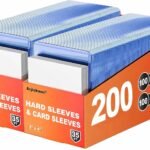
Penny card sleeves review: yes, this 1000-count pack is worth it for anyone with more cards than money. At $9.98, you get a cent-per-sleeve price that’s hard to beat. They’re thin, clear, and basic – which is exactly what most storage situations need.
Exceptional value for high-volume protection, with stellar user satisfaction at a category-typical price.
Price vs. rivals
Typical
CheaperTypicalPricier
This price falls right in the middle of the typical range for bulk penny sleeves, neither notably cheap nor premium compared to similar alternatives.
Ease of use
Excellent 95/100
These sleeves are extremely intuitive—just slide the card in, making them nearly effortless for anyone to use.
Penny Card Sleeves Review – Overview
This is the classic soft sleeve, the kind collectors have used for decades before any of the fancy stiff options existed. Penny makes a 1000-count pack of clear polypropylene sleeves that fit standard trading cards like Pokemon, Magic, and most sports cards. You’ll also hear them called penny sleeves, because the whole point was to protect a card for about a penny.
The problem they solve is the dirt, dust, and fingerprint problem. Every card you touch picks up oils. Every card you stack against another can get scuffed. For a $20 card, you’d put it in a rigid toploader. For a $0.50 common from a booster box, you need something cheap enough to use in bulk. That’s what these are for.
Key Features of the Clear Penny Sleeves Bulk Pack
1000 sleeves in one box – This is the “bulk” part. You get ten stacks of 100, enough to sleeve a full booster box of commons or a whole collection of duplicates without rationing.
Standard trading card size – They measure about 2.5 by 3.5 inches, the same size as a Pokemon or Magic card. The fit is slightly loose on purpose, so you can slide the card in quickly without bending the sleeve.
Soft, clear polypropylene film – Thin enough to feel almost like nothing, which is good for storage because it adds almost no bulk to your stacks. You can see the card’s back and front perfectly.
Archival-safe material – Made from polypropylene, which doesn’t contain acids that can damage paper over time. That means your cards stay yellow-free even if they sit for years.
No chemical smell – Unlike some budget sleeves, these don’t have a strong plastic odor when you open the box. They do have static electricity, but that fades after a few seconds.
Fit for You
You’re sorting a few thousand cards into storage boxes and need to hand out sleeves like candy.
You sell cards online and want a cheap first layer of protection before putting the card in a mailer.
You have a Pokemon binder that holds common and uncommon cards, and you’re tired of them sliding around in the pockets.
You play draft or sealed formats and end up with piles of cards you want to keep but never actually play.
You’re shipping cards as gifts or trades and don’t want the recipient to get scratched cardboard.
You just want a simple, no-fuss way to keep dust off cards in a shoebox.
Uses
The classic scene is a cardboard storage box full of sleeves. You draft, pick up your commons, put each one in a penny sleeve, and drop it in. That’s it. No fanfare. The sleeves keep the cards from rubbing against each other when the box gets moved around, and they keep dust from settling on the faces.
Shipping is another sweet spot. Put a penny sleeve on the card, then slide that into a semi-rigid or a toploader. The soft sleeve keeps the card from moving inside the rigid holder, and it protects the surface from the holder’s edges. For a $5 trade card, this is plenty.
Binder collectors also use these. Slide the card into a penny sleeve, then into a binder page. It adds thickness, but it also adds a second layer between the card and the page’s plastic. Some people worry about holo cards sticking to unbacked binder pages – the penny sleeve solves that worry.
Experience
Living with these sleeves is a study in trade-offs. The first thing you’ll notice is how thin they are. When you pick up a single sleeve, it’s almost weightless. Sliding a card in takes no effort – the opening is generous and you don’t need to fold the sleeve or use a fingernail. That’s a relief after dealing with some tight premium sleeves that feel like you’re trying to put a pillowcase on a mattress.
But the thinness cuts both ways. The sleeve doesn’t hold its shape. If you grab the top corner, the sleeve bends and wrinkles around the card. You have to handle them with a little care. And the static makes fresh sleeves stick together in clumps, so you’ll spend a few seconds shaking them apart before you start.
Penny sleeves vs Ultra Pro sleeves is a real comparison here. Ultra Pro offers a firmer sleeve – thicker material, a snugger fit, and a much better feel for shuffling. But Ultra Pro costs three or four times as much per sleeve. If you’re using these for a deck you plan to shuffle, you’d be unhappy. If you’re using them for storage, you won’t notice the difference.
The only actual annoyance is the box. It’s a plain cardboard box with an open top. Once you take the sleeves out, there’s no way to close it securely. A rubber band works, or you can transfer the sleeves to a Ziploc bag. Not a dealbreaker, but it’s a small thing you’ll end up solving yourself.
One more thing: don’t expect these to protect from spills. If you’re holding a card and a drink topples over, the sleeve is not going to save it. The film is thin and water will get inside. That’s fine – it’s not what they’re for. But you should know the limit before you buy.
Pros and Cons
Pros
Ridiculously cheap – Under $10 for 1000 sleeves is about a cent each. No cheaper way to protect a card exists.
Clear visibility – The polypropylene is transparent enough to read the card name and set symbol from both sides.
Standard size works everywhere – Fits Pokemon, MTG, sports cards, and most standard trading cards.
Good for storage – They keep dust, fingerprints, and minor scuffs at bay in boxes and binders.
No acid worries – Made from archival-safe material, so they won’t yellow or stick over time.
Cons
Very thin and flimsy – They offer no protection against bending, crushing, or spills. Don’t use these for your high-value cards.
Loose fit – The sleeve is slightly oversized, so the card can wiggle a bit. That’s typical for penny sleeves but can annoy people who like a snug fit.
Static cling – New sleeves stick together. You’ll spend a few seconds separating a pile.
The box isn’t resealable – Once you open it, you need your own closure or the sleeves can spill.
Advantages
Compared to alternatives, these make the most sense for anyone who needs to protect a large number of cards and wants to keep the cost per card in the fraction of a cent. That’s why many collectors call them the best penny sleeves for card storage – they’re not the best at anything else, but for sheer value and volume, nothing beats them.
Cost per sleeve is unbeatable – At roughly a cent, you can sleeve an entire collection without remorse.
Bulk pack means fewer restocks – Once you have this box, you won’t need to buy sleeves again for a long while.
Flexible material is gentle on cards – The soft film puts less pressure on edges, which is a nice touch for older cards that might be brittle.
Works with other storage – They add a layer of surface protection inside toploaders, semi-rigids, and binder pages.
Who Should Buy
Here’s the honest breakdown:
Yes if you’re a casual collector with boxes of commons and uncommons that need basic protection.
Yes if you sell or trade cards online regularly and need a cheap layer of protection for shipping.
No if you’re sending a valuable card through the mail – get a semi-rigid or toploader instead, or use these inside one.
No if you’re a tournament player who shuffles their deck repeatedly – penny sleeves break and catch easily. Look for matte or dual-sleeve setups.
FAQ
Is the Penny card sleeves worth it?
Yes, if you need to protect bulk cards from dust and surface scratches. At $9.98 for 1000, you’re paying a cent a sleeve, which means you can sleeve an entire collection without guilt. For anything worth more than $20, use a stiffer holder instead. But for commons, it’s the best value in the hobby.
How long does it last?
A sleeve will last for years in a storage box, as long as you don’t bend it or mix it with rough objects. The material is archival-safe, so it won’t turn yellow or become brittle quickly. The main risk is tearing on the corners, especially if you slide cards in and out often.
What is the penny sleeves size for Pokemon cards?
The penny sleeves size for Pokemon cards is the standard 2.5 by 3.5 inches, which is what these measure. They fit Pokemon, Magic, and Yu-Gi-Oh cards with a little extra room. That extra room is intentional – it makes inserting and removing the card much faster than a snug fit.
Can you use these for double-sleeving?
You can, but they’re not ideal for the inner slot. A proper inner sleeve is tighter and made specifically to go inside an outer sleeve. Penny sleeves work better as a first layer under a toploader or semi-rigid holder. For standard deck double-sleeving, look for dedicated inner sleeves.
Are these sleeves safe for expensive cards?
They’re safe in the sense that they won’t scratch or acid-damage the card. But they won’t protect against bending, crushing, or water. For expensive cards, use a toploader or semi-rigid holder. Some collectors use these inside a toploader for extra surface protection, which works fine.
Do these sleeves fit in a binder?
Yes, they fit in standard 9-pocket binder pages without issue. The card goes in the penny sleeve, then the sleeved card goes into the binder pocket. It makes the page a bit thicker, but it adds protection against dirt and the edge of the pocket. Many collectors prefer this for holo cards.
Penny Card Sleeves Review – Final Verdict
The Penny card sleeves review doesn’t need a complicated ending: buy them if you have cards that need basic protection in bulk. They’re not premium, and they’re not meant to be. At about a cent each, they’re the honest answer to storage needs.
Just keep the one thing in mind – these solve scratches and dust, not drops and dents. For that, you’ll want something stiffer. But for everything else, there’s no better deal in card storage.
Penny card sleeves made a name by doing one thing very deliberately: offering a reliable sleeve at a shockingly low per-unit cost. The 1000ct pack sells for around ten bucks, and buyers consistently rate it 4.8 stars largely because it doesn’t pretend to be anything fancier than it is. In a market full of premium plastic, this puts it in a specific spot—great for volume, but it demands you look at the trade-offs against the usual suspects.
Product
Price Range
Key Strength
Key Weakness
Best For
Penny card sleeves
Budget (~$10 for 1000)
Unbeatable cost per sleeve; good clarity for the price
Feels thinner; less edge protection feel
Bulk storage, sorting commons, basic sleeving
Ultra Pro
Mid (~$5–10 for 100)
Industry standard clarity and fit
Price adds up fast for big collections
The reliable daily driver for standard cards
BCW
Mid (~$3–8 for 100)
Durable material with a strong seal fit
Can be too tight for some sleeves/binders
Players who want a firm hold on the card
Dragon Shield
Premium (~$10 for 100)
Thickest material; superior drop protection
Expensive; overkill for bulk storage
High-value singles and grail cards
Penny card sleeves vs Ultra Pro sleeves
Ultra Pro is the baseline. The clear standard. Their sleeves feel structured and slide effortlessly into top-loaders. The Penny sleeves are distinctly thinner. You can feel it when you pinch the opening. For most cards—the exact penny sleeves size for Pokemon cards and Magic—this difference doesn’t matter for basic storage. The real gap is cost. A 100-pack of Ultra Pros runs you about the same as the entire 1000-pack of Penny sleeves. For sleeving a full bulk lot or storing an entire collection, the Penny sleeves let you protect everything without thinking twice about the budget. For the one or two expensive cards in your trade binder, the extra couple of cents for an Ultra Pro might bring more peace of mind.
Penny card sleeves vs BCW
BCW sleeves are built tough. They have a very specific, almost clingy fit. If you’ve sleeved a lot of cards, you know what that slight resistance feels like. The Penny sleeves are looser. They slip on faster, which is a real plus when you’re running through a stack of common cards after a pack opening. The downside is that the BCW sleeve feels like it has the card locked in. The Penny sleeve is more of a gentle hug. If you are double-sleeving for a binder or moving cards into and out of sleeves frequently, the ease of the Penny sleeve is a genuine feature. If you want the card to stay put and not shift inside the sleeve, BCW has the tighter grip.
Penny card sleeves vs Dragon Shield
This is the value pack versus the premium heavyweights. Dragon Shield sleeves are famously thick. They protect an edge from a drop better than almost any other penny sleeve on the market. They also cost an entirely different amount. A single 100-pack of Dragon Shields costs about the same as the 1000-pack of Penny sleeves. If you are sleeving a card that goes directly into a top-loader and into storage, the Penny sleeve is perfectly adequate. It blocks dust and prevents scratching. If you are handling a card worth hundreds of dollars, the extra material of the Dragon Shield is just cheap insurance. The Penny sleeves are a volume solution. Dragon Shields are a premium safeguard for the cards that really matter.
So who actually buys the 1000ct clear penny sleeves bulk pack? It makes sense if you have a large collection, store bulk lots, or just want a massive stack of sleeves on hand without spending a lot. The per-sleeve cost is the entire point. If you mainly sleeve high-value cards and want the best tactile feel or thickness, you’re better off spending the extra cash on Dragon Shields for the key pieces and leaving the Penny sleeves for the rest. For a general collector who needs a simple, effective bulk pack? This is a very easy buy.
Ready to decide on the Penny card sleeves?
See today’s price, stock and delivery options on Amazon.