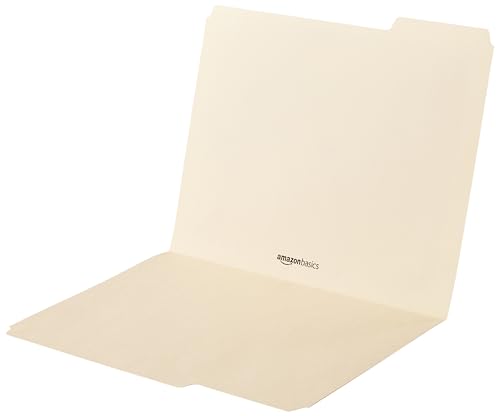
Amazon Basics file folders review: the short answer is yes, they’re worth it. For $12.59 you get a 100-pack of letter-size manila folders with reinforced tabs and assorted tab positions, roughly 13 cents each. They’ll handle everyday filing without fuss, and they won’t make you feel like you overpaid for branded office supplies.
Exceptional value for a high-volume office staple, offering reliable durability and organization at a fraction of competitor costs.
Price vs. rivals
Cheaper
CheaperTypicalPricier
Priced well below most comparable letter-size file folders with reinforced tabs, even though it offers a 100-pack and a high customer rating. It aligns with Amazon Basics’ typical value positioning, undercutting major office-supply brands by a significant margin.
Ease of use
Excellent 95/100
File folders are a straightforward, familiar product requiring no learning or assembly, so an average person can use them immediately without any difficulty.
Overview: Amazon Basics File Folders Review
This Amazon Basics file folders review covers a 100-pack of letter-size manila folders that costs $12.59. They’re the kind of basic product you don’t think about until you need it: no bright colours, no gimmicks, just a stack of paper folders with a reinforced spot where you grip them.
The folders solve a genuinely annoying problem. Paper accumulates at the corners of desks, in tote bags, and in a pile of mail nobody wants to touch. These folders give that paper an address. They’re for anyone who wants a working filing system without paying boutique office-supply prices.
Key Features: Reinforced Tab File Folders That Earn Their Spot
Here’s what the 100-pack actually gets you.
Reinforced tabs: The extra layer at the tab means you can pull hard when a drawer is packed without the folder ripping at the top. This is the feature that keeps a folder usable for years, not months.
1/3-cut tab, assorted positions: Tabs sit left, centre, and right in rotation, so you can see every file name when you look down into a drawer.
Letter size, 8.5×11: The standard US document size. Fits standard cabinets, desk drawers, and archive boxes.
Classic manila stock: The tan shade is the default for a reason. It takes pen, pencil, and labels cleanly, and the surface isn’t so slick that things slide off.
100 folders per pack: At about 13 cents each, you have enough folders to cover a full filing cabinet drawer without rationing.
Fit for You: The Best Budget File Folders for Organization
The real question is whether these match your paper flow.
You’ve been using a pile system on your desk, and the pile has started colonising the coffee mug.
You need to set up a home filing drawer before tax season without burning $30 on folders.
You run a freelance side gig and need one folder per client for contracts, invoices, and reference material.
You have a school-aged kid whose backpack generates a small forest of permission slips and worksheet sets every term.
You’re planning a move and need to sort a decade of paperwork into labelled files.
Uses: Where These File Folders Earn Their Keep
Tax season is the obvious first stop. You sort the year’s receipts, two W-2s, and a handful of medical expense forms into one folder, write “2024 Taxes” on the tab, and for once you know where everything is. The reinforced tab matters here because that folder gets wedged between a lot of other paper by next April.
Medical paperwork is another good match. Referral letters, claim forms, a summary from a specialist visit, a lab result you want to keep. One folder per family member, and nobody has to dig through a drawer to answer a simple question.
Small business owners get real value from a box this size. A folder per client, a folder per vendor, a folder for every open project. If your paperwork currently lives in a box or a tote bag, it’s a small change that pays off the first time you need a contract from three years ago.
Experience: Daily Life with Amazon Basics File Folders
You’ll notice the manila smell when you open the box, the familiar scent of every office supply closet you’ve ever stood in. Expect clean cuts and no ragged edges, a low bar that some budget brands fail to clear.
Writing on tabs works the way it should. Ballpoint, felt-tip, and pencil all leave a readable mark. The reinforced tab has a slightly firmer feel under the pen, but it doesn’t make writing awkward. Labelling before you pack a drawer full prevents most of the fumbling that happens with any new filing system.
The assorted tab positions pull their weight. Flip through a drawer filled with these and you’ll see each file name at a glance because the tabs are staggered. With a box of identical folders all tabbed at the same position, you’d shuffle and squint half a second longer for every file. It adds up.
The tricky part for a 100-pack is storage. It’s a brick of paper about a foot long. If you live in a small space, find shelf room for the extras before you start filing, or you’ll be staring at a stack of leftovers on the kitchen counter.
One small trade-off: the manila stock is flexible, not a rigid cardboard. That helps you pull a folder from a packed drawer, because it can bend around the papers inside. The flip side is that it looks a little floppy when it’s holding one sheet of paper. Not a problem if the drawer is closed most of the time.
Pros and Cons
Pros
Reinforced tabs: The most common failure point on a paper folder is the tab, and these add extra material exactly there.
Staggered tab positions: Easier to read than uniform tabs, especially in a deep drawer.
Per-folder price: 13 cents each is hard to beat from any major brand.
Buyer satisfaction: A 4.8 out of 5 star average suggests these don’t disappoint.
Standard dimensions: Letter size at 8.5×11 fits every normal file receptacle.
Cons
Assorted tabs only: If your filing system needs every tab in the same spot, you’ll be sorting through the box to find the position you want.
Manila only: There’s no colour variation in this pack, so colour-coded filing isn’t possible without a second product.
No hanging hooks: These are manila folders, not hanging folders, so they can’t replace a hanging-file system.
Volume commitment: A hundred folders is a lot to store while you work through them. Plan for the box itself.
Not archival grade: For documents you need to keep for decades, buy acid-free, lignin-free archival folders instead.
Advantages: Amazon Basics File Folders vs Smead
Smead has been the default file folder for ages, and its boxes are in every office supply store for a reason. Smead folders are well made, but they cost more per folder than this Amazon Basics pack at most retailers.
The honest comparison between Amazon Basics file folders vs Smead is about needs, not quality. Smead offers a huge catalogue: coloured cellulose, heavy-duty pressboard, different tab positions, folder pockets, the works. Amazon Basics sells one thing well: a manila folder with a reinforced tab, in a 100-pack, at a price that makes you stop thinking about the cost per folder.
If you need a specific tab position, a heavier stock, or a folder colour that means something in your system, Smead is the right call. If you just need 100 solid manila folders to sort a drawer and get on with your life, the Amazon Basics folder is the smarter buy.
Aspect
Amazon Basics
Smead
Per-folder cost
Around 13 cents
Generally higher
Reinforced tabs
Included
Model dependent
Colour options
Manila only
Many
Tab position choice
Assorted 1/3-cut
Many options
Who Should Buy
You’ll love this pack if you fall into any of these camps.
Home users staring down a drawer of mixed paperwork.
Small business owners who want one folder per client without paying office-supply store prices.
Students who collect handouts, receipts, and syllabi that need a home.
Anyone who wants a bulk supply on hand for projects, moves, or a big clean-out.
Skip these if you need hanging folders with hooks, all tabs in one position, or colour-coded files. In that case, look for a hanging file system, uniform-tab packs, or coloured folders from Smead or another specialist brand.
FAQ
Is the Amazon Basics file folders worth it?
Yes, at roughly 13 cents per folder they’re one of the lowest-cost ways to organise a whole drawer of paperwork. The reinforced tabs and decent manila stock mean you’re not sacrificing function for the price. For everyday filing, this pack is an easy buy.
How long do Amazon Basics file folders last?
For ordinary filing, expect these to last for years. The reinforced tab prevents the usual failure point, and the manila stock is sturdy enough for routine drawer use. If you’re pulling files constantly in a busy clinic or law office, you’ll wear any standard folder out faster, so buy the heavier stuff.
Can you write on the tabs easily?
Yes. Ballpoint pens, felt-tips, and standard pencils all write cleanly on the manila tab. The reinforcement adds a little stiffness, but it doesn’t make the surface harder to write on. A fine-tip pen works best for month and year labels on these tabs.
Do these folders fit a standard filing cabinet?
Yes. They’re letter size at 8.5×11 inches, the standard for most home and office filing cabinets and desk drawers. The 1/3-cut tab in assorted positions also matches standard tab dividers, so you can combine them with a typical A-Z index system without any finagling.
Are these the same as hanging folders?
No. These are manila folders that sit inside a filing drawer or inside a hanging folder. Hanging folders have metal hooks that hang from rails, while these don’t. If your cabinet uses a hanging-file system, buy hanging folders and use these inside them.
Do Amazon Basics file folders have reinforced tabs?
Yes, the tab on each folder has an extra layer of material. That’s one of the main reasons people choose these over cheaper no-name brands. The reinforcement makes the tab stronger and less likely to tear when you pull a folder out of a crowded drawer.
Final Verdict: Amazon Basics File Folders Review
The bottom line is simple. This Amazon Basics file folders review gives a plain yes for anyone who needs standard manila folders at a sensible price. Reinforced tabs, assorted positions, and clean manila stock cover the fundamentals, and 13 cents per folder leaves no room for regret.
The one thing to keep in mind is that these are assorted tab positions. That’s a feature for most people and a catch for the few who need every tab aligned. For the majority, this pack is the easiest, cheapest way to get a drawer of paperwork sorted.
Amazon Basics file folders vs the Competition in 2026
If you’re looking for a 100-pack of letter-size manila folders that won’t make your wallet wince, the Amazon Basics file folders have become the default answer for a lot of home offices and side-hustle paperwork piles. They sit squarely in the budget zone with a 4.8-star average—that’s nearly everyone happy. But “budget” doesn’t have to mean flimsy, and the reinforced tabs here actually hold up to regular pulling. Still, you’ve got alternatives from old-guard names like Smead, Pendaflex, and Oxford that each solve slightly different filing frustrations. The table below lines them up so you can see the trade-offs at a glance.
Product
Price Range
Key Strength
Key Weakness
Best For
Amazon Basics Sturdy File Folders, 100-pack
Budget (about $13)
Reinforced tab and gouge-resistant stock for the price
Manila color only; tab positions are assorted, not all same
Low-volume home filing or shared office that goes through a box every few months
Smead Manila File Folder, 100-pack, 1/3-cut
Mid-range ($15–$20)
Heavier 11-point stock; factory-scored creases that fold flat first time
No reinforced tab on standard version; third-cut tabs are slightly narrower
Everyday use in a busy file cabinet where folders get handled multiple times a day
Pendaflex Essential File Folders, 100-pack
Mid-range ($16–$22)
Colors available (assorted or single); 2/5-cut tab option for more labeling space
Paper weight feels closer to Amazon Basics than Smead; tabs sometimes not perfectly aligned
Visual organization (color-coding projects) or law firms that need extra-wide tab surface for long file names
Oxford Economy File Folders, 100-pack
Budget ($10–$14)
Cheapest large-pack option; works fine for infrequent archiving
Thin stock prone to tearing at the fold; tab reinforcement is hit-or-miss
Throwaway filing—tax records you’ll shred after seven years, or classroom handouts
Amazon Basics file folders vs Smead: where the reinforced tab matters
The obvious question: is the little plastic strip on the Amazon Basics tab actually useful, or just marketing fluff? In practice, it saves you when you’re filing against a packed drawer. That reinforced tab won’t peel off after the third time you thumb through a binder—the same can’t be said for standard Smead folders, which rely on the paper itself holding the tab shape. Smead’s 11-point stock is thicker overall (their heavier “Perma” line does have reinforced tabs, but that runs $5–$7 more). So if you’re the person who shoves folders in roughly and pulls them out by the tab, Amazon Basics file folders give you better grip where it counts, without jumping to a premium price. The trade-off? Smead’s paper body feels denser and less likely to curl at the bottom edge after a humid summer. For a cabinet that gets opened only weekly, the Amazon version is the smarter buy. For a shared drawer in a busy office, I’d lean toward the Smead and accept the unreinforced tabs—the body will outlast the Amazon one.
Pendaflex vs Amazon Basics: color coding versus plain manila
Pendaflex’s big draw is that you can grab a 100-pack in five different colors (or all one color like red or green) without paying per-folder premium. That matters when you’re trying to separate “Clients” from “Invoices” at a glance, or if you’ve got a color-coded system already running. The Amazon Basics pack sticks to manila—that’s it. If you need colored file folders, Pendaflex is the alternative to pick, even though the paper weight is a whisker lighter than Smead’s and the tabs sometimes land a millimeter off from each other (annoying if you’re stacking alpha guides). On the other hand, the Amazon Basics file folders vs Pendaflex comparison on tab strength leans Amazon: Pendaflex’s standard line doesn’t reinforce the tab, and I’ve had a few split at the cut after aggressive use. For a home bookkeeper who wants color and can treat folders gently, Pendaflex wins. For anyone who grabs folders by the tab tip, stay with Amazon Basics and buy a pack of colored adhesive labels.
Oxford economy folders: the real budget alternative
Oxford’s economy pack is often the cheapest option you’ll see—sometimes $10 for 100 folders. You’re paying for thinner paper and a weaker fold. The first time you try to cram one into a full drawer, the crease line cracks. The reinforced tab on Amazon Basics (which Oxford lacks on the economy version) keeps the folder usable for at least a year of regular handling. So if your goal is “I need something to organize the stack on my desk until tax season,” the Oxford folders work fine and save $3. But if you plan to file these away and pull them out again next quarter, the Amazon Basics file folders are the best budget file folders for organization in that sub-$15 space. Oxford’s better move is their “Tyvek” reinforced folders for heavy use, but those cost way more per pack. For plain manila, skip the economy tier.
In the end, you should buy the Amazon Basics file folders if you want a 100-pack of reinforced-tab folders that won’t fall apart at the tab, you’re okay with one color, and you’re not filling a cabinet that gets opened fifty times a day. They’re the sweet spot for small-business startups, home offices, and anyone who has ever sworn at a folder that ripped when they yanked it out. But if you need colored files for instant sorting, go with Pendaflex’s assorted-color 100-pack and treat the tabs gently. And if you’re a heavy filer—think medical records, legal boxes, or engineering prints—skip both and grab a box of Smead’s 11-point heavyweight folders, even without the tab reinforcement, because the body will hold up to years of drawer abuse.
Ready to decide on the Amazon Basics file folders?
See today’s price, stock and delivery options on Amazon.