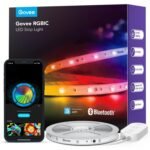
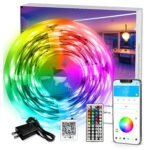
Excellent value for money given the feature set at an exceptionally low price.
Price vs. rivals
Cheaper
CheaperTypicalPricier
This product is priced far below typical alternatives of similar length and features, positioning it as a budget-friendly option.
Ease of use
Excellent 85/100
The app control and remote make it easy to operate, though initial setup may require some patience.
Overview
It’s a 100-foot roll of color‑changing LEDs with a music‑sync mode, an app, and a remote—all for ten bucks. The KSIPZE LED Strip Lights review you’re reading walks through exactly where that low price buys you genuine fun and where it asks you to compromise. If you want bedroom bias lighting that responds to your playlist without spending more than lunch money, this roll is worth the gamble. It’s not for someone who needs perfect color accuracy or pro‑grade adhesive.
Who’s it really for? The person who wants a quick, cheap mood shift in a dorm room, behind a TV, or under kitchen cabinets. The app works, the remote works, and the tape sticks to clean surfaces—most of the time. You won’t mistake it for a $50 Philips Hue setup, but you also won’t cry if a segment accidentally gets snagged.
Key Features
100-foot length in one reel – That’s enough to run two 50‑foot strips side by side, or wrap a large room. Most budget strips stop at 32 feet, so this gives you serious coverage for the price.
RGB music sync via built‑in microphone – The strip listens to ambient sound and shifts colors in rough time to bass hits. It’s not studio‑accurate, but it’s a crowd‑pleaser for parties or late‑night listening.
Smart app control (plus a physical remote) – The free KSIPZE app lets you pick colors, adjust brightness, set timers, and choose modes. The remote gives you quick access to static colors and a few animations without pulling out your phone.
Cuttable and reconnectable every 3 LEDs – You can trim the strip to exact lengths. The copper pads at each cut point let you solder or use connectors if you’re handy, or just stop where you cut.
Self‑adhesive backing – A 3M‑style tape runs the length of the strip. It sticks well to dry, smooth surfaces like painted drywall, plastic, or metal. Rough textures (brick, textured wallpaper) will make it peel quickly.
Low power draw (12V DC, 2A adapter included) – You can plug it into a standard wall outlet. The whole 100‑foot strip uses about 24 watts at full brightness—cheap to run, barely warm to the touch.
Fit for You
You’re in a rental and can’t install permanent fixtures, but you want colored light behind your bed frame or desk.
You host small get‑togethers and want the music to literally “paint the room” without buying a smart lighting system.
You have a TV or monitor on a dark wall and want an inexpensive bias light to reduce eye strain.
You need under‑cabinet lighting in a kitchen or workshop where color temp isn’t critical, but flexibility is.
You’re outfitting a child’s bedroom or game room with something that changes color on demand and won’t break the budget.
You like tinkering—cutting, soldering, extending—and want a cheap source of addressable‑ish LEDs to play with.
Uses
You’re binge‑watching a show in your bedroom, and you want a soft purple glow behind the headboard. Stick the strip there, tap the remote to violet, and you’ve got a cozy halo for about a dollar’s worth of electricity per month.
At a small party, someone shouts “make it go to the beat.” You launch the app, hit the music mode button, and the strip starts bouncing from red to blue on every kick drum. It’s not perfect—it reacts to overall volume, not frequency—but nobody notices after the second song.
Need a nightlight for a hallway that’s too bright for a lamp? Set a timer in the app to turn on at 9 PM at 10% brightness in warm white. The strip runs the whole length of a stair riser without a single dark spot.
Experience
Unboxing: a tangle‑prone 100‑foot roll, a 2‑amp power brick, a thin remote (battery included), and a tiny manual. First job is untangling without fighting it. Expect to spend 10–15 minutes laying it out flat on the floor before installation.
Sticking it to a clean wall works—if you press firmly along the whole strip. Owners report that the tape holds well for months on smooth surfaces but can let go on textured paint within days. You’ll want to clean the surface with alcohol first. If you’re installing on a TV back, consider using extra clips or zip ties for insurance.
The app is basic but functional. You pick a color from a wheel, adjust brightness with a slider, and choose between modes (fade, flash, strobe, music). It remembers your last setting. The remote has 20 static color buttons and a few animated presets—no learning curve.
Music sync: the microphone on the controller picks up noise from the room. It works best if the controller is near a speaker. At low volumes, the response is weak; at moderate volume, it’s fun and lively. Don’t expect it to follow a complex track note‑for‑note.
One annoyance: the strip isn’t addressable per segment. The whole 100‑foot run shows the same color at the same time. That matters if you wanted rainbow waves—you won’t get them. You only get single‑color or simple animation across the whole length.
Cutting is easy—snip at the marked line every three LEDs. But if you cut the wrong spot, you lose that segment permanently. Plan your layout before you cut. The copper pads at cut points are small; connecting two strips without soldering requires clip‑on connectors (not included).
Pros and Cons
Pros
Extreme value for the length – $9.98 for 100 feet of RGB strip is absurdly cheap. Even if it lasts a year, that’s less than a dollar per month of decoration.
Two control methods that actually work – The app connects reliably over Bluetooth (no Wi‑Fi), and the remote works from 30 feet away. No fiddling required.
Music sync adds party value – It’s not high‑fidelity, but it’s entertaining and makes the room feel alive during music or movies.
Easy to cut and customize length – You can trim to fit odd spaces, and each cut point has reuse potential if you plan ahead.
Low power consumption – Runs cool, safe on a standard circuit, and won’t shock your electricity bill.
Cons
Adhesive can fail on rough or dirty surfaces – Expect to buy extra double‑sided tape or mounting clips if your wall isn’t perfectly smooth.
No Wi‑Fi or smart home integration – The app is Bluetooth only, so you can’t control it with Alexa or Google Home. You have to be within Bluetooth range.
Non‑addressable design limits animations – The whole strip behaves as one unit. No chasing lights, no gradient across the room—just one color at a time.
Music sync is volume‑based and a bit laggy – Quiet sections get missed, and there’s a half‑second delay. Fine for background mood, not for live performance.
Controller box can be bulky – The small plastic box with the microphone and IR receiver sits inline and may be awkward to hide behind furniture.
No warranty or support to speak of – At this price, you’re mostly on your own if a segment dies or the controller fails. Many users report months of fine operation, but it’s a gamble.
Advantages
When you compare it to the bigger names, the KSIPZE LED strip lights hold their own in a couple of specific ways. The 100‑foot length for under ten dollars is nearly half the price of a comparable Govee strip that’s only 65 feet. That’s the headline. For a bedroom where you just want a colorful glow, the KSIPZE does the job for less.
Price per foot – About 10 cents per foot. Govee’s budget strips run closer to 15‑20 cents per foot. You’re getting raw length on a shoestring.
Two included control options – Many ultra‑cheap strips give you a remote only. Here you also get a full app with custom colors, timers, and music sync.
Cut‑and‑reconnect flexibility – The 3‑LED segmented design is standard, but the copper pads are well‑placed. It’s easier to work with than some no‑name rolls that melt under a soldering iron.
Music sync that works out of the box – Unlike some super‑budget strips that claim music sync but only flash randomly, this one actually follows the beat decently at moderate volume.
Who Should Buy
Buy it if you want the most affordable way to add color‑changing light to a large area—behind a bed, along a ceiling cove, under a desk, or around a window frame.
Buy it if you’re a renter or student who wants to customize a room temporarily without drilling holes or spending on permanent fixtures.
Buy it if you’re okay with Bluetooth-only control and don’t need voice commands or away‑from‑home scheduling.
Skip it if you need Wi‑Fi, Alexa, or HomeKit integration. Look at Govee or Philips Hue instead—they cost more but offer proper smart home linking.
Skip it if you expect long‑term reliability in a permanent installation. The adhesive and controller may not survive multiple re‑stickings or years of daily use.
Skip it if you want addressable animations like chasing lights or gradient effects. The KSIPZE strip is single‑zone only.
FAQ
Is the KSIPZE LED Strip Lights worth it?
Yes, for the money. You get 100 feet of RGB lighting with app control, a remote, and music sync for under $10. If you’re after a cheap way to add color to a bedroom or party space, it’s a no‑brainer. Just don’t expect premium build or smart home features.
How long does the KSIPZE LED strip last?
Typical LED lifespan is 20,000–30,000 hours, which translates to years of nightly use. The adhesive and the controller are more likely to fail first. Owners report good results for 6–12 months; after that, occasional segment failure is common in very cheap strips.
Can you connect multiple KSIPZE strips together?
You can, but not easily. Each strip comes with its own controller. To connect two strips into one continuous run, you’d need to solder or use a clip‑on connector at the cut points. The power draw may also exceed the included adapter if you daisy‑chain more than 100 feet.
Does the KSIPZE strip work with Alexa or Google Home?
No. The app uses Bluetooth only, so there’s no native integration with any voice assistant or smart home hub. You can pair it with a smart plug to turn power on/off by voice, but you lose color and mode controls that way.
Is it safe to leave on all night?
Yes. The 12V DC adapter is low‑voltage and the strip runs cool. You can safely leave it on for hours. The main risk is the adhesive weakening over time and the strip falling, but the LED itself won’t overheat in a well‑ventilated space.
How does KSIPZE compare to Govee LED strip lights?
Govee offers more reliable adhesive, Wi‑Fi models, and addressable options, but at roughly double the price per foot. For a basic bedroom setup, the KSIPZE gives you similar core features (RGB, music sync, app control) for less money. If you need smart home integration or color‑chasing effects, Govee wins.
Final Verdict
Let’s be honest: the KSIPZE LED Strip Lights are a cheap thrill. They’re not built to outlast a premium strip, and the single‑zone design limits what you can do with them. But if you want to light up a 100‑foot perimeter of your bedroom for the price of a fast‑food meal, they deliver exactly that. The app works, the remote works, the music sync is fun, and the tape holds—at least on a clean, smooth surface. Just keep your expectations in check: this is the “two‑star hotel” of LED strips—fine for a night, not for a lifetime.
If that sounds like the kind of low‑risk, high‑fun gamble you’re up for, grab a roll. You’ll almost certainly be satisfied for the first few months, and even if a segment dies after a year, you’re out less than a dinner tab. That’s a deal.
KSIPZE LED Strip Lights vs the Competition in 2026
The KSIPZE 100ft set hit the shelves priced at just under ten bucks—a handful of dollars less than a takeout lunch. That price puts it in the “buy it on a whim” territory, but it also means it’s competing against brands that have spent years refining their apps, their adhesives, and their music-sync algorithms. Govee, Philips Hue, and LIFX all have real engineering behind their strips. The KSIPZE isn’t trying to beat them on polish; it’s trying to beat them on “can I light up three rooms for the cost of one Hue starter kit.” And for a lot of people, that’s exactly the right trade-off.
Product
Price Range
Key Strength
Key Weakness
Best For
KSIPZE 100ft LED Strip Lights
Under $15
Incredible length-to-price ratio; decent color range for the money
App feels laggy; music sync is more “rhythm guesser” than precision
Solid app with good automation and smooth music sync
Adhesive can fail on textured walls after a few months
Anyone who wants reliable smart integration without breaking $40
Philips Hue Play Gradient Strip (1m)
$70+
Impeccable build; true gradient diffusion; works with Hue ecosystem
Massively expensive per foot; requires Hue Bridge for full features
Home theater enthusiasts who already own Hue; permanent installs
LIFX Z Strip (1m sections)
$50–$60 for starter kit
Wi-Fi direct (no hub); rich colors; reliable zones
Short lengths; price adds up fast; occasional Wi-Fi dropouts
Hater-of-hubs who want strong colors and don’t need huge coverage
KSIPZE LED Strip Lights vs Govee DreamColor H6159
This is the direct battle of “cheap and cheerful” versus “slightly-less-cheap and far more polished.” Govee’s DreamColor H6159 runs about two to three times the KSIPZE’s price, but you get an app that doesn’t hang for ten seconds every time you open it. The music sync on Govee actually follows beats—low drums, hi-hats, the works. KSIPZE’s sync is more like “saw light flicker vaguely in time with noise.” It works if you’re playing EDM at a party and you just want something colorful going, but it won’t impress someone who’s seen a proper sound-reactive strip. Where KSIPZE wins back ground is raw coverage. You get 100 feet of LED for half the price of a single 10-foot Govee set. If you’re lighting a whole bedroom perimeter plus behind a desk plus inside a closet, KSIPZE gets the job done for $10. The adhesive is fine on smooth painted walls; on old textured drywall, it will peel in three months without extra clips. That’s the trade-off.
KSIPZE LED Strip Lights vs Philips Hue Play Gradient Strip
Comparing a $10 strip to Philips Hue is almost unfair—in both directions. Hue’s Play Gradient strip costs more per inch than some people spend on lunch for a week, but the light quality is a different universe. It’s true gradient: colors blend smoothly from one to another, no visible LED dots even at close range. The build is heavy, the adhesive is industrial, and if you already have a Hue Bridge (another $60), it syncs with your movies and games via the Hue Sync Box. KSIPZE can’t do any of that. The LEDs are individually addressable in theory, but in practice the zones are lumpy and the connector headers are fragile. That said: if you’re renting an apartment and just want a warm colorful glow while you watch Netflix in bed, Philips Hue is insane overkill. KSIPZE will throw enough pastel purple and orange around to give you the mood without the mortgage.
KSIPZE LED Strip Lights vs LIFX Z Strip
LIFX sidesteps the hub problem by running straight over Wi-Fi, which sounds great until you have ten devices fighting your router’s 2.4GHz band. The Z Strip’s colors are genuinely vibrant—better than KSIPZE’s by a clear margin, especially deep greens and blues that often wash out on cheap strips. But LIFX starts you with a miserly 1-meter section. To match KSIPZE’s 100 feet, you’d spend over $500. That’s a different budget bracket entirely. So if you only need a small accent strip behind a monitor and you want the best Wi-Fi integration without extra hardware, LIFX is the pick. If you need to outline an entire living room ceiling on a student budget, KSIPZE is the obvious answer. The build quality gap shows in the connectors: LIFX uses robust clip-locks, while KSIZE relies on the same little snap-in pins that crack if you breathe on them wrong. Plan ahead and be gentle.
So Who Should Buy the KSIPZE LED Strip Lights?
Pick the KSIPZE if your main constraint is money and your main need is coverage. It’s the best LED strip lights for bedroom lighting when you want a whole-room glow for under ten dollars and you don’t mind a so-so app and a music sync that’s more party trick than serious tool. Skip it if you’re building a permanent setup, if you need precise color zones for content creation, or if you plan to stick it to rough textured walls without ordering mounting clips separately. In those cases, spend the extra $15 on the Govee DreamColor H6159—it’ll last longer, sync better, and save you the future argument with your roommate over why the strip fell down again.
Ready to decide on the KSIPZE LED Strip Lights?
See today’s price, stock and delivery options on Amazon.