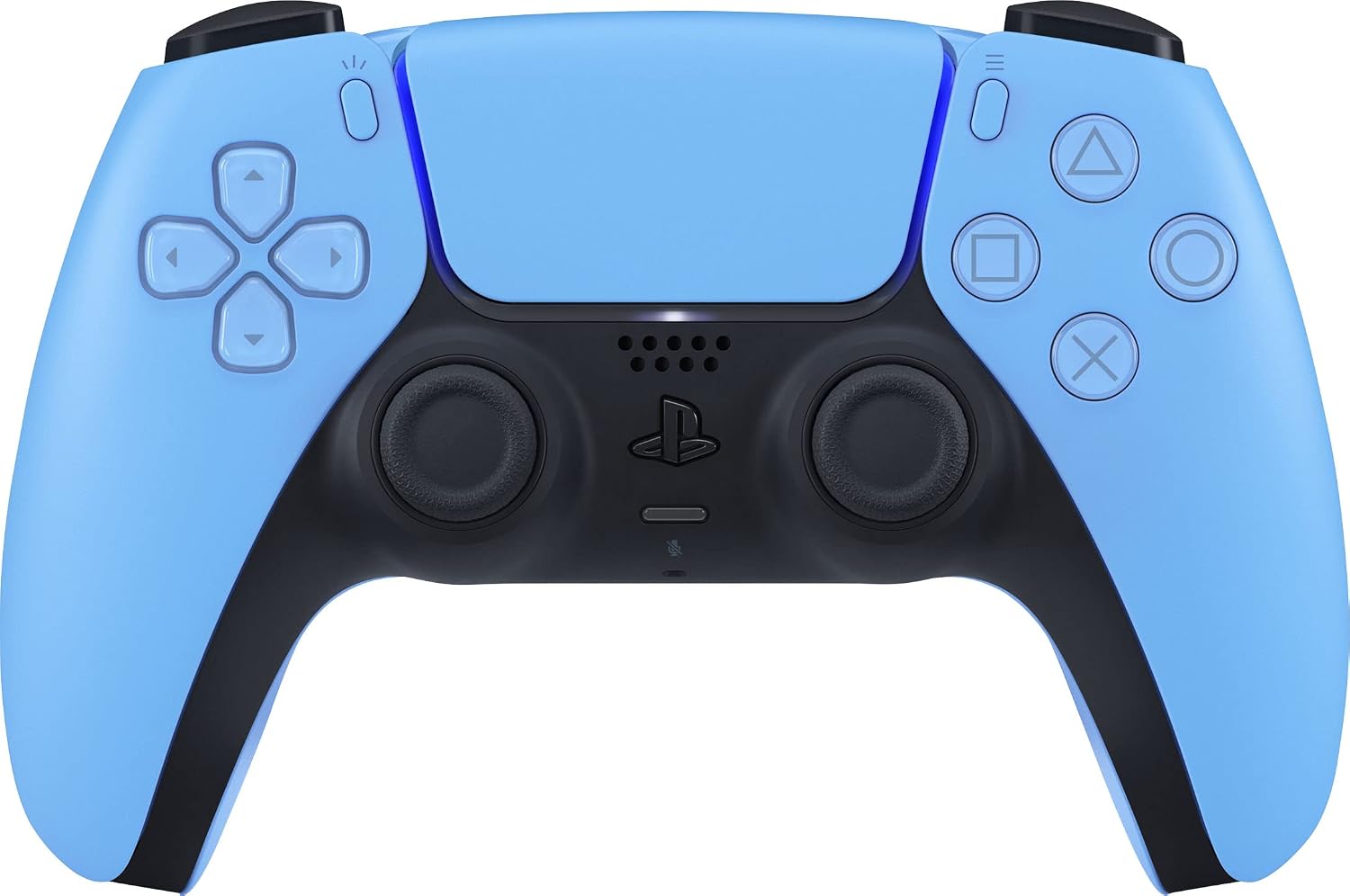
If you’re looking for a straightforward Sony DualSense Controller review, here’s the short answer: yes, it’s worth buying, especially this renewed Starlight Blue model for $61. It brings genuinely new tech to your hands—adaptive triggers and haptic feedback that change how games feel. Just know the battery life is merely okay.
Renewed DualSense offers near-new performance and features at a discounted price, balancing reliability with affordability.
Price vs. rivals
Typical
CheaperTypicalPricier
This renewed controller is priced near the upper end of typical renewed options, positioning it closer to the cost of a new unit.
Ease of use
Excellent 90/100
The DualSense controller's ergonomic design and responsive features make it intuitive for most users, though non-gamers might need a brief adjustment period.
Overview
The DualSense replaces the DualShock 4. It solves the problem of controllers feeling numb or generic. Instead of a simple rumbling motor, it gives you nuanced feedback that reacts to the game world. You feel tension in the triggers when drawing a bow, or the texture of gravel under a car’s tires. It’s for anyone who owns a PS5, obviously. But it’s also a surprisingly solid PC controller, as long as you’re okay with plugging it in for the full experience. The “Renewed” label means it’s a returned or pre-owned unit that has been inspected and tested. At $61, it’s a solid discount off the $70 retail price.
Key Features
Adaptive Triggers – The L2 and R2 buttons can resist your pull. In Returnal, it’s a two-stage trigger for firing and aiming. In Gran Turismo 7, you feel the brakes lock up or the tires slip on wet pavement.
Haptic Feedback – Instead of a spinning weight, this uses voice-coil actuators. You can feel individual raindrops in Ghost of Tsushima or the crunch of snow in God of War.
Built-in Microphone – Good for quick chat without a headset. Everyone will hear your controller clicks and ambient noise, though, so it’s not ideal for serious sessions.
Create Button – Replaces the old Share button. Lets you snap clips or screenshots instantly without leaving the action.
USB-C Charging – Charges faster than the old micro-USB standard. You can also use it wired on a PC with zero driver setup.
Familiar Layout – Symmetrical stick placement like the DualShock 4. If you’re used to PlayStation, it’ll feel like home immediately.
Fit for You
You play Call of Duty or Apex Legends and want to feel the distinct recoil pattern of each weapon through your palms.
You’re a racing fan who wants to feel curb rumbles and tire grip loss through the triggers.
You broke your old DualSense and need a reliable replacement without paying full retail price.
You play PC games but prefer the PlayStation symmetrical stick layout over the Xbox offset design.
You want a controller that actually surprises you with how it makes games feel different.
Uses
In competitive shooters, the haptics can genuinely help your awareness. You hear and feel footsteps more distinctly than standard rumble provides. The precise feedback lets you know exactly when your magazine is empty or your ability is off cooldown. For racers, it’s night and day. The adaptive triggers simulate brake pressure and throttle resistance. You’ll find yourself braking earlier and smoother because your finger can feel the limit. On PC, it works wirelessly via Bluetooth, but you miss the haptic feedback and adaptive triggers unless you plug in via USB-C. Cyberpunk 2077 and Metro Exodus support the triggers on PC, which adds a layer of immersion the Xbox controller simply can’t match. Platformers and action games benefit too. The gyro is responsive for aiming in games like Death Stranding or The Last of Us Part I. It’s precise enough that some competitive players use it for fine-tuning aim.
Experience
Living with the DualSense is mostly great, with one obvious asterisk. Setup on PS5 takes seconds. Pair it and go. On PC, it’s plug-and-play for basic functions. For the full suite of haptic feedback and adaptive triggers in supported games, you’ll want a wired USB-C connection. The port is a relief—charges reliably and doesn’t wiggle loose. The biggest annoyance is the battery. A full charge gives you about 6 to 10 hours of play, depending on how heavy the haptics are. If a game uses the adaptive triggers constantly, you’ll be charging every other session. The speaker is a fun gimmick, but the cheap-sounding audio makes you turn it off eventually. The textured grips feel nice when new. Owners tend to mention they can smooth out after a year or two of heavy use. Keep it clean and don’t eat chips while gaming and it’ll hold up fine.
Pros and Cons
Pros
Haptic feedback is a genuine leap forward. It’s not just a stronger buzz. You feel texture, resistance, and direction in ways that matter for immersion.
Adaptive triggers are excellent when implemented. Racing games and shooters get a huge boost in realism and feedback.
USB-C charging. It’s faster and more convenient than the old micro-USB standard.
Comfortable for long sessions. It’s heavier than an Xbox controller, but the weight is balanced across your hands.
Renewed value is solid. At $61, you get a fully functional, inspected unit for less than retail.
Cons
Battery life is mediocre. Expect to charge it every day or two if you play regularly. The Xbox Wireless Controller lasts much longer on AAs.
Built-in mic is a compromise. Fine for quick voice chat, but audio quality is thin and it picks up every button press.
PC support is inconsistent. Not every game supports haptics or triggers natively. You’ll sometimes just get standard rumble.
Textured grips can wear down. The rubber texture smooths out over time with heavy use.
No internal battery pack included. Unlike the Xbox controller, you can’t swap batteries. Once it’s dead, it needs to charge.
Advantages
Let’s talk Sony DualSense vs Xbox Wireless Controller. The Xbox controller has better battery life (AA batteries last forever) and more consistent PC support. But the DualSense offers haptic feedback and adaptive triggers that the Xbox simply cannot replicate. If you value immersion and play PS5 exclusives, the DualSense wins easily. The Xbox controller feels a generation behind in terms of feedback technology. For the “best PS5 controller for competitive gaming”, the DualSense is the obvious choice. It’s the standard for a reason. Third-party pro controllers like the Scuf Reflex or the Victrix Pro BFG are options, but they cost significantly more and don’t always include the haptic features that make the DualSense special. The “Sony DualSense controller quality” is high overall. The build feels solid in hand. The triggers have metal springs that hold up well. The thumbsticks are the usual wear item, but that’s true of every controller on the market.
Who Should Buy
PS5 owners who want the full intended experience. You’re leaving immersion on the table with any other controller.
PC gamers who play supported titles. If you play Cyberpunk, Death Stranding, or Metro Exodus, this is the best way to play them.
Anyone looking for a reliable backup or replacement controller. The renewed price makes it easy to have a spare for multiplayer.
Skip this if you’re strictly an Xbox or Nintendo Switch player. Support there is limited to basic functions and third-party adapters are clunky.
Skip this if battery life is your top priority. The Xbox Wireless Controller or a third-party pro controller with swappable batteries will serve you better.
FAQ
Is the Sony DualSense Controller worth it?
For PS5 owners or PC players who want the most immersive controller on the market today, absolutely. It’s a meaningful upgrade over the DualShock 4. The renewed version makes that value even better at $61.
How long does the DualSense battery last?
Typically 6 to 12 hours depending on the game’s use of haptic feedback and adaptive triggers. Heavy use of these features drains it faster. Expect to charge every couple of sessions.
Is the DualSense good for PC gaming?
Yes, but with caveats. Basic functions work wirelessly via Bluetooth. For haptic feedback and adaptive triggers, you need a wired USB-C connection and a game that supports the features natively.
Is the DualSense controller durable?
Generally yes, but the thumbstick rubber can wear down over time. The adaptive triggers are sturdy, but dust and heavy use can sometimes cause stickiness or drift in the sticks.
Can you use DualSense on Xbox?
Not natively. You would need a third-party adapter like the Brook Wingman, and even then, features like haptic feedback and adaptive triggers won’t work. It’s not a practical solution.
What is the difference between DualSense and DualShock 4?
The DualSense has adaptive triggers, advanced haptic feedback, a built-in microphone, USB-C charging, and a larger, heavier design. It’s a significant upgrade in terms of technology and immersion.
Final Verdict
The DualSense is the best controller Sony has ever made, and it’s a big reason the PS5 feels truly next-gen. The haptic feedback and adaptive triggers are more than gimmicks—they genuinely change how a game feels in your hands. The battery is a real shortcoming, and the built-in mic is only for emergencies. For $61, this renewed Starlight Blue model is a solid buy. You get the most immersive controller available for a decent discount. Just keep a USB-C cable nearby and you’ll be set.
Sony DualSense Controller vs the Competition in 2026
The renewed Sony DualSense Controller lands at $61, putting it squarely between the bargain bin and the premium tier. It’s a refurbished take on Sony’s flagship PS5 pad, which means you get the adaptive triggers and haptic feedback for less than what a new one costs. But it also means you’re buying someone else’s hand-me-down, with all the quirks that brings. For a controller that normally retails around $70 new, the savings are modest—not a steal, but enough to make you pause. The bigger question is whether you should even be looking at a DualSense at all, or if something else fits your gaming style better.
Product
Price Range
Key Strength
Key Weakness
Best For
Sony DualSense (Renewed)
~$61
Adaptive triggers and haptics at a discount
Used condition; no official warranty; possible stick drift
PS5 owners who want Sony’s signature features on a budget
Sony DualSense (New)
~$70
Full warranty, pristine condition, same core experience
Only $9 more for peace of mind
Anyone who values a fresh, unboxed product
Xbox Wireless Controller
~$60 (new)
Ergonomic shape, better battery life, works on PC/Xbox natively
No adaptive triggers or haptic feedback; needs adapter for PS5
Cross-platform players who game mostly on Xbox or PC
Expensive; same battery life as standard DualSense
Competitive PS5 players who need customization and repairability
Sony DualSense vs Xbox Wireless Controller: The Feature Gap
If you mostly play on a PS5, the Xbox Wireless Controller is a non-starter unless you’re willing to buy a third-party adapter and accept that the adaptive triggers won’t work at all. But if you split time between a PC, Xbox, and maybe a PS5, the Xbox pad is the better daily driver. Its rubberized grip handles sweat better, the A/B/X/Y buttons are quieter, and the battery lasts roughly twice as long as the DualSense’s 6–8 hours. The DualSense adaptive triggers review usually gushes over the tension in Returnal or the gravel crunch in Astro’s Playroom, and those do feel genuinely new. But once the novelty fades—say, in a multiplayer shooter where you just want consistent pull—you might find the Xbox controller’s simpler triggers more predictable. For competitive gaming, the Xbox Wireless Controller is a solid alternative, especially if you’re used to its offset thumbsticks. The renewed DualSense doesn’t win that fight.
Sony DualSense vs DualSense Edge: Is the Pro Worth the Premium?
The Edge is more than triple the price of this renewed unit, and for that you get swappable stick modules (so drift becomes a $20 fix instead of a $70 one), two back paddles, and the same adaptive triggers and haptics. If you’re a player who wears out sticks fast—say, you play a lot of Call of Duty or Apex Legends—the Edge’s repairability is its killer feature. The renewed DualSense, by contrast, carries the same stick drift risk as any used controller. On the plus side, the renewed unit weighs less (since it lacks the Edge’s metal frame) and the battery is identical, so you aren’t losing anything there. For casual or single-player gaming, the renewed model gives you the same adaptive triggers experience for a third of the cost. For those asking “is DualSense controller worth buying” for competitive play, the answer is yes only if you aren’t hard on your sticks. Otherwise, the Edge is the better long-term bet.
Renewed vs New DualSense: The $9 Question
Here’s the awkward part: a brand-new standard DualSense often goes for $70, and $61 for a renewed one saves you just $9. That’s hardly a bargain. The renewed unit is supposed to be tested and cleaned, but you’re still getting a controller that’s been handled, possibly dropped, and had its battery cycled dozens of times. The Sony DualSense controller quality out of the box is excellent—the haptics are precise, the triggers resist smoothly—but a refurbished unit might show wear on the thumbstick rubber or have a slightly looser trigger spring. On the other hand, if you find a renewed unit for, say, $45 during a sale, that changes the math. At $61, the “renewed PS5 controller review” boils down to this: you’re trading a little risk for a small discount. If the money matters enough that $9 is the difference between eating lunch and not, grab the renewed one. Otherwise, buy new and skip the uncertainty.
Who should pick the Sony DualSense Controller (Renewed)? If you’re a PS5 owner who wants the adaptive triggers and haptic feedback but can’t stomach the full retail price, and you’re comfortable rolling the dice on a used device that may have some cosmetic scuffs or a battery that’s not at 100% capacity—then yes, this is your controller. But if you play primarily on PC or Xbox, or if you rely on back paddles for competitive shooters, pass on this and grab the Xbox Wireless Controller instead. And if you’re a stick-drifter with sweaty thumbs, save up for the DualSense Edge. $61 is no steal, but it’s a fair price for a feature set that still has no equal at that price point.
Ready to decide on the Sony DualSense Controller?
See today’s price, stock and delivery options on Amazon.