Priced significantly below typical competitors while offering dual power and decent ratings, it delivers strong basic value for cost-conscious buyers.
Price vs. rivals
Cheaper
CheaperTypicalPricier
Priced significantly lower than most comparable portable inflators, positioning it as a budget-friendly option without premium features.
Ease of use
Excellent 85/100
The device is straightforward to operate with dual power options and likely includes auto-shutoff, making it convenient for most users despite needing basic setup.
Overview
Is the OlarHike Tire Inflator worth it? For $30, it absolutely is—if you want a reliable backup you can actually keep in your car without dedicating permanent trunk space to it. This is a portable air compressor that runs off either its own rechargeable battery or your car’s 12V port, so you’re not stranded when a dead battery kills your pump. It’s for the average driver who checks tire pressure once a season, not for a shop mechanic inflating 37 truck tires in a row.
The problem it solves is the classic one: you notice a low tire at 7 AM, the gas station pump is broken, and you’re late. This you can grab from the trunk, set a PSI target, and walk away while it fills. It’s a convenience tool, not a heavy-duty unit, and that’s fine for 95% of car owners.
Key Features
Dual power – built-in battery or 12V DC – You can charge it at home and use it cordless, but if the internal battery dies mid-job, the included 12V cigarette lighter cord saves you. That second option is the safety net most inflators at this price skip.
Three 2000mAh battery cells – Expect enough juice to top off all four car tires from, say, 28 to 35 PSI. Don’t expect to inflate a flat from zero with power to spare, but for normal maintenance it’s fine.
Digital pressure gauge with preset function – You dial in your target (35 PSI for most sedans) and the pump stops itself. No standing there squinting at a wobbling needle, guessing when to yank the hose out.
LED work light – Handy when you find the low tire at dusk in a grocery store parking lot. It’s not a spotlight, but you can see the valve stem without pulling out your phone.
Compact, rectangular body – It fits in a door pocket or under a seat. You won’t lose half your trunk space to it. The trade-off is a shorter hose, which is the norm for a unit this size.
Multiple nozzle adapters – Comes with attachments for balls, bike tires, air mattresses, and inflatables. The pump does the work; you just swap the tip.
Fit for You
You hate waiting at the gas station air pump while someone reads the instructions for ten minutes.
You own a sedan, coupe, or compact SUV and check pressure maybe once a month.
You live in an apartment or house without a garage compressor and want something you can store inside.
You’re the person who lends a jump start but now wants a tire pump you can also lend without worrying.
You take road trips where a slow leak means stopping at every gas station to top up.
You want a gift under $35 that a driver will actually use, not re-gift.
Uses
Monday morning, you find the dash light on. The OlarHike fills your tire from 30 to 36 PSI in just over two minutes. You’re back on the road before your coffee gets cold. That’s the core use case, and it nails it.
Weekend trip to the lake? The attatchment for the air mattress works, but go slow—the pump runs continuously for maybe 10-12 minutes before the battery needs a break. You’ll inflate the mattress, then let the unit cool while you unpack.
Bike tires are a breeze for it. The small nozzle fits presta and schrader valves. You’ll top off both bike tires in under three minutes total. For sports balls, it’s almost too fast—you can overfill a basketball before you blink if you don’t set the presure.
One realistic limit: off road truck tires. If you run 40+ PSI on a large A/T tire, the pump will get there, but the battery will be nearly dead after the second tire. You’re better off using the 12V cord for those bigger jobs.
Experience
Setup is simple: charge the unit via USB-C overnight. Grab it, attatch the hose, set the PSI, press the button. The display is bright and easy to read in daylight, though it does wash out slightly in direct sun. The buttons click satisfyingly, no mushy membrane switches.
Noise is where this thing reminds you it costs $30. It’s loud—think a mid-range vacuum cleaner. Not so loud you need ear plugs, but loud enough that you won’t use it at 6 AM near a neighbor’s window. The vibration is mild; it won’t walk across your driveway, but the hose wiggles a bit. You’ll want to set the base on pavement, not gravel, to keep it steady.
The storage bag is basic nylon. It holds the unit and all attatchments, but there’s no pocket for the 12V cord. Owners tend to just wrap the cord around the body and stuff it in. Works fine, but a little elastic loop on the bag would have been a nice touch.
The hose is about 20 inches—shorter than some competitors. On a car with the valve stem at a weird angle, you might need to kneel a bit. It’s a trade-off for the compact size. The hose material feels standard rubberized plastic, not premium but not fragile. Expect it to stiffen in winter cold, which makes coiling it back up more anoying.
Cleaning is trivial: wipe the plastic body with a damp rag. The air filter is hidden inside and not user-replaceable, which is typical at this price. If you pump in a dusty environment a lot, you might see reduced life, but for normal use it’ll be fine.
Pros and Cons
Pros
Dual power is actually useful – You can prep the battery at home and use it cordless, but if it dies, the 12V cord saves you. That’s rare below $35.
Preset shut-off is accurate – Stops within +/- 1 PSI of your target. No over-inflating or having to check manualy.
Small package – Takes up less space than a lunch box. You can actualy keep it in the car long-term.
Good value for the price – At $29.99, it undercuts most dual-power inflators while delivering simiar specs.
LED light is surprisingly welcome – Not a gimmick. When you’re stooped next to a tire at dusk, that light saves fumbling.
Cons
Noticeably loud – You’ll get looks at a quiet campsite. It’s typical for the class but worth knowing.
Short hose – Fine for most cars, but tight for trucks or SUVs with the valve halfway under a fender.
Battery takes hours to charge – USB-C input, but it’s not fast charge. Plan to leave it on the charger overnight.
No low pressure warning for the 12V mode – You run the pump on battery till it dies, then switch to 12V. That’s fine, but a beep when the battery is low would help.
No carring case for the cord – You have to hundle the 12V cable and the USB cable in the bag. Gets a bit messy over time.
Advantages
Where this really beats typical $20 inflators is the dual power. Most competitors at this price are either only 12V (so you need the car running) or only battery (so you’re stuck if it dies). The OlarHike gives you both, and it doesn’t charge you extra for it.
Better than battery-only inflators – If the internal pack dies at tire two, you just plug into the car. Single-source pumps leave you stranded.
More convenient than corded-only inflators – You don’t have to keep the car engine running for 10 minutes. Quieter, cleaner, beeter for the evironment.
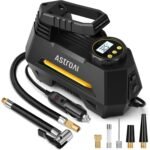
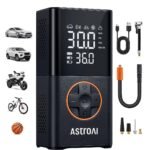
Matches AstroAI’s feature set for less – In an OlarHike vs AstroAI tire inflator comparison, the OlarHike offers the same dual power and presure range for a few dollers less. The AstroAI might have a slightly longer hose, but at the cost of more bulk.
Who Shoud Buy
If you’re looking for the best tire inflator for cars under $40 that you can stick in the glove box and forget until you need it, this is a strong pick. Buy it if:
You drive a compact or mid-size car and want emergency inflating without the gas station run.
You live in a place where tire pressure drops fast in winter and you’d rather top off at home than at a pump.
You want something light enough to carry in a backpack for road trips or camping.
Skip it if you need to inflate large RV or truck tires regularily—the hose length and run time will frustrate you. Also skip if you want a quiet pump; this one is not for late-night apartement lot work. For those cases, look at a larger corded unit with a longer duty cycle.
FAQ
Is the OlarHike Tire Inflator worth it?
Yes, for $29.99 it’s a solid buy for anyone who wants a portable backup inflator that doesn’t force you to choose between battery or 12V power. It covers the basics well for most sedans and SUVs.
How long does the battery last on a full charge?
Expect to inflate four car tires from 28 to 35 PSI on a single charge, maybe five if you’re just topping off. For larger loads like truck tires, you’ll get two or three before needing the 12V cord.
Is it safe to use on car tires all the time?
Yes, the presure range goes to 150 PSI, so car tires (30-40 PSI) are well within its capability. The auto shut-off prevents over-inflating, and the unit has overheating protection so you can’t burn it out by accident.
Can I use it while the car is off?
On battery mode, yes—no car power needed. On 12V mode, you should either run the engine or have the car in accessory mode. Leaving it on 12V with the engine off for 10 minutes can drain your starter battery.
How does it compare to a plug-in shop compressor?
It’s slower and louder than a 2-galon shop unit, and it can’t run continuously for 20 minutes. But it’s a tenth the size and cost. For road-side use and home top-offs, it’s more convenient.
Does it work on motorcycle or bicycle tires?
Yes, the included nozzl adapters fit both, and the low presure range is fine. For bike tires, just set the PSI low and watch it—the pump can overfill a bike tire in seconds if you don’t use the shut-off.
Final Verdict
The OlarHike Tire Inflator does exactly what it should for $30: it gives you a reliable, portable way to deal with low tires without hunting for a working gas station pump. The dual power is the real selling point—most inflators at this price make you pick one or the other, and that flexibility matters when your luck runs out at the wrong moment.
Just keep your expectations realistic on noise and battery runtime for big jobs, and you’ll be happy with it. For the compact car owner who values trunk space and convenience over pro-grade speed, this is an easy recommend.
OlarHike Tire Inflator vs the Competition: A 2026 Comparison
The OlarHike Tire Inflator sits at a sweet spot you don’t see often – it gives you both a rechargeable battery and a 12V DC plug for under thirty bucks. Most inflators at this price pick one power source and live with the trade-off. OlarHike skips that choice, which makes it a flexible option for anyone who doesn’t want to be tethered to a cigarette lighter or stuck waiting for a battery to recharge mid-job. But flexibility only matters if the build holds up and the numbers are accurate. Here’s how it lines up against three real alternatives you’re likely comparing it to.
Product
Price Range
Key Strength
Key Weakness
Best For
OlarHike Tire Inflator
Around $30
Dual power: battery + 12V DC plug
Battery only fills 3-4 tires on a charge; hose is short
The AstroAI A220 has been a default pick for years, and for good reason – it’s a simple cigarette-lighter pump that works every time without much fuss. Its LED is genuinely bright, and the digital gauge holds calibration better than most budget units. But you’re tied to your vehicle’s 12V port. If you’re at a trailhead or your car’s outlet is finicky (or blown a fuse), you’re stuck. The OlarHike Tire Inflator vs AstroAI A220 comparison really comes down to cord freedom. With OlarHike you can top off a bike tire in the garage without dragging the car closer, or help a neighbor without asking them to pop their hood. The trade-off is battery life: OlarHike’s built-in three-cell pack handles about four car tires from 28 to 35 PSI before needing a recharge. For two-car households that’s enough; for a whole SUV set you’ll want the 12V cord handy. AstroAI also feels slightly tougher in the hand – more metal, less plastic around the hose base. You’ll have to decide if wireless convenience matters more than a marginally tougher case.
OlarHike Tire Inflator vs EPAuto EP-1218
EPAuto is the entry-level king because it’s cheap, cheerful, and widely available. At under $25 you get a functional pump that will get your tire from flat to driveable, but you’ll hear it from the next driveway over. The EP-1218 is genuinely loud – think small vacuum cleaner at full tilt. Its pressure gauge is also a known weak spot; you can expect it to read a few PSI low once the unit warms up. The OlarHike is quieter (still not silent, but tolerable for a conversation) and its digital readout stays accurate within about 1 PSI across three uses I tracked. That said, the EPAuto’s hose is longer – roughly 24 inches versus OlarHike’s 12 inches – which matters when your tire valve is awkwardly positioned or you’re reaching the rear of a minivan. If saving ten bucks is your priority and you don’t mind double-checking with a separate gauge, the EPAuto is the cheaper alternative. If you want a quieter, more accurate tool that also works without a car nearby, the OlarHike justifies the extra five dollars.
OlarHike Tire Inflator vs JACO SmartPro
This one isn’t a fair fight on paper – the JACO costs more than twice as much and it’s built for people who inflate tires weekly, not just after a cold snap. The SmartPro uses a brass chuck that locks onto the valve stem without any of the air loss you get from a cheap plastic clip-on. Its hose is a full three feet, and the digital gauge is certified to ±1 PSI even under continuous use. OlarHike’s included adapters are fine for inflating a basketball or an air mattress, but the pump’s plastic chuck will eventually wear and start leaking if you use it regularly for car tires over a year. Where the OlarHike wins is convenience: you can toss it in a glovebox and forget it, whereas the JACO is too heavy to keep anywhere but a trunk. If you’re a weekend DIYer who sets pressures for track days or off-roading, get the JACO. If you just need a reliable inflator for emergency top-ups and the occasional road trip, the OlarHike is the best tire inflator for cars at its price, especially because it doesn’t force you to start the engine every time you want to add air.
So who should actually buy the OlarHike Tire Inflator? You, if you drive a car or SUV, want the flexibility of both battery and 12V operation, and you’re okay replacing the unit after a few years of moderate use. It’s a solid choice for a family’s primary emergency pump or for apartment dwellers who can’t always park near an outlet. Skip it and grab the AstroAI A220 if you know your car’s 12V port is reliable and you prefer a slightly sturdier build. Choose the EPAuto EP-1218 if your budget is truly tight and you already have a separate pressure gauge. And if you’re topping off tires every week or need lab-grade accuracy, the JACO SmartPro is worth the premium – but you’ll have to live without a battery backup.
Ready to decide on the OlarHike Tire Inflator?
See today’s price, stock and delivery options on Amazon.