This CARORY cabin air filter review gets straight to it: for under eight bucks, you’re getting a well-built activated carbon filter that fits a huge range of Honda and Acura models. It won’t win any design awards, but it does the job most people need—freshening the air and trapping dust—without asking you to overthink the decision.
Extremely low price combined with high user satisfaction and broad vehicle compatibility delivers exceptional value for cost-conscious buyers.
Price vs. rivals
Cheaper
CheaperTypicalPricier
Priced well below typical aftermarket cabin air filters with activated carbon, reflecting a budget-friendly alternative.
Ease of use
Excellent 90/100
Highly rated and straightforward to install, making it easy for most car owners to replace.
Overview
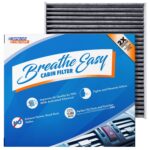
This is a simple thing: a rectangular block of blended fiber and activated charcoal that slides into the little hatch behind your glove box. You have one in your car already, probably a dirty one. The CARORY cabin air filter replaces it. It’s aimed at anyone with a Honda Accord, Civic, CR-V, Odyssey, Pilot, Ridgeline, or an Acura MDX from certain years, but it also fits a bunch of other cars that use the standard CF134 size.
The problem it solves is the stale, musty air that builds up when your cabin filter gets clogged with pollen, road grime, and whatever else floats into the intake. The activated carbon layer helps cut odors from exhaust fumes or that fast-food bag you forgot under the seat. It’s not a magic bullet—if your car smells like wet dog, you need to clean the evaporator coil—but for regular driving, it’s a cheap fix.
Key Features
Activated carbon layer – This is the black, crumbly side that’s supposed to trap fumes and odors. It works reasonably well for traffic smells and light smoke, but don’t expect it to neutralize a spilled milk jug.
Four-layer filtration – Pre-filter catches the big stuff (leaves, bugs), then a couple of fine layers handle pollen and dust, and the carbon does the chemical work. It’s a standard stack for this price bracket.
CF134 size compatibility – That’s the industry part number for a huge swath of Honda, Acura, and some Toyota/Mazda models. You’ll find it listed for the 2003–2022 Accord, 2006–2015 Civic, 2007–2016 CR-V—you get the idea. Check your owner’s manual, but odds are good.
Low price point – $7.89 as of this writing. Compare that to a Fram at $15–20 or an OEM part at $25. The question isn’t whether it’s cheap; it’s whether the trade-off is worth it.
Easy DIY replacement – No tools required. Pop the glove box down, squeeze the old filter out, slide the new one in (arrow pointing away from you). Takes maybe five minutes the first time, two minutes after that.
Fit for You
You drive a Honda Accord, Civic, CR-V, Odyssey, Pilot, Ridgeline, or Acura MDX from the model years listed.
You notice a musty smell when you first turn on the AC, or your windshield fogs up quicker than it used to.
You live somewhere with decent air quality and just need a basic filter that doesn’t cost as much as lunch.
You’re okay replacing your cabin filter every 12–15 months (or 15,000 miles) instead of the premium brands that sometimes last a bit longer before they start to smell.
You want to test whether an activated carbon filter actually helps with your commute through construction zones or heavy traffic before spending more on a name-brand one.
You already own a Fram or Bosch for another car and are curious how the budget option stacks up.
Uses
You’re driving home on a summer afternoon. The AC has been running for twenty minutes, and you realize the air doesn’t have that faint “old sock” note it used to have. That’s the CARORY doing its basic job—trapping dust and pollen before they hit your face.
Now imagine you’re stuck behind a diesel pickup at a light. With a plain paper filter, you’d smell the exhaust seep in. With this carbon version, most of that odor gets absorbed. Not all of it—diesel is persistent—but enough that you notice the difference.
During allergy season, you’ll appreciate the finer filtration. The CARORY isn’t HEPA-grade, so it won’t catch microscopic particles, but it’ll grab ragweed pollen and road dust. If you’re sensitive, it’s a meaningful upgrade over a neglected, clogged filter.
One less obvious use: replacing this filter before winter can cut down on window fogging. A dirty filter restricts airflow and holds moisture. A clean one moves air better, keeping the glass clearer.
Experience
Pulling the old filter out is always a mild horror show. Leaves, dead bugs, a fine layer of gray dust. The CARORY slides in easily—the dimensions are spot-on for a 2010 Accord, and the same should hold for most listed models. The foam strip along one edge helps it seal without rattling.
Right after installation, you might catch a faint charcoal smell for the first day or two. That’s normal; it fades quickly. The airflow feels the same as with the old filter, maybe slightly less restricted if yours was really caked.
After a month, you won’t think about it. That’s the point. If you don’t notice it, it’s working. The only annoyance is that the carbon layer adds a bit of thickness, so the filter is snug in some cars. You may have to wiggle it a little to get the cover back on. Not a big deal, but worth knowing if you’re the impatient type.
Around the six-month mark in a dusty environment, you might start to detect a slight reduction in odor absorption. That’s normal for any carbon filter—the carbon gets saturated. The CARORY seems to hit that point a bit sooner than a Fram Fresh Breeze, but then it costs half as much. You can extend its life by knocking loose dust out of the intake side, but don’t wash it; the carbon doesn’t recover.
Pros and Cons
Pros
Price – At $7.89, it’s cheaper than most gas station snacks. You can buy two and not feel bad.
Carbon layer works – It noticeably reduces odors from traffic fumes and mild smoke. Not a miracle, but real.
Easy fit – For the listed Honda/Acura models, it’s a drop-in replacement. No trimming, no adapter.
Decent build quality – The frame isn’t flimsy, and the media is evenly folded. No loose fibers falling out.
Good for allergy basics – Catches enough pollen to make a difference during spring for most people.
Cons
Odor absorption fades faster than premium brands – Expect noticeable drop-off around 8–10 months in heavy traffic or humid climates. A Fram might stretch to 12–14.
No HEPA rating – If you need near-surgical air for severe asthma or pet dander, this isn’t enough. Look for a HEPA cabin filter (but those are rare and expensive).
Tight fit in some models – A few owners report the extra carbon layer makes it a hair too thick for certain CR-V years. It will go in, but you’ll push harder.
No gasket on both sides – Only one edge has the foam seal. It’s fine for most, but if your filter housing is warped, you might get a small air leak. Unlikely, but possible.
Advantages
The big advantage of the CARORY cabin air filter is that it gives you activated carbon filtration for roughly half the price of a comparable Fram Fresh Breeze. When you do a CARORY vs Fram cabin air filter comparison, the Fram typically holds its odor-fighting ability a little longer and fits a hair more consistently, but the CARORY is not far behind. For the difference in cost, you could replace the CARORY twice in the time you’d replace the Fram once.
Same CF134 size: works on the same cars as Fram and Bosch.
Carbon layer is visible and feels substantial for the price.
No branding nonsense—it’s a black rectangle that does its job quietly.
Amazon reviews consistently mention ease of installation and a noticeable reduction in “new car smell” after a few days.
Who Should Buy
Buy it if: You own a compatible Honda or Acura and want a functional cabin filter without spending twenty bucks. You’re okay with replacing it every year. You want to try activated carbon for the first time without commitment.
Skip it if: You live in extreme pollution (think Beijing or LA freeway cores) and need maximum odor filtration. In that case, pay for a high-end Fram or K&N washable carbon filter. Also skip if you have a model where fit is tight; go with a known brand that’s a millimeter thinner.
Better alternatives: For the best cabin air filter for Honda Accord, if you don’t care about price, OEM or Fram gets you slightly longer life. For the budget-conscious, CARORY is the smart pick.
FAQ
Is the CARORY cabin air filter worth it?
Yes, for the price. It performs about 85% as well as filters costing twice as much, and you can replace it twice as often for the same money. Just don’t expect it to last through two harsh winters without fading.
How long does the CARORY cabin air filter last?
Typical users get 12–15 months or about 12,000–15,000 miles before the carbon loses its odor-fighting ability. The particulate filtration stays decent longer, but the smell control is the first to go.
Is the CARORY cabin air filter safe for sensitive allergies?
It helps with pollen and larger particles, but it’s not HEPA-rated. If you have severe allergies or asthma, you’d be better off with a filter specifically marked as “allergen” or “HEPA-like,” though those are rare for cars.
Will this CARORY activated carbon cabin air filter fit my 2014 Honda CR-V?
Yes, it’s listed for the 2007–2016 CR-V. That said, a few owners on forums mention a slightly tight fit. You can push it in, but if you want a looser fit, go with a Fram.
How does CARORY compare to a plain paper filter?
The carbon layer makes a real difference for odors. A plain paper filter (like the cheapest OEM equivalent) stops dust but lets exhaust and mildew smells through. The CARORY absorbs those. It’s thicker too, so airflow is a tiny bit more restricted—negligible for most.
Is it worth upgrading to a CARORY cabin air filter if I live in a rural area with clean air?
Probably not necessary, but it won’t hurt. If your driving is mostly on quiet country roads, a plain filter at half the price would be fine. The carbon is overkill unless you occasionally drive through farm smells or dust.
Final Verdict
The CARORY cabin air filter is a straightforward, no-regret purchase if you have a compatible Honda or Acura. It does what a cabin filter should do—clean the air, cut the odors—for a price that makes “should I order one?” a non-question. The only thing to keep in mind is that its carbon performance fades a bit faster than premium brands, so set a reminder to swap it every autumn. But at eight dollars, you can afford to.
CARORY cabin air filter vs the Competition in 2026
This CARORY cabin air filter review puts the CF134 up against the filters you actually see on shelves. If you’re searching for the best cabin air filter for Honda Accord, CR-V, or Odyssey and you keep seeing CARORY at a price that seems too low, you’re not wrong to be skeptical. At $7.89 with a 4.7-star average, the CARORY activated carbon cabin air filter undercuts most paper-only filters while adding odor-fighting carbon. But there are trade-offs between this and the bigger names you recognise from the auto parts store.
Product
Price Range
Key Strength
Key Weakness
Best For
CARORY CF134
$7.89
Activated carbon at a bargain price
Less brand history, fit can be tight
Drivers who want odor control without spending much
Fram Fresh Breeze CF10410
Around $13
Widely stocked, consistent fit
No carbon, basic paper filtration
Quick in-store replacement, minimal fuss
Bosch Premium 6036C
Around $18
Electrostatic media catches finer particles
No carbon, higher price
Allergy sufferers who need particle filtration
K&N VF2040
Around $35
Washable, reusable for years
No carbon, high upfront cost, oil residue risk
Long-term owners who avoid disposable parts
CARORY vs Fram cabin air filter: Carbon changes everything
Fram’s Fresh Breeze CF10410 is the default pick at any parts counter. It’s a solid paper filter, it fits every time, and it costs about $13. But it’s paper and nothing else. The CARORY cabin air filter replacement CF134 adds a layer of activated carbon that traps exhaust smells and musty outside air. If you’re looking for a cabin air filter with activated carbon for your CR-V, the CARORY gives you that without the premium price. On a CR-V stuck in traffic, that’s a real difference you can feel — or smell, rather.
The downside is that Fram has been making filters forever. Their cardboard frame seals consistently. Some CARORY owners report the foam strip along the edges is a touch thicker, which makes the initial install a little snug. It seals fine once it’s in, but the first push takes more effort. If you want a filter that drops in without thinking, Fram is safer. If you want carbon at a lower price, the CARORY gives you more for less.
CARORY cabin air filter vs Bosch and K&N: What extra money gets you
Bosch’s Premium 6036C uses an electrostatic charge to grab particles down to 0.3 microns. That’s better for pollen, dust, and allergens than a standard mechanical filter. The CARORY uses mechanical filtration plus carbon. So the Bosch catches smaller stuff, but the CARORY catches odors. If you sneeze every time you drive past a field, pick the Bosch. If the smell of the truck in front of you bothers you more, the CARORY wins.
The K&N VF2040 is a whole different proposition. For about $35, you buy it once, wash it every 30,000 miles, and never buy another cabin filter. Over five years, that’s cheaper than replacing a CARORY every 12 months. But K&N has no carbon layer, so odors pass straight through. And there’s a known issue — the oil on the filter can transfer to your HVAC evaporator, which creates a different smell entirely. Honda Odyssey forums have threads about it. The CARORY simplifies things — it’s disposable and cheap. For most people, that simplicity wins.
So is CARORY cabin air filter worth it? If you drive a Honda Accord, CR-V, Pilot, or Odyssey and you want activated carbon without paying Bosch or K&N prices, yes. It’s a straightforward upgrade over a basic paper filter at a lower price than most paper filters. If you have serious allergies and need maximum particle filtration, get the Bosch 6036C. If you plan to keep your car for 100,000 miles and hate throwing things away, the K&N VF2040 makes long-term sense despite the lack of carbon. For the rest of us doing a yearly swap, the CARORY is the smarter buy.
Ready to decide on the CARORY cabin air filter?
See today’s price, stock and delivery options on Amazon.