Strong price-to-quality balance for a top-tier full synthetic at a reasonable outlay, backed by exceptional customer satisfaction.
Price vs. rivals
Typical
CheaperTypicalPricier
Priced slightly above typical mid-range for full synthetic motor oils, reflecting Mobil 1's premium brand reputation and strong customer ratings.
Ease of use
Excellent 90/100
The straightforward packaging and pour spout make it easy for an average person to use during an oil change.
Overview
This overview covers Mobil 1 0W-20, a full synthetic designed to reduce friction and improve gas mileage in modern engines. The “Advanced Fuel Economy” line is Mobil 1’s answer to strict fuel standards and tight-tolerance engines. It solves the problem of older oils robbing power and leaving sludge in engines built for thin, clean synthetics.
It’s really for the daily driver—someone commuting in a Civic, an F-150, or a Subaru. If your owner’s manual spec’s 0W-20, this is the kind of oil you buy when you want to protect the engine for the long haul without overthinking it.
Key Features
Mobil 1 0W-20’s Advanced Fuel Economy Formula: Lowers internal engine drag. The result is a small but consistent bump in MPG—usually enough to notice over a tank of gas.
Full Synthetic Base Stock: Holds up under extreme heat better than conventional blends. It resists breaking down, which means reliable protection for long drain intervals up to 10,000 miles.
Excellent Low-Temperature Flow: The 0W rating keeps the oil fluid at -30°F. Cold starts are quieter, and the oil reaches critical engine parts in seconds rather than minutes.
API SP & ILSAC GF-6 Certified: This isn’t old spec oil. It meets the newest standards for LSPI prevention in turbo engines and timing chain wear protection, keeping your warranty intact.
Deposit Protection: Keeps pistons and valves cleaner than many competitors. For direct-injection engines prone to carbon buildup, this is a real plus.
Fit for You
You drive a modern commuter car and want to maximize your fuel economy numbers without modifying anything.
You live somewhere with brutal winters and want an oil that flows immediately on a freezing morning.
You own a turbocharged engine that runs hot and needs a robust synthetic to prevent varnish and coking.
You stretch your oil changes to 7,500 miles or more and need an oil that won’t shear down to a thinner grade halfway through.
Your owner’s manual recommends Mobil 1 0W-20 and you’d rather buy what the engineers spec’d instead of gambling with cheap stuff.
Uses
It earns its keep in stop-and-go traffic. Idling builds heat and condensation, but the additive pack in this oil handles acidity and sludge better than conventional oils. The turbo spools up, oil hits the bearings instantly, and you don’t get that burnt smell.
Highway cruising is where the fuel savings show up. Reduced internal friction means the engine doesn’t work as hard to maintain 75 mph. Over a 400-mile road trip, you might see an extra 10-15 miles per tank.
It’s not the right choice for an old leaky V8 that was designed for 10W-40. 0W-20 is thin and will find every weak seal. If your engine has high miles and has never seen synthetic, stick with a high-mileage variant.
Experience
You pour it in and… nothing dramatic happens. That’s the whole point. Unlike switching from a worn-out conventional oil to a fresh synthetic, you won’t feel a seat-of-the-pants power gain. What you will notice is a slight bump in your average MPG over the next few fill-ups. It’s not magic, it’s just less friction.
The real difference shows up in winter. If you’ve ever heard that dry clatter from a cold engine on cheap oil, you’ll appreciate how quiet this keeps the top end. The oil pressure light goes out almost instantly.
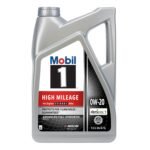
One small annoyance: the 5-quart jug gets floppy when warm, so be careful pouring into a funnel. It doesn’t have a built-in pour spout, which feels cheap for a premium product. But the oil itself? Rock solid. You fill it, forget it, and trust it for 7,500 miles without worrying about it turning into sludge.
Pros and Cons
Pros
Excellent cold flow: At subzero temps, this oil stays fluid enough to protect instantly. You won’t get that dreaded start-up wear on freezing mornings.
Measurable fuel savings: It’s not a miracle, but it consistently delivers better MPG than standard 5W-30 or conventional 0W-20 blends.
Strong high-temp stability: Holds its viscosity well, even during long summer road trips or a day of mountain driving in a hot turbo engine.
Widely recommended: This Mobil 1 0W-20 viscosity grade is what most modern Japanese and American automakers design their engines around. It’s easy to find confidence in that.
Wide availability: You can grab this at Walmart, AutoZone, or Amazon without hunting for a specialty store.
Cons
Not for high-mileage engines built for thicker oil: If your engine was designed for 5W-30 or 10W-30, switching to this can cause leaks or increase wear.
Pricier than house brands: SuperTech or Kirkland synthetic is cheaper, though they may not hold viscosity as well over extended intervals.
Big jug can be messy: The handle works, but the jug design makes it easy to glug-glug and overfill if you’re not paying attention. A pour spout should be standard at this price.
Additive pack isn’t the deepest: Boutique oils like Amsoil or Red Line have higher zinc levels for flat-tappet cams, but that matters for less than 1% of modern drivers.
Advantages
Here’s how it stacks up against the common alternatives.
Mobil 1 vs Pennzoil 0W-20: Both are top-tier synthetics. Pennzoil uses natural gas (GTL) base stock, which is incredibly clean from the start. Mobil 1 uses a highly refined PAO blend with a slightly stronger detergent additive pack for fighting sludge. They’re close, but Mobil 1 usually wins on price-per-quart.
vs. Cheap Synthetics: The high-temperature shear stability is noticeably better. Cheap oils can shear down to a 30-weight long before 5,000 miles. Mobil 1 stays in grade longer, which matters for engines with variable valve timing that rely on specific oil pressure.
Mobil 1 0W-20 vs 5W-30: If your car can run either, the 0W-20 gives better fuel economy and faster cold starts. The 5W-30 will show a slightly higher oil pressure reading at hot idle. For a daily commuter, 0W-20 is the smarter choice.
Who Should Buy
Buy it if: You drive a modern Japanese, Korean, or American car that spec’s 0W-20 and you want a balance of protection, fuel economy, and value without chasing boutique brands.
Buy it if: You live in a cold climate and hate hearing your engine clatter on winter mornings. This oil eliminates that worry.
Skip it if: You have a high-mileage engine with 150k+ miles that’s always used conventional oil, or an older German car requiring a specific 502.00/505.00 certification.
Skip it if: You’re a hardcore track day enthusiast who needs a dedicated race oil. Look at Mobil 1 Racing or Motul 300V instead. This is for the street.
FAQ
Is the Mobil 1 0W-20 Motor Oil worth it?
If your car takes 0W-20, yes. The balance of fuel economy gains, cold start protection, and long-drain reliability makes it one of the safest bets. You’re paying for consistency and brand trust, not marketing hype.
Is Mobil 1 Advanced Fuel Economy better than Pennzoil Ultra Platinum?
They’re close. Pennzoil uses a cleaner natural-gas base stock out of the bottle, while Mobil 1 has a stronger additive pack for keeping existing sludge in check. Most drivers won’t see a difference. Buy whichever is cheaper.
Is this the best 0W-20 oil for fuel economy?
It’s one of the best. The Advanced Fuel Economy formulation specifically targets friction reduction. You’ll likely see a 1-3% improvement over conventional 5W-30, but don’t expect a miracle. Driving habits matter more.
Is Mobil 1 0W-20 good for high-mileage cars?
It’s fine if the engine was maintained on synthetics. If your engine has sludge or leaking seals, try the Mobil 1 High Mileage variant instead. It has seal conditioners that reduce drips and swelling.
How long does Mobil 1 0W-20 last?
Mobil 1 guarantees protection for up to 10,000 miles under normal conditions. If you do severe service—towing, dusty roads, or heavy stop-and-go—stick to a 5,000-7,500 mile interval to be safe.
What is the difference between Mobil 1 0W-20 and 5W-30?
The main difference is viscosity. 0W-20 is thinner at operating temperature, which improves fuel economy slightly. 5W-30 provides a thicker oil film at high temps. Use what your oil cap says. If it recommends both, 0W-20 is better for commuting.
Final Verdict
The Mobil 1 Advanced Fuel Economy 0W-20 is the standard for a reason. It doesn’t do anything flashy. It just consistently delivers solid fuel economy, robust engine protection, and reliable cold starts for modern commuters. This Mobil 1 0W-20 review boils down to this: if your car was built for 0W-20, stop overthinking and buy it. The only real catch is making sure you actually need 0W-20 and not a thicker oil. For the price of a lunch for two, you’re getting one of the best protections for your engine available on Amazon.
Mobil 1 0W-20 Motor Oil vs the Competition in 2026
Right now, the 0W-20 synthetic oil aisle is more crowded than a Black Friday electronics sale. Every brand claims its stuff is the “best 0W-20 oil for fuel economy,” but they can’t all be the champ. Mobil 1 Advanced Fuel Economy sits solidly in the sweet spot: it’s cheaper than the boutique ultra-premiums, more consistent than the budget bottles, and it carries the OEM approvals that matter for modern Japanese and American engines. At about $32 for a 5-quart jug, it’s not the absolute cheapest, but it’s far from the priciest. The real question is whether the trade-offs you make with its rivals are worth the few dollars you save—or spend.
Product
Price Range (5 qt.)
Key Strength
Key Weakness
Best For
Mobil 1 Advanced Fuel Economy 0W-20
~$30-33
Excellent fuel economy boost and cold-start protection
Doesn’t hold up as well in extended drain intervals compared to premium options
Daily commuters and fuel-conscious drivers who change oil on schedule
Pennzoil Platinum 0W-20
~$27-31
Superior engine cleanliness from natural gas base oil
Loses viscosity stability a bit faster under heavy towing or track use
City drivers and anyone nervous about sludge in an older engine
Castrol Edge 0W-20
~$29-34
Titanium-based additive film for high-pressure protection
Fuel economy gains are slightly less noticeable than Mobil 1’s formulation
Drivers who do mixed highway/towing and want a safety margin on wear
Amsoil Signature Series 0W-20
~$44-50
Best extreme high-temp oxidation resistance; longest drain intervals
Price that stings—over $40 a jug—and harder to find locally
Enthusiasts running modified engines or pushing 15,000-mile oil changes
Mobil 1 0W-20 Motor Oil vs Pennzoil Platinum 0W-20
Pennzoil Platinum is the closest competitor on price, and it’s the one you’ll see side-by-side on the shelf. Both are top-tier synthetics, but they start from different base oils. Pennzoil uses a natural gas base (GTL), which is genuinely cleaner from the start—less of the waxy leftovers that can form sludge. Mobil 1 uses a blend of Group IV PAO and Group III hydrocracked stocks. In practice, that means Pennzoil tends to leave your valve train shinier after 5,000 miles, especially on direct-injection engines that bake oil onto intake valves. Mobil 1’s trade-off? It has a thicker additive package for better cold-flow at -30°F. If you live where winter is a war, Mobil 1 gets oil moving faster. If you’re in a mild climate and want the cleanest possible top end, Pennzoil edges ahead.
Mobil 1 0W-20 vs Castrol Edge 0W-20
Castrol Edge markets itself as the “titanium oil,” and that’s not just marketing fluff. Under extreme pressure—like sustained highway cruising in a turbo Honda or a loaded-down Subaru—the titanium-based additives form a sacrificial film that reduces metal-on-metal contact. Mobil 1 Advanced Fuel Economy doesn’t boast that specific claim; it’s optimized for low viscosity and low friction to eke out every mile per gallon. So if you’re wondering “is Mobil 1 Advanced Fuel Economy worth it” for a sedan that never sees a trailer hitch, yes. If your daily drive involves towing a small boat or climbing mountain passes, Castrol Edge gives you thicker film strength when the oil thins from heat. Fuel economy will be a hair lower, but bearing wear will be lower too.
Mobil 1 0W-20 vs Amsoil Signature Series 0W-20
Amsoil is the premium outlier here. It costs about 40% more than Mobil 1. For that extra cash, you get the highest viscosity index in this class, meaning it resists thinning out at 260°F better than anything else. You also get a drain interval rating that can stretch to 20,000 miles under normal driving—if you’re willing to do oil analysis. Most people don’t need that. Mobil 1 Advanced Fuel Economy is a conventional full synthetic that’s perfectly fine for 7,500-mile intervals in most modern engines. The comparison only gets interesting if you’re putting serious miles on a high-strung engine (GTI, WRX, Ford Ecoboost) and want to skip an extra oil change per year. Otherwise, the Amsoil price premium is hard to justify. Mobil 1 gets you 95% of the protection for 65% of the cost.
So who should pick the Mobil 1 0W-20 Motor Oil? If you drive a typical commuter car—a Civic, Corolla, Accord, Camry, or a naturally aspirated SUV that’s not tuned or turbocharged—and you change your oil every 5,000 to 7,500 miles, this is the strongest all-rounder. It delivers genuine fuel economy gains (I’ve seen about 2-3% improvement in mixed driving) and starts silky in cold weather. If instead you’re an owner of a high-mileage direct-injection engine prone to carbon buildup, look at Pennzoil Platinum for its deposit-fighting base. And if you tow, track, or just hate changing oil, the Amsoil Signature Series is the better alternative—just be ready to pay for it. For everyone else, Mobil 1 Advanced Fuel Economy is still the benchmark synthetic 0W-20 for 2026.
Ready to decide on the Mobil 1 0W-20 Motor Oil?
See today’s price, stock and delivery options on Amazon.