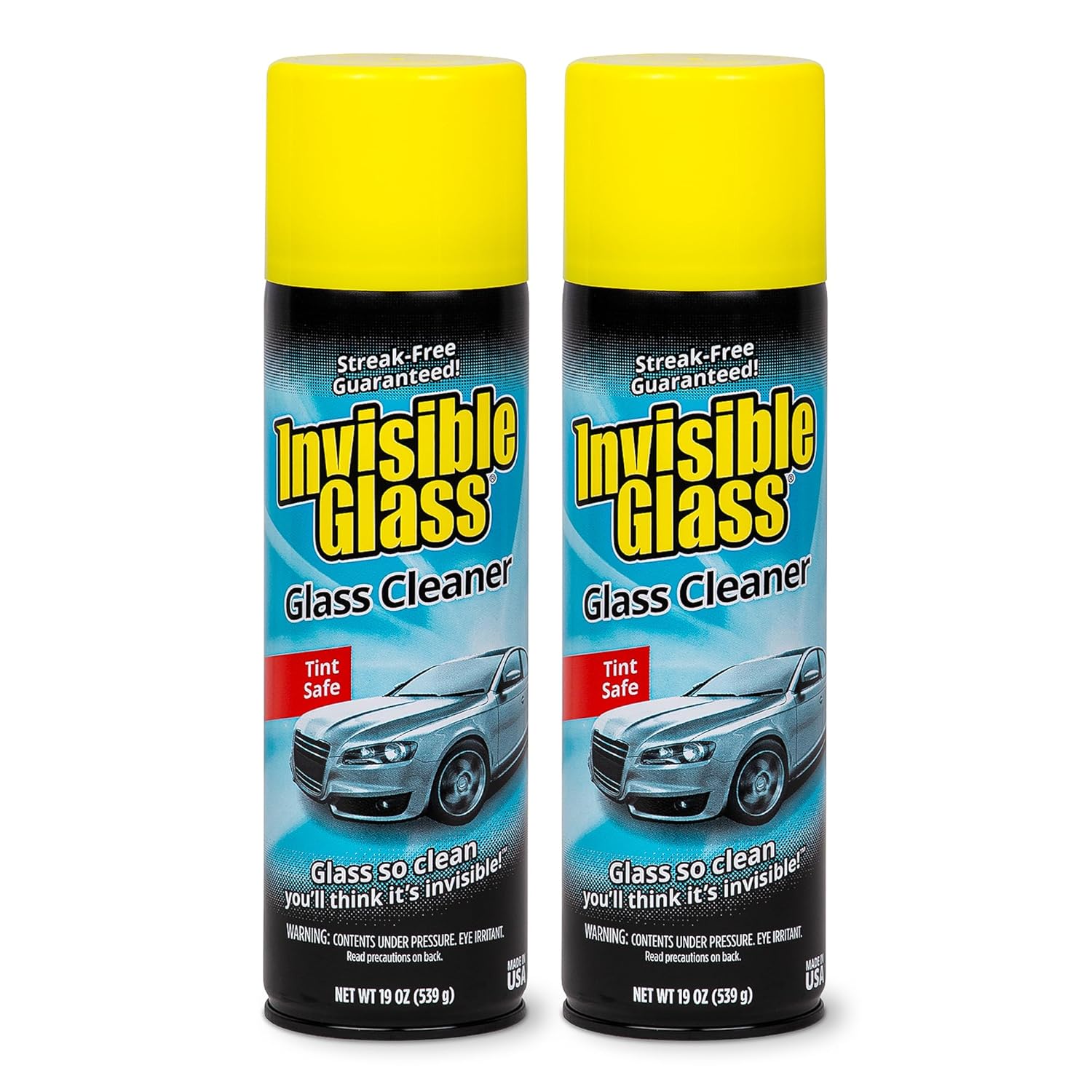
Excellent user reviews and low price point deliver exceptional value for a reputable glass cleaner brand.
Price vs. rivals
Typical
CheaperTypicalPricier
Priced at a typical mid-range level for a two-pack of premium glass cleaner, comparable to single-can alternatives from leading brands.
Ease of use
Excellent 95/100
The foaming spray format makes it easy to apply evenly on auto glass, and the high rating indicates consistent user satisfaction with its usability.
Overview
If you’ve ever tried to clean your car’s windshield with Windex and ended up with a rainbow of streaks, you know why people hunt for a car glass cleaner that doesn’t streak. Invisible Glass Foaming Spray is made for that exact problem. It’s a 19-ounce aerosol can that sprays a thick foam, clings to vertical glass, and evaporates without leaving residue. This pack of two costs about $10.36, which works out to roughly five bucks a can. That’s less than what you’d pay for a single bottle of Stoner’s original formula at some auto parts stores.
The real audience here isn’t just car nerds who polish their dashboard. It’s anyone tired of seeing smudges on their kitchen glass table, bathroom mirror, or the inside of their car windshield after a foggy morning. The foam format solves the two biggest complaints about spray bottles: drips running down the glass and evaporation before you can wipe it clean.
Key Features
Foam formula – It clings to vertical glass instead of running down onto your dash or door panel. You get time to wipe without the drip race.
No ammonia or alcohol – That means it won’t damage tinted windows or the anti-reflective coating on eyeglasses. You can use it on sunglasses and phone screens without worry.
Low-odor – The smell is mild and fades fast. Unlike some glass cleaners that make your car smell like a hospital, you can use this with the windows up.
Streak-free drying – The formula leaves no haze or chemical residue. Owners tend to notice that a single pass with a microfiber towel gets perfectly clear glass.
Large 19 oz can – Each can covers roughly the equivalent of 20–25 car windshields. The pack of two means you’ll go months before restocking.
Works on multiple surfaces – Glass, mirrors, chrome, and even clear plastic interior gauge covers. It’s versatile enough to keep one can in the garage and one in the house.
Fit for You
You drive through fog or rain often and need the best glass cleaner for car interior fog that doesn’t leave a filmy layer.
You have tinted windows and want a cleaner that won’t peel or discolor them over time.
You clean your car’s interior once a month and hate using three different sprays for glass, dash, and trim.
You own a house with lots of glass panels – shower doors, sliding patio doors, or picture windows – and want a product that dries without smearing.
You’re the person who actually reads the ingredients list because you’ve been burned by a “streak-free” cleaner that left swirl marks.
You want a car glass cleaner that doesn’t streak on the driver’s side in direct sunlight.
Uses
The most common scenario: you get into your car on a chilly morning, and the inside of the windshield is fogged up from your breath overnight. You grab a can of Invisible Glass Foaming Spray, spray a few puffs of foam across the glass, wipe with a clean microfiber cloth, and the fog disappears instantly. No smears, no waiting for chemical haze to evaporate.
Another real moment – after a long road trip, the outside of the windshield is plastered with bug splats and road grime. A few sprays of the foam, let it sit for fifteen seconds to soften the crud, then wipe. It dissolves dried bug guts faster than most orange citrus sprays without leaving a tacky residue.
Inside the house, the foam works well on the bathroom mirror after a shower. The foam doesn’t drip onto the counter, and you can catch every edge without wiping twice. People also use it on glass coffee tables and picture frames – the foam stays put, so you don’t end up with cleaner dripping onto furniture.
Experience
You open the can and press the nozzle – it’s a standard aerosol top, nothing fancy. The foam comes out thick and white, like a mousse. It holds its shape for a few seconds before slowly melting. That clinginess is the whole point. You can spray it on a vertical car window and it stays put, giving you time to grab a towel.
One detail that owners mention: the nozzle can sometimes clog if you put the can away without clearing it. A quick upside-down spray into a rag after each use keeps it flowing. Not a dealbreaker, but an easy habit to learn.
The cleaning itself is fast. You wipe once with a dry microfiber, then buff lightly with a clean section. The foam evaporates almost immediately after the wipe, so you don’t have to wait. On a sunny day, you won’t see rainbow streaks even if you’re slow.
The biggest annoyance? The can doesn’t have a very wide spray pattern. You’ll need three to four sprays to cover a full windshield, rather than two with some other brands. It’s a minor trade-off for the foam’s clinginess.
Storing the cans is easy – they’re 19 oz, so they fit in a typical door pocket or under the sink. The pack of two means you can keep one in the garage and one in the kitchen. The aerosol design also means the cleaner won’t settle or separate over time, unlike some trigger spray bottles.
Pros and Cons
Pros
Actually streak-free – No residue left behind, even on tinted glass or in direct sun. You get perfectly clear glass every time.
Foam clings to vertical surfaces – No drips down the door panel or onto the dash. This alone makes it worth the switch from liquid sprays.
Safe on tints and coatings – Ammonia-free and alcohol-free, so you won’t damage aftermarket window tint or anti-glare coatings on sunglasses.
Low odor – You can use it in a closed car without getting a headache. The scent is neutral and disappears quickly.
Great value per can – At about $5 each in this two-pack, it’s cheaper than many single bottles at auto parts stores. You get the same or better performance.
Versatile – Works on glass, mirrors, chrome, and clear plastics. You can use it on your phone screen, glasses, and glass cooktop in a pinch.
Cons
Narrow spray pattern – The nozzle doesn’t fan out as wide as some competitors. You need more sprays to cover a large windshield, which uses more product.
Aerosol can means you can’t take it on a plane – If you travel and want a glass cleaner for rental cars, you’ll need a non-aerosol alternative. This can is for home and garage use only.
Foam can leave a temporary whitish haze if you use too much – The fix is simply less product, but if you’re heavy-handed, you’ll have a short moment of cloudy glass before you wipe again.
Not a degreaser for heavy grime – For baked-on bug splats, it works, but you might need an extra wipe or a stronger cleaner first. It’s not a heavy-duty degreaser.
Advantages
Compared to common drugstore glass cleaners like Windex, Invisible Glass wins on streaks and odor. The foam also means you waste less product on vertical glass because it doesn’t run off. But a more direct comparison is Invisible Glass vs Sprayway Glass Cleaner. Sprayway is cheaper per ounce and has a wider spray pattern, but it uses ammonia – which can harm tinted windows and leave a faint ammonia smell. Invisible Glass foams up, stays where you put it, and has no ammonia. If you have tinted windows or clean interior fog often, the extra few dollars for Invisible Glass is worth it.
Another advantage is the invisible glass 91164 review consensus among car detailing forums: the foam version consistently outperforms the liquid version of Invisible Glass on vertical windows and car interior glass. The foam simply hangs better. Owners who switch from the liquid spray report using less product per session because they aren’t fighting drips.
It also beats the typical “ammonia-free” store brands because the foam format actually keeps the cleaner on the glass long enough to dissolve oils from fingerprints. Many ammonia-free cleaners are too watery and evaporate before you get a proper wipe. Invisible Glass avoids that entirely.
Who Should Buy
Buy it if: You frequently clean car interiors, especially the windshield and side windows. You value a streak-free finish without lingering chemicals.
Buy it if: You have tinted windows or factory privacy glass and need a cleaner that won’t cause bubbling or discoloration over time.
Buy it if: You want one product for car glass, home mirrors, and glass tables – the foam works well on all of them.
Skip it if: You need a glass cleaner for travel (aerosol can be an issue) or you prefer a non-aerosol pump spray. In that case, look for the liquid version of Invisible Glass or a similar ammonia-free trigger spray.
Skip it if: You’re on a tight budget and want the cheapest option per ounce. Sprayway gives you more product for less money, but you’ll trade tint safety and a stronger ammonia smell.
FAQ
Is the Invisible Glass Foaming Spray worth it?
Yes, if you want a streak-free, ammonia-free glass cleaner that clings to vertical surfaces and works on tinted windows. The two-pack at roughly $10.36 is a fair price for the performance – you’re not overpaying for marketing hype.
How long does a single can last?
You’ll get about 20–25 full-size car windshields per can, depending on how much you use. For a typical weekly windshield and mirror clean, a can lasts 2–3 months. The two-pack covers half a year or more.
Is it safe for tinted windows?
Yes. The formula contains no ammonia or alcohol, so it won’t damage factory or aftermarket tint. I’d still spot-test on an inconspicuous area, especially if your tint is older or peeling, but owners report no issues.
Can I use it on my phone or laptop screen?
Yes, but spray onto a microfiber cloth first, not directly onto the screen. The foam is safe for oleophobic coatings, but the aerosol propellant can be too strong if sprayed directly. Dampen the cloth, then wipe.
Does it work for car interior fog?
It’s one of the best glass cleaner for car interior fog because it leaves no film. Most fog forms because of a greasy residue on the glass – this foam cuts through that film without adding a new layer. Many owners report that the windshield stays fog-free longer after using it.
How does Invisible Glass compare to Sprayway?
Invisible Glass wins on tint safety and low odor. Sprayway is cheaper and sprays a wider pattern, but uses ammonia. For interior car glass and mirrored surfaces, Invisible Glass is the better choice; for exterior windows where tint is not a concern, Sprayway is a decent budget alternative.
Final Verdict
Invisible Glass Foaming Spray is the kind of product that makes you wonder why you ever used regular glass cleaner. The foam solves the drips-and-streaks problem that every liquid spray introduces. At $10.36 for two cans, you get a year’s supply for less than the cost of a single bottle at an auto parts store.
The one thing to keep in mind: the narrow spray pattern means you’ll use slightly more per windshield. But given the streak-free finish and the safety on tinted windows, that’s a fair trade. If you clean glass regularly – in your car, your house, or both – this is the invisible glass auto glass cleaner review you were hoping for. It delivers on the promise.
Invisible Glass Foaming Spray vs the Competition in 2026
You’re here because you want a car glass cleaner that doesn’t smear, fog, or leave you wiping the same spot three times. The Invisible Glass Foaming Spray (the 91164 two-pack, currently around $10.36) has a 4.7-star average for a reason. But it’s not the only bottle on the shelf. Sprayway, Chemical Guys, and Rain-X all want your money. This is the comparison you actually need — which one solves your specific annoyance without introducing a new one.
Product
Price Range
Key Strength
Key Weakness
Best For
Invisible Glass Foaming Spray (91164, 2-pack)
~$10 for two cans (mid)
Thick foam clings to vertical windshields and doesn’t run
Haze if you overspray or buff too slowly
Daily drivers who want reliable, no-streak results on both interior and exterior glass
Sprayway Glass Cleaner (aerosol)
~$5–7 per can (budget)
Dries fast with nearly zero residue; cheap
Thin liquid runs off vertical glass quickly; less forgiving on greasy film
Quick interior wipes and light dust — not heavy grime
Chemical Guys Cloud Nine Glass Cleaner
~$12–15 per bottle (premium concentrate)
Pleasant scent, concentrated formula lasts many washes
Requires dilution; easy to get the ratio wrong and end up with streaks
Detailing hobbyists who already own a spray bottle and want a concentrate that goes further
Rain-X Glass Cleaner with Rain Repellent
~$6–8 per bottle (mid)
Adds water beading to exterior glass in one step
Can smear on interior surfaces; not ideal for fog-prone car interiors
Exterior-only use when you want repellent without a separate treatment
Invisible Glass Foaming Spray vs Sprayway Glass Cleaner
Sprayway is the budget king, and for good reason. It’s cheap, it smells like a barbershop, and it disappears fast. But “disappears fast” is both the selling point and the flaw. On a vertical windshield that’s seen a winter of off-gassing and vape residue, Sprayway runs before the foam can actually lift the film. You end up chasing drips. The Invisible Glass Foaming Spray vs Sprayway Glass Cleaner comparison comes down to cling. The foam from Invisible Glass sits where you put it — even on a hot windshield tilted 60 degrees. You can work it into the grime instead of racing gravity. If you only wipe down lightly soiled side windows once a month, Sprayway is fine. If you fight actual film and fog on your daily driver, the foam is worth the extra few dollars.
Invisible Glass Foaming Spray vs Chemical Guys Cloud Nine
Cloud Nine is the darling of the detailing forums, and it does smell better than any glass cleaner has a right to. But it’s a concentrate, which means you are now in the dilution business. Too much water and you’re just smearing. Too little and you’re buffing off a haze that takes three passes. The best glass cleaner for car interior fog shouldn’t require a lab notebook. Invisible Glass foaming spray comes ready to use — you press the nozzle and the foam lands thick enough to cling to the inside of a fogged-up rear window on a rainy morning. Cloud Nine wins if you already have a dedicated sprayer and you like tuning your mix. But for the “I just want the fog gone” crowd, Invisible Glass is the simpler, more consistent answer.
Invisible Glass Foaming Spray vs Rain-X Glass Cleaner
Rain-X with repellent is a clever idea for exteriors. Spray it on, hose it off, and water beads up nicely on the highway. The trouble starts when someone uses it indoors. On an interior windshield, the repellent additives can create a haze that fogs up worse than the original grime. Is invisible glass cleaner worth it compared to a 2-in-1? Yes, because Invisible Glass leaves nothing behind. It’s formulated specifically for optical clarity — no waxy residue, no silicone, no water-beading chemistry. For your front windshield’s interior face, especially if you drive at night and hate halo glare from oncoming headlights, that matters. Rain-X is fine for the outside of the glass if you like the beading effect and you keep it off the inside. But for a true car glass cleaner that doesn’t streak on every surface, Invisible Glass is the safer bet.
So who should buy the Invisible Glass Foaming Spray? Anyone who cleans their own car windows and wants to do it once, not three times. It’s ideal for interior windshield fog, exterior bug splatter, and the greasy film that builds up on driver-side windows. The foam clings, the formula dries clear, and a single can lasts through multiple full-car jobs. Who should skip it? If you only clean windows twice a year and budget is the only number that matters, Sprayway will get you by. If you already mix your own detailing chemicals and enjoy the ritual, Cloud Nine gives you more control. And if you only care about exterior water beading and never touch the inside glass, Rain-X does that one job well. But for the broadest, most reliable one-bottle solution for keeping your car’s glass actually clear, this is it.
Ready to decide on the Invisible Glass Foaming Spray?
See today’s price, stock and delivery options on Amazon.