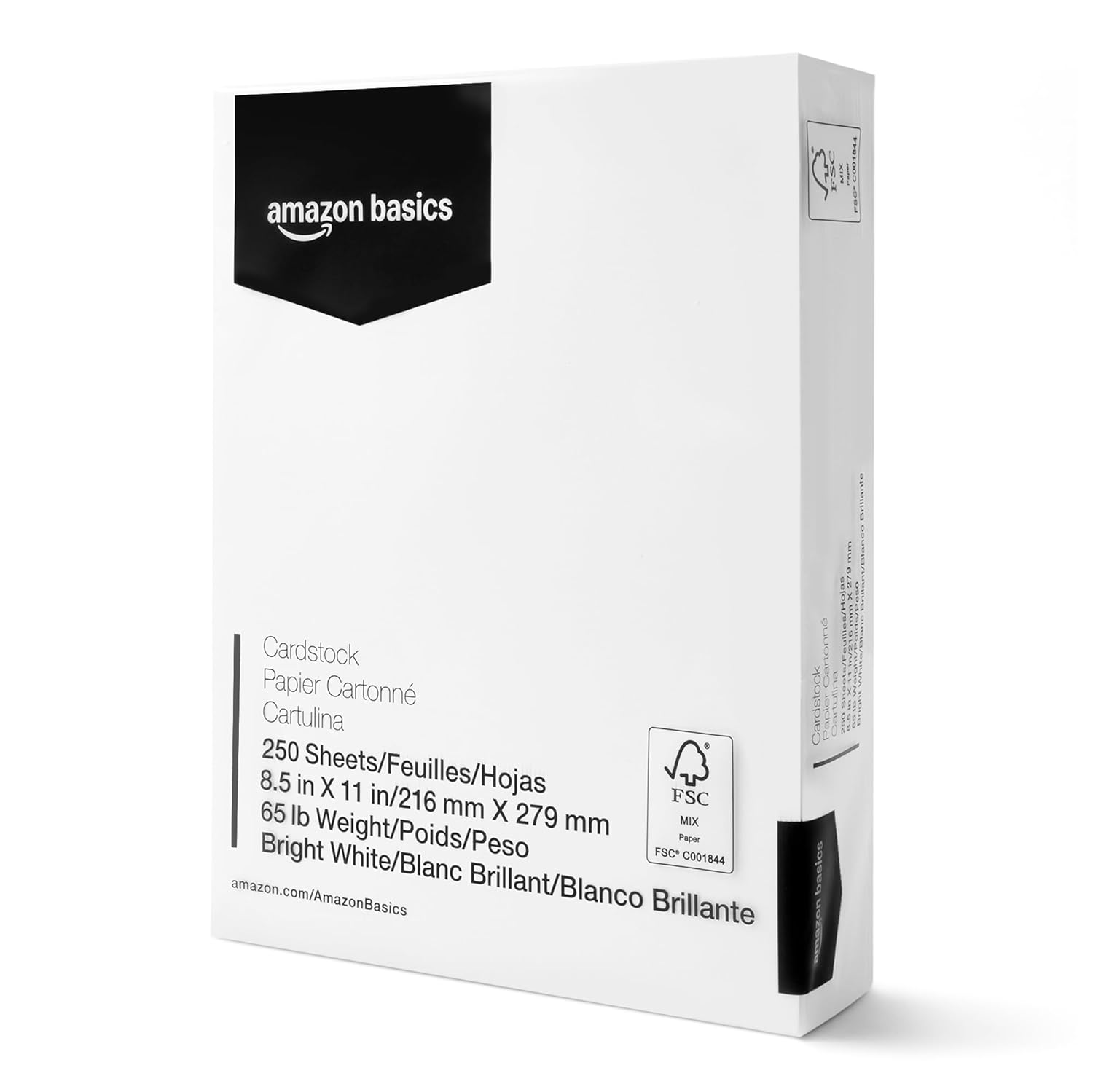
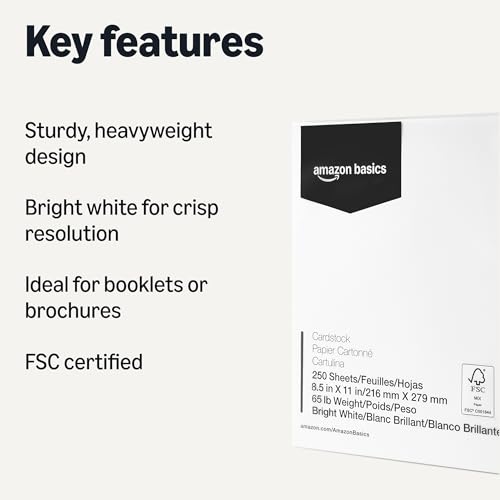
Amazon Basics offers a reliable cardstock at a fraction of the cost of premium brands, making it an excellent value for everyday crafting and printing needs.
Price vs. rivals
Cheaper
CheaperTypicalPricier
This Amazon Basics cardstock is priced below many competing brands, making it a budget-friendly option while still maintaining solid quality.
Ease of use
Excellent 92/100
The cardstock is straightforward for printing and crafting, though its thickness may occasionally cause jams in some home printers.
Overview
This Amazon Basics cardstock review covers the standard 65 lb cardstock from the house brand. It solves the problem of needing paper heavier than standard copy paper for signs, cards, or covers without drawing too deeply into your wallet. You get 250 sheets of a consistent, bright white base.
Who is it really for? Someone who runs a lot of paper through a printer or cutting machine and wants the price per sheet to hit rock bottom. If you’re making premium wedding invitations, you likely want a smoother finish. For day-to-day projects, it’s entirely capable.
Key Features
65 lb / 176 gsm weight: Heavy enough to stand up in a greeting card or hold a poster crease, but light enough to go through most home printers without a jam.
96 Bright White: Colors pop well against the bright base. Puts it in the same visual league as pricier brands for everyday projects.
250 sheets per box: You get a serious stack for the price. Means you can print a whole classroom set of templates without hoarding the last few sheets.
Standard 8.5 x 11 size: Fits perfectly into any standard paper tray, cutting mat, or die-cut machine without trimming.
Smooth finish: Laser and inkjet prints come out crisp. Text doesn’t bleed or feather like on some cheaper textured stocks.
Acid free: Not just a buzzword—it means your kids’ art projects or printed photos won’t yellow and crumble in a few years.
Fit for You
You print a lot of flyers for the PTA or a small business and need the price per sheet to bottom out.
You own a Cricut or Silhouette and go through cardstock like a kid goes through crayons on a birthday.
You run a paper-intensive classroom and your budget has to cover 150 other things besides cardstock.
You just need a bright, crisp white for wedding programs or baby shower games without paying for premium stationery prestige.
You’re tired of your inkjet eating your 110 lb stock and jamming, so you want a lighter weight that still has some body.
You’re setting up a home office and want a single bulk box to handle everything from test prints to client draft proposals.
Uses
Greeting cards. Fold one in half, it holds a solid crease. Layer a cutout on the front, write a note inside, and it feels like you got it from a real gift shop.
Signage for a garage sale, a bake sale, or a party. The 65 lb weight means it stands up in a cheap plastic tent card holder without drooping over.
Kids’ projects. You won’t feel guilty when they use a whole sheet for one sticker or cut a tracing into a million confetti pieces. It’s cheap enough to hand over freely.
Bulk printing for resumes, cover letters, or business cards for a networking event. It runs through a laser printer like standard paper but feels completely different in the hand.
Experience
Living with this paper is the core of this Amazon Basics cardstock review. Opening the box, you get a solid ream. No fancy wrapping, just shrink wrap and cardboard. The sheets are bright out of the package. You’ll probably pull out a sheet to compare against your usual stock, just to check the thickness against the light.
Setting up the printer for the first time is the same drill as any 65 lb paper. You flip the paper tray guides, drop the stack in, and tell the driver to expect heavy paper. It feeds cleanly. It doesn’t curl on the edges like some cheap paper you might find at a dollar store. That’s a real relief if you have a finicky printer that eats the snaggly stuff.
Everyday use feels completely serviceable. It handles double-sided printing well. No show-through on most designs. A small annoyance is that the edges of the ream can feel a little dusty from the cutting process. Nothing an air duster can’t fix, but you’ll notice it on the first cut if you don’t wipe down the blade. A real win you’ll hear from owners: this stuff sits in the corner of a room and doesn’t immediately warp into a potato chip shape when the humidity changes. Storage is easy. The box itself isn’t flimsy cardboard that collapses after two weeks. You can tuck a few packs on a shelf in the closet.
Small annoyance: The brightness is great, but it is a cool white. If you’re comparing it against a cream or natural white, your colors will look different. The vibrancy is there, but the undertone is blue.
Pros and Cons
Pros
Price per sheet: Peak budget friendliness. You save serious coin compared to standard office brands.
Bright color base: At 96 bright white, your prints look crisp and vibrant, not dull.
Printer friendly: The 65 lb weight sails through most inkjets and lasers without a jam.
Acid free: It’s actually archival quality, which is a bonus you rarely get at this price.
Versatile weight: Thick enough for cards and signs, but light enough for bulk drafting and test runs.
Good box quantity: 250 sheets means you won’t run out halfway through a big project.
Cons
Not the smoothest surface: You get some visible texture. Not for stamps needing a flawless mirror finish, but fine for general printing.
Cool tone: It’s definitely a bright, cool white. Pair it with cream envelopes and the mismatch is obvious.
Dusty edges: Cuts can leave a little paper dust on your cutting mat. You’ll want to brush off or use a sticky mat.
Not foolproof for every printer: Very fussy printers might still wrinkle the corners. Usually a tray adjustment solves it, but it’s a real thing.
Feels a bit cheap in the hand: Compared to a 100 lb premium stock, this feels lighter and less substantial. That’s the trade-off for the weight and price.
Limited color options: You get white. If you want a rainbow of colors or black in this exact spec, you have to look at other alternatives.
Advantages
Against the competition, this pack makes the most sense on the bottom line. Compared to paper from the grocery store or general office supplies, this is a clear step up in brightness and consistency. The 65 lb weight avoids the flimsiness of standard page feel.
Beats standard copy paper in brightness and stiffness. No contest, the same stock you use in the office shredder can’t do what this can.
Competes with pricier 65 lb brands on basic print quality. The ink doesn’t bleed, and the finish takes a score line well.
Outpaces the no-name budget brands you find in dollar stores. No wavy sheets, no weird smell, no jams every third page.
Who Should Buy
Buy it if: You need a workhorse cardstock for bulk projects, classroom use, or everyday crafting and want to save money for other supplies.
Buy it if: You’re testing designs or doing drafts and need a real cardstock feel without the cost of premium stock.
Skip it if: You need 110 lb or heavier weight for boxes, tags, or premium invitations that must stand totally rigid.
Skip it if: You’re a stationery snob who requires the perfect texture and weight of a specific mill. This is a utility player, not a luxury brand.
Skip it if: You absolutely need a specific shade of warm white or cream. This is strictly bright white.
FAQ
Is the Amazon Basics Cardstock worth it?
For the price, yes. You get 250 sheets of bright, consistent 65 lb stock that works beautifully in most home printers. It isn’t the thickest or smoothest out there, but for the cost per sheet, it holds its own against much pricier brands in basic utility.
How does it compare to alternatives to Amazon Basics cardstock?
Against cheaper generic brands, it’s more reliable and brighter. Compared to premium cardstock like Neenah, it lacks the ultra-smooth surface and luxurious bulk. It sits right in the middle—much better than bargain paper, but a clear step below boutique options.
Is this the best budget cardstock for crafting?
It’s a very strong contender. Combined with the price and the bright white base, it runs perfectly through most die-cut machines and inkjet printers. If your budget is tight, this is one of the best budget cardstock for crafting you can grab without getting burned.
Can I use this 65 lb cardstock paper in a Cricut or Silhouette?
Yes, it cuts beautifully on standard blade settings for 65 lb cardstock paper. It’s actually a favorite weight for these machines because it’s thick enough to hold detail but light enough to not dull the blade as fast as the heavy stuff.
Is the Amazon Basics cardstock actually bright white?
Yes, the 96 brightness rating is the real deal. This bright white cardstock gives a clean, modern look. Colors printed on it really pop. Just remember it’s a cool white, so don’t expect a cream or vintage shade.
Will it work in my laser printer?
Usually, yes. The 65 lb weight is the standard heavy paper setting on most laser printers. Run a test sheet first to check the curl, but most people find it feeds reliably without the jams associated with thicker 80 lb or 100 lb cardstock.
Final Verdict
The honest bottom line of this Amazon Basics cardstock review is that it’s a smart buy for anyone who needs a steady supply of bright white paper. It nails the core requirement: affordable paper that prints well and handles basic tasks without complaint.
Keep in mind it’s a budget paper. It’s not the most luxurious thing you’ll ever run your hands over. But if you measure value by what you get for what you pay, this pack is one of the best deals on the shelf. Buy it for the utility, not the prestige, and you’ll be happy.
Amazon Basics Cardstock vs the Competition in 2026
If you’re shopping for 65 lb cardstock, the price per sheet usually dictates the experience. Amazon Basics sits in a strange and useful spot: cheap enough to rival the no-name brands, but consistent enough to hold its own against the office staples from Hammermill and Georgia-Pacific. It’s the default choice for anyone who just needs a stack of bright white paper that won’t jam their printer. But how does it stack up against the dedicated brands when you actually start folding, cutting, or inkjet printing on it?
Consistent ultra-smooth finish, vibrant inkjet color payoff
Costs almost twice as much per sheet
Professional projects, high-quality prints
Hammermill Cardstock 65 lb
Budget ($9-13)
Trouble-free feeding in printers, crisp edges
Duller white, slightly less stiff
High-volume office printing, double-sided docs
Georgia-Pacific Cardstock 65 lb
Ultra-Budget ($8-11)
Cheapest big-brand option, widely available
Rougher feel, lower brightness
Kids’ crafts, signs, throwaway prototypes
Amazon Basics Cardstock vs Neenah Astrobrights
The main reason you’d pay more for Neenah Astrobrights is the printing experience. If you run a sheet through an inkjet printer, the Amazon Basics paper absorbs the ink differently. Colors come out a little muted—a little fuzzy around the edges. On the Astrobrights, the ink sits on the surface more, drying with a sharper, glossier look. It’s the difference between a flyer that looks homemade and one that looks professionally printed. If you are making a birthday card and the photo is the whole point, the Neenah paper is worth the extra money. If you are just printing 200 party stickers that will end up in the recycling bin anyway, save your cash. The Amazon Basics paper also feels a bit more porous, almost like thin felt, compared to the slick, tight grain of the Astrobrights. This makes it slightly worse for scoring and folding crisp lines, though it’s perfectly workable.
Amazon Basics Cardstock vs Hammermill
The Hammermill comparison is actually the more interesting one for most people, because the prices are so close. Hammermill has a reputation for being the paper that your printer does not complain about. It’s engineered to run without jamming in office machines. The Amazon Basics paper feeds well, but it’s not quite as dimensionally stable. If you have a finicky printer, especially an older laser jet, the Hammermill is the safer bet. The Amazon Basics paper has a higher brightness rating (96) compared to Hammermill’s standard white (usually 92). This means the Amazon paper looks visibly whiter and crisper in the stack. If the final look of the document matters more than absolute reliability in the paper tray, the Amazon Basics wins. For throwaway drafts or trays that get reloaded constantly, the Hammermill is a workhorse.
Amazon Basics Cardstock vs Georgia-Pacific
Georgia-Pacific is the lowest common denominator. It is the cheapest name-brand cardstock you can buy at an office supply store. The Amazon Basics paper is a clear step up from this. The Georgia-Pacific paper has a tendency to develop a rough, fuzzy edge when cut on a guillotine or printed with heavy ink coverage. The Amazon Basics holds a much cleaner edge. The brightness difference is also massive here — the Georgia-Pacific looks almost yellow in comparison. If you were buying Georgia-Pacific because it was the cheapest option in the aisle, switch to Amazon Basics. It’s a dollar or so more, but it feels like a completely different tier of paper.
So, is the Amazon Basics Cardstock worth it? For the money, yes, if you just need a reliable stack of bright white 65 lb sheets that won’t break the bank. You should pick it over Hammermill if whiteness matters more than absolute printer reliability, and over Neenah if you can’t justify spending double for slightly better inkjet sharpness. You should pass on it if print quality is your absolute priority, or if you need a specifically silky surface for intricate die-cuts. In that case, the Neenah Astrobrights is the better splurge. But for the vast majority of crafters and office workers, this specific pack hits a price-to-performance ratio that is very hard to beat.
Ready to decide on the Amazon Basics Cardstock?
See today’s price, stock and delivery options on Amazon.