Offers a compelling balance of triple-driver performance and well-known brand identity at a price that undercuts many competitors without sacrificing audio quality.
Price vs. rivals
Cheaper
CheaperTypicalPricier
Priced noticeably below typical triple-driver in-ear monitors, offering a strong value proposition for budget-conscious audiophiles while still delivering decent sound quality.
Ease of use
Great 80/100
Wired in-ear headphones are generally easy to use with a simple plug-and-play setup, but the in-ear fit may require adjustment for comfort and stability.
Overview
Is the 1MORE Triple Driver worth it? For $69.99, you get a pair of wired in-ear headphones with three drivers per side, which is rare at this price. The 1MORE Triple Driver review you’re about to read will break down where they shine, where they frustrate, and whether they belong on your shortlist.
These are designed for people who want detailed, balanced sound without spending hundreds. They solve the problem of muddy or harsh audio from cheap earbuds. But they’re not for everyone—their fit and cable noise can be dealbreakers. Mostly, they appeal to budget-conscious audiophiles, remote workers, and musicians who need a clear reference for mixing.
Key Features
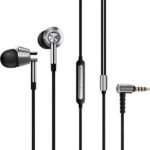
Three drivers per earpiece – A dynamic driver handles lows, a balanced armature covers mids, and another armature takes highs. The result is separation you usually only get from pricier IEMs. You’ll hear the bass line distinctly from the vocals, even in busy tracks.
Lightweight aluminium housing – Each earpiece weighs 18 grams, so they don’t pull on your ears during long sessions. The metal shell also reduces resonance compared to cheap plastic.
Detachable MMCX cable – If the cable breaks (and it can), you swap it out instead of trashing the whole set. The cable itself is fabric-wrapped, which resists tangling better than rubber ones.
9 pairs of ear tips – You get silicone (sizes XS–XL), foam, and a triple-flange set. That’s more variety than most brands include, so you can dial in fit and seal.
Built-in microphone and remote – The cable has a single-button remote with a mic. It works for calls and playback control, but the remote is only for iOS—Android users lose volume adjustment. A small but annoying oversight.
90-day limited warranty – That’s short. Most competitors offer at least a year. Keep your receipt handy.
Fit for You
You spend your commute in a noisy train or bus and need passive noise isolation that doesn’t cost extra.
You’re a bedroom guitar player who wants to hear your backing track clearly without shelling out for studio monitors.
You watch movies or play games late at night and don’t want to disturb anyone else in the house.
You’ve been disappointed by the muddy bass or sizzly treble of twenty-dollar earbuds and want a real step up.
You hate replacing entire earbuds because a cheap cable shorted out after three months.
You’re a musician or producer on a tight budget and need a wired in-ear monitoring option that reveals mixing mistakes.
Uses
Use them for critical listening. The triple-driver separation helps you pick out individual instruments in a dense rock mix. You’ll notice when the hi-hat is slightly too loud or the synth pad is clipping. That’s why many owners call them the best in-ear headphones for music production under 100 dollars.
On a cross-country flight, plug them into a portable DAC or your phone’s headphone jack. The foam tips block out engine hum, and the balanced sound profile won’t fatigue your ears after a four-hour movie marathon. The fabric cable is long enough to route under your shirt without snagging.
Gaming is a mixed bag. For single-player adventures where you want to hear footsteps and ambient cues, these work well. The imaging is decent—you’ll know the monster is to your left. But for competitive shooters, the soundstage feels narrower than open-back headphones, so don’t expect pinpoint footstep timing against serious players.
Experience
Setup is simple: pick your ear tips, twist the earpieces into your ears, and go. The cable runs over your ear, which takes a day or two to get used to if you’ve only used straight-down earbuds. Once you do, the fit becomes secure enough for gentle jogging, though not for sprints.
Everyday use reveals one big frustration: cable noise. The fabric wrap rubs against itself and your clothes and transmits that scratchy sound straight to your ears. Wearing them under a collar or using the included shirt clip helps, but it doesn’t go away completely. This is the most common complaint in user feedback, and it’s real.
The 18-gram weight is a plus—you can wear them for a full work day without aching. The L-shaped plug is angled so it doesn’t stick out of your phone’s jack like a flagpole. Storage is where you need a small case; the cable doesn’t coil neatly on its own. The included pouch is barely adequate; a hard case would have been nicer at this price point.
Cleaning is straightforward: wipe the metal shells with a damp cloth, brush the nozzle grilles gently. The foam tips will degrade over six months and need replacement. The silicone tips last longer but can accumulate earwax. Plan to rinse them with mild soap every few weeks.
Pros and Cons
Pros
Exceptional clarity for the price – The triple-driver design gives you detail that undercuts most single-driver IEMs under $100.
Replaceable cable – When the wire fails (and it may, given the fabric sleeve), you spend $15 to fix it instead of buying new headphones.
Lightweight and comfortable for extended wear – 18 grams per ear, with a low-profile shell that doesn’t poke your ear cartilage.
Good accessory kit – Nine tip pairs let you dial in the best seal, which directly improves bass and isolation.
Balanced sound signature – Not overly bassy or bright. Works for music, movies, and gaming without EQ tweaks.
Cons
Noticeable cable noise – The fabric-wrapped wire rubs against clothes and transmits every brush into your ear. A shirt clip helps, but it’s still a daily irritation.
Short 90-day warranty – Most wired IEMs in this range come with at least one year. This feels like a gamble.
iOS-only remote – Android users lose volume control. The button still works for play/pause and calls, but that’s a compromise.
Mediocre stock cable durability – Some owners report the MMCX connectors loosening or the fabric fraying after six months. The replacement cost is low, but it shouldn’t happen that soon.
Soundstage is average – For a triple-driver design, the sense of space is good but not great. Open-back headphones at the same price (like the Samson SR850) give you a wider stage.
Advantages
Most sub-$100 IEMs use a single dynamic driver. The 1MORE splits lows, mids, and highs across dedicated drivers, so you get less distortion and clearer separation—especially noticeable with complex music.
Build quality is above average for the price. The aluminium housing feels solid compared to the plastic shells on many budget competitors.
Weight. At 18 grams per earpiece, they’re lighter than the KZ ZS10 Pro (about 24g) and much lighter than over-ear monitors like the Audio-Technica ATH-M20x (190g). For long listening sessions, that difference matters.
The tip variety is genuinely useful. The triple-flange tips, in particular, offer maximum isolation for noisy environments, something you often have to buy separately with other brands.
Who Should Buy
Buy them if you want a wired reference for mixing on a budget, need replacement options, or prioritize weight and clarity over a wide soundstage.
Skip them if cable noise drives you crazy, you need a volume remote on Android, or you want a warranty that covers more than three months.
Look elsewhere if you’re a runner—the over-ear fit can slip with sweat, and the microphonics will annoy you. For that, consider wireless earbuds with ear hooks.
Consider the Sennheiser IE 100 Pro if you need a more robust cable and better warranty. The 1MORE Triple Driver vs Sennheiser IE 100 Pro comparison often comes down to sound signature: the 1MORE is slightly more balanced, while the Sennheiser has a warmer tilt and costs about $30 more. Both are decent entry-level monitors, but the 1MORE gives you more drivers for less cash.
FAQ
Is the 1MORE Triple Driver worth it?
Yes, for $69.99 you get triple-driver clarity that beats most single-driver options under $100, but you accept cable noise, a short warranty, and an iOS-only remote. Worth it if those trade-offs don’t bother you.
How does the 1MORE Triple Driver sound quality compare to cheaper earbuds?
Sound quality is significantly better than standard earbuds under $30. You’ll hear instrument separation, less muddiness in the bass, and clearer highs without harshness. It’s not night-and-day versus good $50 IEMs, but the triple drivers give you an edge in detail retrieval.
Are these good for music production?
They work as a portable reference. The balanced response helps you spot frequency clashes or sibilant vocals. But for critical mixing, you’ll want over-ear studio headphones with a wider soundstage. Many owners cite them as the best in-ear headphones for music production under 100 dollars for initial sketch mixes.
Can I use the 1MORE Triple Driver with a microphone for gaming?
The inline mic works for chat, but the cable picks up rustling sounds when you move. For competitive gaming, a dedicated headset mic is better. For casual voice chat, it’s passable.
How long do these headphones last?
The earpieces themselves should last years if you don’t abuse them. The cable is the weak point—expect 6–12 months of daily use before fraying or connection issues appear. Replacement cables cost $10–$20.
Do the 1MORE Triple Drivers fit small ears?
The housings are compact, and the variety of ear tips helps. If you have very small ear canals, the extra-small silicone tips and foam tips (which compress) should work. The over-ear cable keeps them in place without pinching.
Final Verdict
The 1MORE Triple Driver delivers on its core promise: detailed, balanced sound from multiple drivers, at a price that undercuts most competitors. The 1MORE Triple Driver review bottom line is that they’re a solid buy if you care about audio detail and are okay with a few daily-use quirks—especially the cable noise and short warranty.
They’re not the last word in comfort or longevity, but for $69.99, they give you a glimpse of the high-end IEM experience without the high-end cost. Buy them for the sound, and plan to swap the cable if it becomes a problem.
The 1MORE Triple Driver landed in a different era. Back then, a triple-driver IEM for under $100 was a genuine selling point. In 2026, the budget wired IEM market is stacked with well-tuned alternatives from brands that have spent years refining their approach. The 1MORE still has things going for it — the metal build is solid, the triple-driver setup delivers real detail, and the price has settled at around $70. But it’s no longer the obvious choice. Here’s how it stacks up against three serious contenders.
Product
Price Range
Key Strength
Key Weakness
Best For
1MORE Triple Driver
Around $70
Triple-driver setup with good detail retrieval
Uneven tuning, 90-day warranty, fixed cable
Listeners curious about multi-driver IEMs on a budget
Sennheiser IE 100 Pro
Around $100
Neutral, honest tuning for critical monitoring
Single dynamic driver, bass-light, higher price
Musicians and live monitoring use
Moondrop Aria
Around $80
Smooth, balanced tuning with excellent midrange
Paint finish chips, stock cable is average
Critical listening and vocal-focused music
Tin HiFi T3 Plus
Around $75
Refined tuning, detachable cable, good comfort
Soundstage is narrower, larger nozzle size
Everyday all-around listening
1MORE Triple Driver vs Sennheiser IE 100 Pro
If you’re comparing the 1MORE Triple Driver vs Sennheiser IE 100 Pro, you’re looking at two completely different ideas of what an IEM should do. The Sennheiser is built for work — it’s a monitoring tool with a neutral, almost flat response that lets you hear flaws in a mix. The 1MORE is built for pleasure, with a more energetic, consumer-friendly sound that pushes bass and treble forward. That doesn’t make the 1MORE better. For music production, the IE 100 Pro is the right pick because it doesn’t lie to you. But for casual listening, the 1MORE’s extra punch makes it more fun. The trade-off is the cable: the Sennheiser uses detachable MMCX cables, while the 1MORE’s cable is fixed. If the cable breaks on the 1MORE, that’s a problem. The Sennheiser also comes with a 2-year warranty, compared to the 1MORE’s 90 days. That’s a real gap.
1MORE Triple Driver vs Moondrop Aria
The Moondrop Aria is the most direct competitor to the 1MORE Triple Driver at this price, and it wins on tuning. The Aria’s midrange is smoother and more natural, vocals sound less strained, and the treble doesn’t get peaky the way the 1MORE can on certain tracks. Where the 1MORE fights back is in its bass — the dynamic driver gives it a slightly fuller, punchier low end than the Aria’s single dynamic driver. If you listen to a lot of electronic or hip-hop, you might prefer the 1MORE’s kick. But for acoustic, jazz, or vocal-forward music, the Aria is clearly better. Build-wise, both use metal housings, but the Aria’s paint finish is known to chip over time, while the 1MORE’s silver finish has held up better in my experience. The Aria’s stock cable is also a weak point — it’s fine, but the 1MORE’s cable feels more substantial. Still, for sound quality alone, the Aria is the safer bet for most listeners.
1MORE Triple Driver vs Tin HiFi T3 Plus
Tin HiFi’s T3 Plus flies under the radar compared to the 1MORE, but it might be the better all-rounder. The T3 Plus has a more balanced tuning — the bass is present without being overwhelming, the mids are clear, and the treble is smooth without sacrificing detail. The 1MORE can sound a bit uneven next to it, with some frequencies jumping out more than they should. The T3 Plus also comes with a detachable cable using the standard 0.78mm 2-pin connector, which makes replacement and aftermarket upgrades easy. The 1MORE’s fixed cable is a real limitation here. Comfort is another factor: the T3 Plus has a smaller, more ergonomic shell that fits more ears without hot spots. The 1MORE’s nozzle is larger and can be uncomfortable for some. The 1MORE does have a slightly wider soundstage and a bit more bass impact, but the T3 Plus is more consistent across genres. For an everyday IEM you can grab and go without second-guessing, the T3 Plus is the stronger choice.
So is the 1MORE Triple Driver worth it in 2026? Yes, but with conditions. Pick the 1MORE if you want a metal-bodied IEM with a triple-driver setup, you prioritize bass punch and soundstage width over tuning smoothness, and you’re okay with a 90-day warranty and a fixed cable. It’s a decent entry into multi-driver IEMs for around $70. But if you want better tuning and a detachable cable, the Tin HiFi T3 Plus is a smarter all-rounder. For critical listening or vocal clarity, the Moondrop Aria is the pick. And if you need a monitoring tool for best in-ear headphones for music production under $100, the Sennheiser IE 100 Pro is the professional choice despite costing more.
Ready to decide on the 1MORE Triple Driver?
See today’s price, stock and delivery options on Amazon.