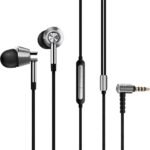
Priced moderately above typical budget earphones, reflecting its triple-driver design and Hi-Res certification, yet remains well below premium flagship models from established audiophile brands.
Ease of use
Excellent 85/100
The earphones are straightforward to use with a standard headphone jack and inline remote, though finding the right ear tip fit may require a brief adjustment.
Overview
The 1MORE Triple Driver review comes down to one question: can a $70 earphone really deliver crisp highs, punchy bass, and a mic that doesn’t make you sound like you’re in a tunnel? Short answer—yes, mostly. These in-ear monitors use one dynamic driver for lows and two balanced armatures for mids and highs, a configuration that used to cost three times as much. They’re wired, they’re silver, and they’re aimed at anyone who wants better sound than phone earbuds without diving into the deep end of audiophile pricing.
What problem do they solve? That middle ground where you care about detail and separation but you’re not ready to spend $200+ or carry a portable DAC. They’re for the person who listens to music on a smartphone or laptop, wishes the stock buds had more presence, and wants a single cable that does music and calls without fuss.
Key Features
Triple driver hybrid design – One dynamic driver handles low frequencies, two balanced armatures cover mids and treble. In practice, that means bass has a physical thump while vocals and cymbals stay airy and separated. You won’t get the muddy blending cheaper single-driver earphones often have.
Hi-Res Audio certification – They reproduce frequencies up to 40 kHz, which matters if you listen to lossless files on Tidal or Apple Music. On standard Spotify streams, you’ll still hear better clarity than typical earbuds, just not the full extension.
In-line MEMS microphone and remote – The three-button remote works on both Android and iOS. The mic is surprisingly usable for calls—owners mention it handles wind noise better than most wired buds at this price.
Braided OFC cable with Kevlar core – The cable resists tangling and feels tougher than the rubbery ones that turn sticky after six months. It’s detachable too, so if a dog chews one side, you replace only the cable.
Nine sets of ear tips – Silicone in three sizes, foam in three sizes, and two “ear hooks” for extra stability. You’ll find a fit that seals well, which is critical for bass response and noise isolation.
Fit for You
You listen to pop, hip-hop, EDM, or rock and want bass that hits without crushing the mids.
You take calls on your phone while walking a noisy street and hate repeating yourself.
You’re tired of earbuds that fall out during a jog or while you’re leaning over a desk.
You want one earphone that works with your phone, laptop, and Nintendo Switch without Bluetooth pairing hassles.
You’ve been curious about “balanced armature” sound but don’t want to spend $150 to try it.
Uses
On a packed commuter train, the foam tips block out the rumble and chatter enough that you can hear bass lines in old D’Angelo tracks that you missed before. The isolation isn’t as deep as noise-cancelling over-ears, but it’s close enough that you’ll miss your stop if you’re not paying attention.
In a home office with two kids running around, the mic picks up your voice clearly while cutting the background mayhem. People on Zoom calls stop saying “you’re cutting out.” The cable’s long enough (about 4.5 feet) to reach a desktop PC without stretching, but short enough that it doesn’t tangle in your chair wheels.
At the gym, keep the cable under your shirt or clip it to your collar. The over-ear hooks (the ones that loop around your ear) and the metal housing make them feel secure. Sweat resistance is okay but not waterproof—don’t take them into rain or a drenching run.
Experience
Out of the box, you get a small carrying case that’s more of a padded pouch than a hard shell. It fits in a jacket pocket but won’t survive being sat on. The first thing you’ll notice is the weight—these are metal, not plastic, so they feel substantial without being uncomfortable. The cable has a bit of memory from being folded, but it relaxes after a day or two.
Fit is the make-or-break detail. With the stock silicone tips, you might get a loose seal and thin bass. Swap to the foam tips and the sound transforms: lows tighten up, isolation improves, and the treble becomes less piercing. Owners agree the foam tips are worth the thirty-second swap. The housings sit flush-ish with your outer ear, so they’re fine for side-sleeping if you’re careful, but not as low-profile as something like the Moondrop Chu.
The mic button is clicky and responsive. One press pauses, two skips, three goes back. Volume control works on both platforms. The MEMS mic handles normal conversation volume well; if you shout, it clips. One small annoyance: the cable rubs against collars and jackets, and that noise travels up to your ears. It’s not terrible, but if you wear a denim jacket or nylon coat, you’ll hear the rustle. A shirt clip (included) helps.
Storage is simple: wind them loosely, put them in the pouch. Don’t wrap tightly around your phone—the metal housings can scratch a screen, and the connector might bend over time.
Pros and Cons
Pros
Solid bass presence for the price – The dynamic driver gives low-end weight that balanced-armature-only designs often lack, so electronic and hip-hop tracks feel engaging.
Detachable cable – When the cable frays or fails (and it will, eventually, because cables do), you don’t toss the whole earbuds. A replacement cable costs about $15–20.
Good microphone for a wired earbud – The MEMS mic is clearer than what you get on most $70 earphones and beats many Bluetooth buds in quiet rooms.
Generous tip selection – With nine pairss, most people will find a comfortable, sealing fit. That directly affects both sound quality and noise isolation. >
Tough build at this price point – The metal housings and braided cable feel like they’ll outlast plastic competitors from Sony or JBL at the same price.
>
Cons
Cable noise (microphonics) – The braided cable rubs against clothing audibly. If you’re walking or moving a lot, you’ll hear every brush against your collar.>>
Fit isn’t universal – The housings are on the larger side. People with small ear canals may find them uncomfortable after an hour, even with the smaller tips.
No in-line volume on some Android phones – The remote works, but volume control compatibility can be spotty on certain Android devices. iPhone users have fewer issues.
Carrying case is basic – The pouch protects from scrateches but not from crushing. If you toss your bag around, get a hard case separateley.
Treble can sound hot on bright recordings – With the foam tips, especially, some rock tracks and poorly mixed pop songs can sound sibilant (essessive ‘s’ sounds). It’s not harsh, but it’s there.
Advantages
The 1MORE Triple Driver sits in a sweet spot where it beats most best in-ear earphones for bass under $100 by offering real instrument separation rather than just a bloated low end. Compared to single-dynamic-driver competitors like the Tin HiFi C2 or the Blon BL-03, the 1MORE gives you more treble air and vocal clarity without sacrificing the thump. The microphone is a genuine advantage over almost every Chi-Fi earphone at this price, which usually skips a mic or includes a terrible one. And while the Moondrop Aria costs about $20 more and has a smoother, more neutral sound, the 1MORE wins on bass punch and call usability—so if you listen to pop or EDM and take calls, it’s the more practical pick.
Better bass than most balanced-armature earphones under $100.
Clearer microphone than 90% of wired earphones in this range.
Detachable cable means it can be repaired, not replaced.
Foam tips included (many competitors make you buy them separate).
Who Should Buy
Buy if you: Want a single wired earphone for music and calls, listen to bass-heavy genres, and don’t want to spend more than $70. You’ll be happy with the foam tips and the durability.
Buy if you: Are curious about hybrid driver designs and want an affordable entry point. The 1MORE is a good intro to what dual-armature clarity sounds like without a huge investment.
Skip if you: Have very small ear canals or ear sensitivity. The metal housings are large and may press on the cartilage of your ear. Look at the Shure SE215 (sleeker) or the Moondrop Aria (smalleer nozzle).
Skip if you: Need Bluetooth or true wireless. These are wired only. If you’re fine with a cable, great. If not, look at the Soundcore Libery Air 2 Pro.
Skip if you: Want a perfectly neutral, refrence sound for mixing or critical listening. The 1MORE is fun and engaging, not clinical. For flat response, the Etymotic ER2SE or the Moondrop Aria are better options at similar prices.
FAQ
Is the 1MORE Triple Driver worth it?
Yes, for most people. At $70, you get a detailed, bass-forward sound, a usable microphone, and a detachable cable—a combination that’s rare at this price. It’s not perfect (cable noise, fit issues for small ears), but it’s one of the best value wired earphones you can buy in 2025.
How does the 1MORE Triple Driver compare to the Sennheiser IE 100 Pro?
The 1MORE Triple Driver vs Sennheiser IE 100 Pro is a battle of fun vs. monitor. The IE 100 Pro has a more neutral, forward midrange that’s better for live monitoring and instruments. The 1MORE has more bass and treble sparkle, making it more enjoyable for regular music listening. The Sennheiser’s cable is also detachable, but its mic is an add-on, not included.
How does the 1MORE Triple Driver compare to the Moondrop Aria?
The 1MORE Triple Driver vs Moondrop Aria comes down to tuning. The Aria has a smoother, more balanced sound with less bass emphasis and a warmer treble. The 1MORE is brighter and punchier. The Aria builds slightly smaller and uses a fixed cable. The 1MORE’s detachable cable gives it a durability edge. Pick the 1MORE for bass and calls, the Aria for neutral listening.
What is the 1MORE Triple Driver sound quality like?
The 1MORE Triple Driver sound quality is lively and slightly V-shaped. Bass has good sub-bass extension and punch without being boomy. Mids are clear but slightly recessed, so vocals sit a step behind the lows and highs. Treble is detailed and can get sibliant on hot recordings. With foam tips, the sound tightens up noticeabley.
How is the 1MORE Triple Driver microphone quality?
The 1MORE Triple Driver microphone quality is good for a wired earbud. It uses a MEMS mic that picks up voice clearly and handles moderate wind noise okay. It sounds natural on Zoom calls and phone conversations. It’s not as good as a dedicated headset mic, but it’s better than most earbud mics below $100.
Are these safe for use with a gaming console?
Yes, they work with PlayStation, Xbox (via the controller’s 3.5mm jack), Nintendo Switch, and PC. The mic works on PC and PlayStation. On Xbox, the mic may need an adapter depending on the controller version. The sound staging is good for gaming—you can hear footstep direction and environmental cues clearly.
Final Verdict
The 1MORE Triple Driver earphones still hold up years after their release because they got the fundamentals right: a hybrid driver setup that actually delivers on its promise, a cable that won’t die in a month, and a microphone that works. At $70, they’re not the last word in detail or neutrality, but they’re one of the most complete packages for anyone who wants better sound than phone earbuds without spending a lot or carrying extra gear.
The one thing to keep in mind: fit is everything. Spend five minutes trying the different tips, especially the foams, and you’ll get sound that rivals many $100–130 earphones. If the housings don’t fit your ears comfortably, they’re not for you—but if they do, you’ve found a daily driver that’ll last for years. That’s why the 1MORE Triple Driver review ends with a simple verdict: worth it, with a tip swap.
1MORE Triple Driver Earphones vs the Competition in 2026
The 1MORE Triple Driver Earphones have been a fixture of the under-$100 IEM scene for years. They offer a triple-driver hybrid setup (one dynamic, two balanced armatures) at a price that often dips below $70. That’s a lot of engineering on paper, but the real question is whether they still hold up against newer alternatives that have refined tuning and build. At $69.99, the 1MORE leans into bass-forward sound and a surprisingly good MEMS microphone for calls. But the competition — especially the Moondrop Aria and the Sennheiser IE 100 Pro — target very different listeners. This is the part where you decide who wins your money.
Product
Price Range
Key Strength
Key Weakness
Best For
1MORE Triple Driver Earphones
~$70
Strong bass, versatile mic/remote, detailed for a hybrid
Non-detachable cable, bulky housing, treble can be uneven
Bass lovers who want a reliable in-line mic for calls and gaming
Requires aftermarket cable for mic, stock cable is okay, not for heavy bass heads
Listeners wanting a relaxed, detailed sound for long sessions without fatigue
KZ ZS10 Pro
~$50
Very affordable, 5 drivers per side, good to mod
Treble can sound brittle, cheap build, tuning is a bit V-shaped and shouty
Budget shoppers who want to experiment with ear tips and cable swaps
1MORE Triple Driver Earphones vs Sennheiser IE 100 Pro
If you’re torn between “bass I can feel” and “every note in its proper place,” this is the fork in the road. The Sennheiser IE 100 Pro was designed for stage monitoring, so it aims for a flat, almost boring response. It’s precise — you hear exactly what the engineer sent. But the 1MORE Triple Driver Earphones are anything but boring. Its dynamic driver shoves bass forward, especially the sub-bass, while the two balanced armatures handle mids and highs. The trade-off is that the 1MORE’s treble has a slight splashiness — cymbals can seem a bit dashed and harsh when the track is busy. The Sennheiser keeps everything contained. Also, the Sennheiser’s cable is detachable (MMCX) and replaceable; the 1MORE’s cable is fixed, which is the single biggest annoyance with this model — if the cable frays or fails, the earphones become a paperweight. On the other hand, the 1MORE includes a MEMS microphone that actually works well for calls, and the Sennheiser’s mic (if you buy the optional cable) is worse. So: want bass punch and call quality? 1MORE. Want honest monitoring and durability? Sennheiser.
1MORE Triple Driver Earphones vs Moondrop Aria
The Moondrop Aria is the darling of the budget-to-midrange community, and for good reason. Its liquid resin and metal shell feels more premium than the plastic of the 1MORE, and the cable is standard 0.78 2-pin — meaning you can swap it for any aftermarket cable with a mic. That alone is a huge advantage if you ever break the stock cable. Sound-wise, the Aria is tuned to what Moondrop calls “Harman-ish” — it’s smooth, with a gentle bass boost that doesn’t overwhelm. Vocals are lush, and treble is refined. The 1MORE Triple Driver Earphones, by contrast, push harder in the low end, making them better for electronic, hip-hop, and any track where you want the kick drum to thump your eardrum. But the Aria sounds more coherent — the three drivers in the 1MORE can sometimes sound disjointed, especially in the crossover region between the dynamic driver and the BA’s. So if you listen to acoustic jazz, singer-songwriter, or orchestral music, the Aria is the more natural choice. If you crave that extra bass weight and don’t mind the fixed cable, the 1MORE is a solid alternative.
1MORE Triple Driver Earphones vs KZ ZS10 Pro
The KZ ZS10 Pro is the budget wildcard — five drivers for around $50. On paper, that sounds like insane value. In practice, the treble can be piercing and the mids feel scooped, which makes some tracks sound bonkers in a bad way. The 1MORE Triple Driver Earphones cost about $20 more but deliver far better tuning balance. The KZ’s build is also a step down: cheaper plastic, non-detachable cable (though newer versions have detachable ones, the original ZS10 Pro didn’t), and the stock tips are terrible. You get your money’s worth, yes, but the 1MORE is the upgrade for anyone who found the KZ too shouty. The 1MORE also has a far better microphone — the KZ’s included cable mic is passable at best. If you’re on an absolute shoestring, the KZ is an option, but the 1MORE is worth the extra $20 for bass that doesn’t just rumble but has texture, and for a mic that doesn’t make you sound like you’re calling from a tunnel.
So who should buy the 1MORE Triple Driver Earphones? If your playlist lives in bass-heavy genres — EDM, trap, modern R&B — and you use your earphones for calls, gaming, or voice chat, the 1MORE is an easy pick. The built-in mic is genuinely good for a sub-$100 pair, and the bass slope gives you that theater-like rumble. If, however, you are a critical listener who wants accurate staging, or if you plan to upgrade cables and want a more neutral signature, look at the Moondrop Aria instead — it’s the better all-rounder for the same money. And if you need a tool for monitoring or live use, the Sennheiser IE 100 Pro, despite costing more, is the logical choice. The 1MORE Triple Driver Earphones are not the best overall, but for a specific, bass-first need with a decent mic, they still make sense in 2026 — even if the fixed cable makes you cringe every time it snags on a drawer handle.
Ready to decide on the 1MORE Triple Driver Earphones?
See today’s price, stock and delivery options on Amazon.