Offers exceptional value with a well-known brand at a low per-unit cost, suitable for gifting and parties.
Price vs. rivals
Typical
CheaperTypicalPricier
This bulk 42-pack sits in the typical mid-range for party-favor modeling compound, balancing a low cost per item with the convenience of a large bulk box; it is not the cheapest per-ounce option but is far from a premium-priced set.
Ease of use
Excellent 95/100
Opening the small 1-ounce cans is straightforward, and the modeling compound is immediately usable with no assembly or instructions needed.
Overview
The Play-Doh 42-pack review you’re looking for starts with a simple answer: yes, it’s worth it – if you need a stack of small cans for a crowd. This is the set of 1-ounce cans, not the big tubs. It solves the problem of handing out something cheap but fun without everyone fighting over one color. It’s really for teachers, party hosts, and anyone who’s ever watched a preschooler melt down because the only blue left is a dried crumb.
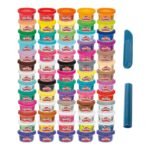
Forty-two cans in a single box. Every color you expect – red, blue, yellow, green, plus the pastels and the weird ones like “magenta.” No tools, no accessories, just the compound. The price works out to about forty cents a can, which is roughly what you’d pay for a single tube of basic modeling clay, only this is the classic stuff your kid’s fingers already know.
Key Features
1-ounce cans – Small enough to disappear in a goody bag, big enough for a few mornings of squishing. Don’t expect to build a life-sized elephant; these are for little hands and short attention spans.
42 individual containers – No one’s sharing. That alone stops a third of the arguments in a classroom. Each can has its own lid, and they seal tight enough to survive a backpack bounce.
Classic Play-Doh formula – The same salty, slightly chemical smell you remember. It stays soft longer than the store-brand stuff. It doesn’t crumble into dust after one session if you close the lid.
Non-toxic modeling compound for kids arts and crafts – It’s been tested to death. Wheat-based, so if you have a gluten allergy in the house, that’s a real concern. Otherwise, it’s safe for ages two and up.
Amazon exclusive packaging – That means you won’t find this exact bundle on a store shelf. The box itself is plain cardboard, nothing fancy. The cans come in a shrink‑wrapped tray, so nothing rattles loose during shipping.
Fit for You
You’re a preschool teacher planning a whole-class activity and don’t want to referee “she took my orange.”
You’re stuffing party favor bags for a birthday and need something that won’t break the bank or break a window if thrown.
You run a classroom prize box and want a reward that actually gets used rather than tossed under the couch.
You keep a stash for rainy afternoons when your kid has announced, again, that there’s nothing to do.
You’re a day‑care provider who needs a low‑mess craft option that doesn’t require a special tablecloth.
You’re buying a bulk handout for a church event or summer camp and don’t want to manage forty different zipper bags.
Uses
Handing these out at a school carnival? Grab a handful and toss them into brown paper bags next to the cupcake walk. No assembly required. For a birthday party, you can tape a “thank you for coming” tag to each can and call it done. Parents appreciate that it’s not a plastic whistle.
In a classroom, every kid gets their own can. The predictable chaos of “who touched my red” vanishes. You can keep a few extras in a drawer for the kid who forgets their supplies. The 1‑ounce size is small enough that a child can roll it into a snake or flatten it into a pancake without feeling overwhelmed by a huge brick of dough.
For at‑home play, these are perfect for the under‑five set. You don’t need to cut a big tub into pieces. Just hand over a can, let them mush it, and when they lose interest, snap the lid back on. The whole “put it away” struggle is shorter because the can is tiny.
Experience
Out of the box, the cans feel sturdy. Not flimsy like some off‑brands where the rim bends if you look at it wrong. Twist the lid – it’s a quarter turn, not a pop‑off that shoots across the room. The first squeeze: the compound is soft, a little oily on your fingers. That’s normal. It’s been sitting in a warehouse, so give it a knead for ten seconds and it’s ready.
The smell is pure Play‑Doh. Nostalgic, but if you’re sensitive to it, you’ll notice it lingers on your hands for a while. Wash with soap and you’re fine.
Cleaning is simple. The compound doesn’t stain most surfaces – it can leave a faint oily mark on raw wood, so keep it on a tray or a wipe‑clean table. Crumbs dry into little rubbery bits that vacuum up easily. The real annoyance: if you leave a can open overnight, the top layer hardens into a crust. Peel that off, and the stuff underneath is still good. You lose maybe a tenth of the can. Best to always reseal.
Storage is a non‑issue. All forty‑two cans fit back into the original box, though you’ll want to toss the cardboard after a while and just keep the cans in a bin. The lids pop off if a kid really tries, but normal preschool handling won’t do it. One minor complaint: the labels are stickers that can peel off if they get wet. Not a deal‑breaker, but if you care about color identification, you might want to mark the lids with a Sharpie.
Pros and Cons
Pros
Price per can is unbeatable – At roughly $0.40 each, you’re paying less than a quarter of what a single 3‑ounce tub costs at the grocery store. For bulk gifting, that math works.
No sharing conflicts – Every child gets their own color. That alone is worth the box price in a classroom.
Consistent quality – Play‑Doh has been making this stuff for decades. You know exactly what you’re getting: soft, pliable, and it doesn’t dry out as fast as the cheap alternatives.
Compact and portable – The whole set fits in a small tote. You can grab a handful for a restaurant trip without hauling a huge container.
Safe for ages 2+ – No small parts, no sharp edges. The compound passes all standard toy safety tests.
Cons
Small cans run out fast for older kids – A five‑year‑old who really gets into building might polish off a 1‑ounce can in one session. If you have a heavy user, spring for the 3‑ounce packs instead.
No variety pack of colors – You get a mix, but it’s the same mix every time. Six greens, six blues, six reds – not a curated set of twenty‑one unique shades. You’ll have a lot of white and black.
Wheat‑based formula causes real issues for some – If you or your kid has celiac disease or a wheat allergy, this isn’t safe. Gluten‑free alternatives exist (Crayola’s modeling clay is one), but they’re pricier.
Lids can be hard for toddlers to close – The quarter‑turn lid needs a little grip. A two‑year‑old might need help or they’ll leave it half‑open, and the compound dries.
Not for sculpting details – This is squish‑and‑smush play, not fine art. If you need something that holds sharp edges, look at Crayola Model Magic or a proper air‑dry clay.
Advantages
The best bulk Play-Doh for classroom prizes is hard to argue with. Other modeling compounds in this price range, like the generic store brands, tend to be stiffer – you have to warm them up in your hands for thirty seconds before they’re usable. Play‑Doh is ready right out of the can. Also, the color payoff is brighter. Cheap stuff often comes out pastel and streaky.
When you consider Play-Doh vs Crayola modeling clay for preschoolers, there’s a real difference. Crayola’s modeling clay is oil‑based and doesn’t dry out at all – it stays soft forever. That sounds great, but it’s also greasier and leaves a residue on paper and carpets. Play‑Doh dries, which means you can clean up dried bits with a vacuum, and it doesn’t stain fabric the way oil clay can. For a preschool setting where mess is inevitable, Play‑Doh is the lower‑risk choice.
The Play-Doh 1-ounce cans set is also one of the few products that actually gives you a consistent weight per can. Some cheap multipacks have cans that are half‑full. These are filled right to the top. You can feel the heft.
Who Should Buy
Buy it if you’re organizing a party, classroom treat, or camp activity where you need mass quantities without spending a fortune. Also buy it if your child is two to four and you just need a low‑stakes introduction to modeling.
Skip it if you have one kid who plays with modeling clay for hours every day. They’ll burn through these tiny cans in a week. Go for the 24‑pack of 3‑ounce tubs – more compound per dollar, fewer lids to lose.
Skip it if you’re after a gluten‑free option. Look at Crayola’s Dough or a homemade alternative. Your child’s health isn’t worth saving a few bucks.
Also skip it if you want a tool set along with the clay. This is raw compound only. No cutters, no rollers, no extruder. You’ll need to buy those separately or already have them.
FAQ
Is the Play-Doh 42-pack modeling compound worth it?
Yes, for bulk handouts and group play. At $16.99, you get 42 individual cans, which is cheaper per can than almost any alternative. It’s not worth it if you need large quantities for a single child – then the bigger tubs make more sense.
How long does the Play-Doh last after opening?
If you seal the lid tightly after each use, it stays soft for about two to three months. Once the can is open and played with, the compound gradually dries. Keeping it in a sealed zipper bag inside the can can extend the life.
Is it safe for kids with gluten allergies?
No, Play‑Doh contains wheat. The package clearly states it’s not for anyone with celiac disease or wheat allergy. If that’s a concern, choose a gluten‑free modeling compound like Crayola Dough or a non‑wheat clay.
Can you mix the colors together?
Yes, and you’ll get muddy results fast. Once you blend two colors, you can’t separate them. For clean play, encourage your child to use one color per session, or accept that you’re making brown playdough for the rest of its life.
Is the Play-Doh 42-pack good for classroom prizes?
Absolutely. Each can is small enough to fit in a prize bin, and the price means you can stock up for the whole year. Teachers report that kids actually prefer these over stickers or little erasers because they can play with them immediately.
What colors come in the 42‑pack?
The set includes a mix of standard colors: red, blue, yellow, green, orange, purple, pink, white, black, brown, and a couple of pastel shades. You’ll get roughly four to six of each, not a unique color per can. There’s no glitter or neon specialty dough in this bundle.
Final Verdict
If you need a Play-Doh bulk handout for party favors or a classroom reward that doesn’t feel like a cheap token, buy this pack. The price is right, the quality is exactly what you expect from the brand, and the 1‑ounce cans are the ideal size for short sessions. The biggest downside is the small volume per can; if your kid is a serious sculptor, buy bigger ones. Otherwise, this is the simplest way to hand out fun without the headache of dividing a big tub into forty‑two portions yourself. One thing to keep in mind: wheat allergy. Check before you buy for a group, and you’re set.
Play-Doh 42-pack modeling compound vs the Competition in 2026
The Play-Doh 42-pack sits in a weird spot: it’s a bulk handout that costs $16.99, which is cheap per can but a bigger upfront spend than most parents expect for a single toy. On Amazon it’s got a 4.9-star average, which says a lot about how well it nails the “party favor” and “classroom prize” brief. But when you stack it against smaller Play-Doh sets, Crayola’s modeling clay, or even Kinetic Sand, the trade-offs show up fast. Here’s where each one earns its keep, and where it doesn’t.
Product
Price Range
Key Strength
Key Weakness
Best For
Play-Doh 42-pack modeling compound
$16.99
42 individual 1-ounce cans – the sheer count beats anything near this price
Smaller cans (1 oz) run out quickly if a kid really gets into it
Classroom goodie bags, party favors, bulk prizes where you need one per kid
Play-Doh 10-pack (standard 2-ounce cans)
$8–$10
Bigger cans (2 oz) – better for solo play sessions that last
Only 10 cans, so not enough for a class of 20+ kids without buying multiples
Home play for one or two siblings, or a small preschool group
Crayola Modeling Clay 4-pack (1-ounce sticks)
$6–$8
Doesn’t dry out – you can leave it out for days and it’s still moldable
Harder texture; little fingers (under 3) struggle to squish it compared to Play-Doh
Older kids (4+) or projects that need to hold shape longer than an afternoon
Kinetic Sand 2.5-pound bag
$12–$15
Unique sensory feel – it flows and cuts like wet sand without mess
Doesn’t build stable structures; can’t roll into snakes or press into detailed molds
Sensory play bins and calm-down time, not for making actual shapes
Play-Doh 42-pack modeling compound vs Play-Doh 10-pack (the size trade-off)
The 42-pack uses those skinny 1-ounce cans, while the 10-pack gives you the classic 2-ounce size. That half-size matters more than you think. One 1-ounce can is about enough for a kid to make two small cookies or one lumpy frog before it’s all mixed into a brownish grey. For a single kid at home, the 10-pack is the smarter buy – you get twice the dough per can and fewer colors to argue over. But the 42-pack’s whole point is quantity over can size. If you’re handing these out at a birthday party or stuffing them into Halloween treat bags, that 1-ounce can is actually ideal: it’s small enough to fit in a goodie bag and big enough to keep a kid busy for 20 minutes. The 10-pack doesn’t scale, and you’ll end up spending $20+ to match the same headcount.
Play-Doh 42-pack modeling compound vs Crayola modeling clay for preschoolers
Crayola’s modeling clay is a completely different beast. It’s oil-based, so it never dries out, and it holds fine details like a tiny dog’s ears without drooping. That’s great for a preschooler who wants to make a gift for grandma and leave it on the shelf for a week. But here’s the catch: that clay is stiff. A three-year-old with typical hand strength will get frustrated trying to squish it into a ball. Play-Doh is soft right out of the can – no warm-up needed. So for the 2–3 age range, the 42-pack wins because you don’t want a meltdown over hard clay. For kids closer to 5 who can handle the firmer texture and want their creations to last, Crayola modeling clay is the better investment per can if you only need a few colors. But you won’t get 42 sticks for $16.99 – Crayola sells a 4-pack for around $7, so it’s less about bulk and more about durability.
Play-Doh 42-pack modeling compound vs Kinetic Sand (the sensory alternative)
Kinetic Sand is the wildcard. It doesn’t mold like Play-Doh; you can’t roll it into a snake or stamp it with a cutter. What it does is flow through your fingers in a way that calms down a hyped-up kid. If your goal is classroom prizes or party favors, Kinetic Sand is actually a pain because it needs a contained bin and doesn’t come in portable 1-ounce packs. The 42-pack wins on portability and mess control. But if you’re shopping for a single child who craves squishy sensory input (and you don’t care about building things), Kinetic Sand 2.5 pounds lasts longer because there’s more mass. And unlike Play-Doh, it never drys out, even if the bag is left open overnight. So the decision comes down to activity type: structured creation? Play-Doh. Open-ended sensory play? Kinetic Sand. **So who should buy the Play-Doh 42-pack modeling compound?** You, if you need to supply a classroom of 20+ kids with something they can open and start squishing immediately, no prep, no cleanup beyond a wipe. It’s also perfect for party favor bags, backpack stuffers, or as a quick prize for a reading challenge where each kid gets one can. You could buy three 10-packs to get 30 larger cans for roughly $27, but that’s $10 more and you still don’t have individual packages for each child. The 42-pack beats every other alternative on per-unit cost at the “one per kid” scale. **Skip it and buy the Play-Doh 10-pack instead** if you’re only buying for one or two kids at home – the larger can size means less frustration when the purple runs out mid-dinosaur. And if you want a toy that doesn’t dry out and your child is past the mouthing stage, grab the Crayola modeling clay 4-pack for half the price and a much longer shelf life.
Ready to decide on the Play-Doh 42-pack modeling compound?
See today’s price, stock and delivery options on Amazon.