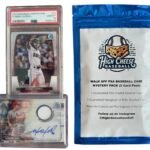
Affordable entry point with guaranteed stars and vintage cards, but moderate quality rating limits perceived value.
Price vs. rivals
Cheaper
CheaperTypicalPricier
Priced well below most comparable premium packs, reflecting a budget-friendly position with moderate customer ratings and lower-tier guarantees.
Ease of use
Excellent 95/100
Opening a baseball card pack is extremely simple and intuitive, requiring no effort for an average person.
Overview
Calling this the best baseball card pack for collectors is a stretch. It’s not designed for serious set builders. It’s designed for the collector who remembers the names on the wrappers from their childhood, or the parent who doesn’t want to spend fifty bucks on a blaster box just to see their kid’s face light up. In this review of the Legends baseball card pack, let’s be clear about what it actually delivers.
The pack solves a specific problem. It fills the gap between a gumball machine pack and a top-tier hobby box. It’s a low-stakes gamble for casual fans who just want to open something with a familiar name inside.
Key Features
The main draw of this Legends baseball card pack review is the guarantee. You don’t get mystery. You get known quantities.
15 Cards Total – Enough for a satisfying rip without feeling like you have burned through your budget. You get a little stack to sort through.
Three Guaranteed Stars or Hall of Famers – This is the headline. You will see a name you know. It keeps the pack out of the trash pile.
Three Vintage Cards – “Vintage” needs a disclaimer. Expect reprints or cards from less-collected eras. It sets the right expectation.
Possibility of an Autograph or Jersey Patch – People buy this pack hoping to get a baseball card pack with autograph potential without the hobby box price tag. The odds are long, but the possibility is very real.
Randomized Inserts and Rookies – Adds a layer of surprise. You might snag a modern rookie that looks sharp in the stack.
Fit for You
You want a cheap way to feed the pack-ripping habit without a major financial commitment.
You’re buying a small gift for a baseball fan and need something that looks substantial.
You teach or coach a young fan and want to show them what a “legend” looks like on cardboard.
You host a break or just like the social ritual of opening packs with friends.
You’re filling out a purchase to get free shipping and want a fun add-on.
Uses
The best place for this pack is in a shopping cart with other things. It’s exactly the right price to push your order over the free shipping threshold. It’s cheap enough that you don’t feel guilty, and the fun of ripping it is a small reward at the end of the shopping trip.
It also works as a palate cleanser. If you have been deep into modern chase cards, ripping a Legends pack reminds you of the simpler side of the hobby. The names are older, the stakes are lower.
For the kids who just know the big names, seeing a Hank Aaron or a Babe Ruth card — even a reprint — can be a cool little history lesson.
Experience
The packaging is standard — you won’t mistake this for a premium product when it arrives. The wrapper has a clean but simple design. Inside, the cards have a distinct paper stock. It’s thinner than a modern flagship Topps card, which makes sense given the price point.
The rip itself is quick. You’ll probably have the whole pack sorted in two minutes. The good part happens in the first few cards. That story — the specific list of who you pulled — is what you tell your friend.
Owners tend to mention the variance. One buyer gets a solid old common that looks the part. Another gets something that feels like a cheap reprint. That inconsistency is probably why the rating sits at 3.2 stars. You hope for the first experience but brace for the second. The letdown comes when you compare the stars to the rest of the pack. You might pull a big name and then twelve cards that feel like filler. It makes the pack feel top-heavy.
Pros and Cons
Pros
Guaranteed stars – You always walk away with a few names you actually know. That’s more than you can say for most packs under ten bucks.
Accessible price – At $8.25, it is in impulse-buy territory. You don’t need a second thought.
Good for beginners – A safe way to teach a younger collector about the history of the game.
Fun lottery aspect – The autograph and jersey patches keep the dream alive for the duration of the rip.
Cons
Card quality – The stock and print quality don’t match the flagship products. It feels like a budget product because it is one.
Inconsistent vintage selection – You might get a 70s common or a 90s overproduction era card. The term is used loosely.
Low resale value – Don’t buy this expecting to make money. You almost certainly won’t. The 3.2-star rating reflects this.
Duplicates across multiple packs – If you buy a case, expect to see the same stars show up. The pool of inserted players isn’t huge.
Advantages
If you are doing a Legends vs Topps pack comparison, the core difference is predictability. A fresh Topps pack gives you a shot at modern superstars and high resale value. It also costs more and might give you a pack of players you’ve never heard of. Legends guarantees you names. You lose the high ceiling of modern inserts, but you avoid the floor of a pack full of no-names.
The other big advantage is giftability. Handing a friend a random pack of Topps is a gamble on their taste. Handing them a Legends pack tells them you know they love the history of the game. The lower price point also means you can afford to take risks on it you wouldn’t on a twenty-dollar pack.
Who Should Buy
Who it is perfect for:
Parents of young kids who just want to open something cool.
Casual fans who grew up on the names and want a cheap nostalgia hit.
Collectors who need a low-stakes fix between real paydays.
Who should skip it:
Serious graded-card investors looking for a return.
Set builders looking for specific modern cards.
People who hate reprints and lower-tier card stock.
If you skip it, look for a standard Topps or Bowman pack for a cleaner modern experience, or just save your money for a collection you already love.
FAQ
Is the Legends Baseball Card Pack worth it?
As any honest Legends baseball card pack review will tell you, it depends on your expectations. For a casual rip, yes. The guaranteed stars make it worth the asking price for fun. If you are looking for high-grade investment pieces, you will likely be disappointed by the print quality.
Best baseball card pack for collectors on a budget?
It is a strong candidate. All packs are fun, but the guarantee of known names makes this one of the safest low-cost bets for the casual collector who just wants to enjoy the hobby without breaking the bank.
Legends vs Topps pack comparison: which is better?
They serve different needs. Topps is modern, shiny, and built for the current speculator market. Legends is a history lesson with a lottery ticket. Buy Topps for potential value. Buy Legends for guaranteed names at a low price.
Does the pack actually contain an autograph?
It can, but it does not guarantee one. The pack is a baseball card pack with autograph possibilities. The odds are low, comparable to a scratch-off ticket. People do find them, which is what keeps the experience interesting.
Is a 2026 baseball card pack review fitting to describe this?
This is a current product sold on Amazon, so a 2026 baseball card pack review is very relevant. The design and strategy haven’t changed much year over year. It is the same low-cost, high nostalgic value model.
Are the vintage cards real vintage cards?
Most often they are reprints or commons from less popular 70s and 80s sets. They are real cards, but they are not high-grade vintage investment pieces. They add context and a feeling of history to the rip.
Final Verdict
This is a solid $8 purchase if you understand exactly what you are paying for. You are paying for the guarantee of ripping three famous names. You are not paying for a premium product. The 3.2-star rating is earned by inconsistent quality and the letdown some feel when they realize the vintage isn’t as old as they hoped.
The Legends baseball card pack review consensus is simple. Buy it for the fun of it. Buy it for the kid who loves baseball. Don’t buy it hoping to flip it. As long as your expectations match the price tag, it does exactly what it promises.
Legends Baseball Card Pack vs the Competition in 2026
If you’ve been hunting for a baseball card pack that doesn’t leave you with a stack of commons and a faint hope, the Legends Baseball Card Pack makes a specific promise: three guaranteed stars or Hall of Famers, three vintage cards, and a shot at an autograph or jersey patch. At around $8.25, it sits right between a cheap retail pack and a premium box. But the real question is whether that guarantee delivers enough value compared to the packs you already know. Here’s how it stacks up against the heavy hitters.
Product
Price Range
Key Strength
Key Weakness
Best For
Legends Baseball Card Pack
~$8
3 guaranteed stars/HOFers + vintage cards
Brand recognition; inconsistent autograph odds
Collectors who want known names without spending $30+
Topps 2026 Series 1 Retail Pack
~$4–5
Official MLB license; iconic design; strong rookie class
Only 1–2 stars per pack; no guaranteed hits
Budget-conscious fans chasing the latest rookies
Panini Prizm Baseball Retail Pack
~$6–8
Flashy refractors and parallels; strong resale on hot names
No MLB team logos; base cards feel thin
Investors flipping shiny inserts and serial-numbered cards
Bowman Chrome 1st Edition Retail Pack
~$10
Prospect-heavy with high long-term upside; iconic chrome finish
Expensive for 4–5 cards; many unknown names
Speculators who want rookie autographs before they blow up
Legends Baseball Card Pack vs Topps Series 1 Retail Pack
Topps is the default choice for most collectors, and at $4–5 it’s half the price of the Legends pack. You get 10–12 cards, usually one or two stars if you’re lucky, and the rookie class is always the main draw. The Legends pack costs more but guarantees you three legends — think Aaron Judge, Nolan Ryan, or a Hall of Famer like Johnny Bench. That’s a direct and immediate payoff. Where Topps wins is consistency: you know exactly what you’re buying, and the card quality is industry-standard. Legends uses a mix of vintage reprints and modern inserts, and the paper stock on those vintage cards can feel a bit flimsy compared to a fresh Topps flagship card. If you just want to rip something cheap and hope for a hot rookie, grab the Topps. If you’d rather walk away with a Shohei Ohtani or a Mickey Mantle reprint and skip the lottery, Legends is the better bet.
Legends Baseball Card Pack vs Panini Prizm Baseball Retail Pack
Panini Prizm runs on flash. The retail pack is about the same price as Legends, sometimes a dollar less, and you get 4–5 cards that are entirely about the refractor rainbow. The base cards are plain and paper-thin, but the parallels — silver, green, orange — can sell for real money if you hit the right player. Legends doesn’t do refractors; it does vintage-style cards and the occasional jersey patch or autograph. The annoyance with Prizm is the lack of team logos — the uniforms are airbrushed, and that bugs some collectors. Legends doesn’t have that problem: they license player names and photos, but they’re not an MLB-licensed product either, so you won’t get any team logos in the legends set either. The trade-off is simple: what do you value more? A flashy parallel that might be worth $10 next month, or a guaranteed Hall of Famer you can put in a binder today? Prizm is for the flipper. Legends is for the collector who wants to open a pack and already feel satisfied.
Bowman Chrome is the king of prospect speculation. You’ll pay around $10 for a 4-card pack (or $25 for a mega box with more cards), and every card is a chrome parallel of a minor leaguer you might not have heard of. The thrill is pulling a 1st Bowman auto of a kid who might be the next Mike Trout. The catch is that most of those cards end up worthless. Legends takes the opposite approach: it guarantees known commodities. For $8.25, you get 15 cards, three of which are stars you already know. You might get a rookie, but you’re paying for a floor of recognizable names. Bowman Chrome is a high-risk, high-reward gamble that only pays off if you’re patient or lucky. Legends is a low-risk pack for someone who’s been burned by too many Bowman packs full of no-name shortstops. If you have $10 and want to dream, buy Bowman. If you have $8 and want to actually enjoy what you pulled, buy Legends.
So who should pick the Legends Baseball Card Pack? If you’re tired of paying $5 for a pack of Topps and getting a single marginal star, or you’ve had it with Bowman’s prospect roulette, Legends gives you something rare: a guarantee that you’ll open a pack and see a name you know. The three stars or Hall of Famers are the selling point, and the vintage cards add a nice break from the usual modern design. That said, if you’re chasing the biggest long-term value or you need MLB licensing for a team-builder set, skip it and grab Topps Series 1 instead — you’ll get more cards for less money, and the rookies have better resale potential. Legends is a pack for the collector who wants a quick hit of nostalgia without the empty feeling of a dud rip. It’s not the flashiest, but it delivers exactly what it promises.
Ready to decide on the Legends Baseball Card Pack?
See today’s price, stock and delivery options on Amazon.