Competitively priced with high user ratings, offering reliable performance at a lower cost than leading brands.
Price vs. rivals
Cheaper
CheaperTypicalPricier
This price is moderately lower than typical retail for similar insulin syringes from major brands, reflecting a budget-friendly positioning while maintaining a high customer rating.
Ease of use
Excellent 88/100
The high 4.5-star rating and common 31G short needle design make it straightforward for most people, though proper injection technique is still required.
Overview
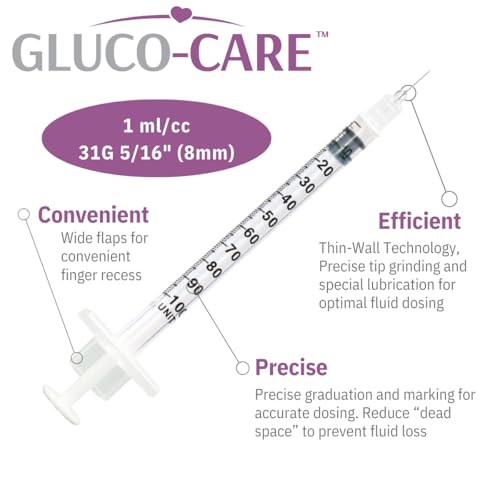
GLUCO-CARE 31G syringes are a solid, everyday option for anyone who needs to dose insulin precisely and hates wasting money on fancy packaging. They’re 1ml syringes with a thin 31-gauge needle that’s 5/16-inch (8mm) long—short enough for most adults and kids, thin enough that you barely feel the stick. At roughly $21.97 for a box of 100, that’s about 22 cents a syringe. You’d pay double for certain big-brand alternatives and get the same basic job done.
Who are these for? People who take insulin daily, test their blood sugar, and want a reliable, no-drama syringe that doesn’t require a second mortgage. The orange cap helps you spot it in a crowded drawer, and the half-unit markings make tuning doses easier than with pens. The real question is whether they hold up against the usual suspects.
Key Features
31G x 5/16-inch needle – That thin wall means less tissue trauma and a quick, clean injection. The short length works well for subcutaneous shots even if you’re lean.
Orange cap and plunger – Orange cap syringes 1ml are easy to tell apart from your green-capped BDs or grey-capped store brands. The colored plunger also makes reading the fill line less squinty.
Half-unit markings – The barrel has clear lines every 0.5 units. If your insulin regimen calls for odd numbers (like 4.5 units), you won’t be guessing.
Pre-attached needle – No fumbling to twist a needle onto a pen. Pull the orange cap off, draw, inject. Saves ten seconds you’ll use to check your phone.
100-pack box – Lasts about three months at one injection a day. The box is compact and doesn’t fall apart after three weeks of opening.
Fit for You
You inject insulin twice or three times a day and want a syringe that doesn’t feel like a blunt stick.
You’re on a mixed insulin (like NPH and Regular) that you need to draw from two vials—the half-unit marks help you blend accurately.
You’ve been burned by cheap syringes whose plungers stick or leak. GLUCO-CARE syringe quality here is consistent enough to avoid that.
You travel a lot and want a needle short enough to not poke through muscle if you inject in your arm or thigh.
You hate hunting for the right syringe in a messy bag—orange cap syringes 1ml are unmistakable.
Uses
Picture this: you’re at a restaurant, trying to inject before a meal without making a scene. The short 5/16-inch needle means you can pinch a small fold of skin on your stomach, slip it in, and no one notices. The thin gauge also means less bleeding—great if you’re on blood thinners and already get enough bruises.
Another common scene: you’re mixing two insulins. Draw air into a U-100 syringe, inject it into the cloudy vial, then clear from the regular vial. The half-unit marks on this GLUCO-CARE model let you hit 7.5 units without eyeballing. The plunger moves smoothly—no sudden jerks that make you overdraw and waste insulin.
Experience
You pull a syringe out of the box. The orange cap pops off with a dry click—no sticky residue. The needle is mounted slightly off-center on the hub, but that’s typical for this price range; you just rotate it. Drawing solution is clean: the plunger slides without skipping, and the rubber tip doesn’t drag against the barrel. When you push to inject, the resistance is even, not too stiff.
The catch? The needle is not silicone-coated as heavily as some premium brands. It’s still sharp, but it dulls a bit faster if you’re reusing them (which you shouldn’t, though people do). The graduation print is white against clear plastic, easy to read under a bright lamp but harder in dim restaurant light. A magnifying window would help, but you don’t get that at 22 cents a syringe.
Storage? They sit fine at room temperature out of direct sun. The box is flimsy—cardboard, not plastic—so if you toss them in a backpack, the corners get crushed and syringes can fall out. A small pencil case solves that.
Pros and Cons
Pros
Low price per syringe – $0.22 each. You can stock a full three-month supply for less than a single copay on a fancy injector pen.
Half-unit markings – Not all 1ml syringes have them. For flexible dosing, especially with kids, these lines are a lifesaver.
Short needle – 8mm is long enough to hit fat but short enough to avoid hitting muscle, even on a thin belly. Much easier than the old 12.7mm ones.
Orange cap – Instantly recognizable. If you have multiple types of syringes in the house, you’ll never mix them up.
Consistent plunger glide – No sticky spots or air bubbles trapped because the rubber doesn’t seal unevenly. Smooth draw every time.
Cons
Needle lubrication is average – It’s sharp enough for a single use, but if you try reusing it (some do), the coating wears off faster than on a BD syringe. Skip the reuse.
Cardboard box is cheap – The box doesn’t hold up to travel abuse. You’ll want a separate storage case.
No safety shield or needle disposal cap – Some syringes come with a cap that goes back on after use. These don’t—you need a sharps container.
Markings are white, not black – Fine in good light, but if you’re injecting in a dim car or bathroom, you might wish for higher contrast.
Advantages
The biggest advantage of GLUCO-CARE over a brand like BD is cost. For the same specs—31G, 5/16 inch, 1ml—BD syringes can run $30–$35 for a hundred. GLUCO-CARE syringes are about 30% cheaper, and the core function is identical. The half-unit scaling is actually more common on these than on some BD models, which often skip it on the 1ml size. If you’re doing best syringes for insulin dosing on a budget, these are hard to beat.
Another edge: the orange cap. In a household where several people use different syringes, color-coding matters. You grab the orange one for insulin, the green one for something else—no squinting at tiny text.
Who Should Buy
Buy them if – You need a reliable everyday syringe for insulin and don’t want to pay premium for a name. You dose in half-units and appreciate the extra marks. You like orange (or at least don’t hate it).
Skip them if – You require a safety-engineered syringe for clinical use or needle reuse prevention. Also skip if you have a strong preference for the slightly smoother glide of a BD or if you inject by feel in very low light often—those markings will test your patience.
FAQ
Is the GLUCO-CARE 31G syringes review positive overall?
Yes, it’s positive for the price. Buyers consistently say they work just as well as name-brand syringes for daily insulin injections. The main caveat is the needle lubricant is lighter, so limit to one use per syringe.
How do GLUCO-CARE vs BD syringes compare?
BD syringes have a slightly better silicone coating and a sturdier cap. GLUCO-CARE costs less and includes half-unit markings that many BD 1ml syringes lack. For most people, the difference isn’t noticeable after the first stick.
Are these the best syringes for insulin dosing?
If “best” means accurate dosing at a reasonable price, yes. The half-unit marks and smooth plunger give you precision without the premium. If you need a needle with a safety shield, look elsewhere.
Do “orange cap syringes 1ml” work for U-40 insulin?
No. These are U-100 syringes, designed for standard insulin (100 units per ml). U-40 insulin requires a different barrel scale. Using the wrong one will cause dangerous dosing errors. Check your insulin concentration first.
Is GLUCO-CARE syringe quality consistent across boxes?
Generally, yes. Owners report few duds. The manufacturing tolerances are tight enough that plungers don’t stick and needles don’t break. A small percentage of syringes have a slightly bent needle, but you’d notice that before injection.
How long does a 100-pack box last?
If you inject once daily, about three months. If you inject twice daily, six weeks. The box is not resealable, so transfer extras to a clean container to keep them dust-free.
Final Verdict
GLUCO-CARE 31G syringes are a smart pick for anyone who needs a reliable, affordable insulin syringe and isn’t obsessed with brand prestige. You get thin needles, half-unit dosing, and a color that’s easy to spot in a crowded drawer. The trade-offs are minor—the box isn’t travel-proof, and the needle coating is okay but not deluxe.
If you’re buying a three-month supply for $22, you’ll have no regrets. Pair them with a small sharps container and a zippered pouch, and you’ve got a setup that works anywhere. That’s the honest story on GLUCO-CARE 31G 1ml syringes. Is it worth it? For the price, yes—especially when you compare the half-unit marks to what BD charges.
GLUCO-CARE 31G 1ml Syringes vs the Competition in 2026
If you’re shopping for insulin syringes, you’ve landed on a crowded shelf. The GLUCO-CARE 31G 1ml syringes sit right in the middle of the pack — not the cheapest, not the fanciest, but they’ve built a loyal following for a reason. At about $22 for a box of 100, they undercut premium brands while sticking with the same 31-gauge, 5/16-inch needle that most people with standard dosing needs reach for. Here’s how they stack up against the real alternatives you’ll find online and in pharmacies.
Product
Price Range
Key Strength
Key Weakness
Best For
GLUCO-CARE 31G 1ml (orange cap)
~$22/box
Smooth plunger, consistent dead space
Orange cap harder to read against some lighting
Cost-conscious users who still want reliable quality
Higher price, sometimes harder to find multipacks online
Anyone with sensitive skin or who values brand trust
Easy Touch 31G 1ml (orange cap)
~$18–22/box
Low cost, same orange cap design
Plunger can feel scratchy, less consistent sterility seals
Budget shoppers who don’t mind a rougher draw
Sure-Ject 31G 1ml
~$20–26/box
Large finger-grip wings for stability
Thicker barrel markings can smudge
Users with limited hand dexterity
GLUCO-CARE 31G syringes review vs BD Ultra-Fine
The big question in any “GLUCO-CARE vs BD syringes” matchup is needle feel. BD’s Ultra-Fine uses a proprietary siliconization process that makes the needle slip in with almost no drag — genuinely impressive. The GLUCO-CARE needle isn’t far behind, but if you’re someone who injects six times a day and every little scratch matters, BD wins. What GLUCO-CARE does better is the plunger. The rubber stopper moves with less stuttering than BD’s, especially when you’re drawing from a vial. That smoothness matters more than most people realize until they’ve wrestled with a sticky plunger mid-dose. Price gap is about $6–13 per box. If you’re on a tight budget or go through a box every month, you’ll feel that difference.
GLUCO-CARE 31G 1ml syringes vs Easy Touch
Easy Touch is the alternative that looks almost identical — orange cap, 31G, 1ml, 5/16 inch. But hold both side by side and you’ll notice the GLUCO-CARE barrel markings are bolder and more permanently printed. Easy Touch markings can rub off after a few weeks in a bag or pocket. More important: the GLUCO-CARE plunger head is slightly wider, which means less side-to-side wobble when you push. That wobble in Easy Touch can cause tiny air bubbles to sneak in if you’re not careful. For rapid-acting insulin where a single unit matters, GLUCO-CARE gives you more precision. Easy Touch is cheaper by a few bucks, but you’ll throw away more syringes early if the sterility wrap tears — a common complaint on those cheaper boxes.
Who wins?
Choose the GLUCO-CARE 31G 1ml syringes if you want a reliable, affordable tool that doesn’t punish you with a sticky plunger or faint markings. It’s the best syringe for insulin dosing at this price point for anyone who draws their own doses daily. But if you’ve got very sensitive skin or inject into scarred tissue regularly, spring for the BD Ultra-Fine — the extra $8 is worth it for the needle comfort. And if you’re strictly counting every penny, Easy Touch will work; just expect to handle them with a little more care.
Ready to decide on the GLUCO-CARE 31G 1ml syringes?
See today’s price, stock and delivery options on Amazon.