River of Goods ceiling fan review: yes, it’s worth it for a specific buyer. At $132.99, you get a 52-inch LED fan with barnwood-look blades and a fabric shade that hides the mid-century modern lines in plain sight. It’s not a Hunter, but it doesn’t try to be.
Offers a stylish mid-century modern design with integrated lighting at a price point that balances quality and affordability.
Price vs. rivals
Typical
CheaperTypicalPricier
This fan is priced at a typical mid-range level for a 52-inch LED ceiling fan with modern styling and dual finish options.
Ease of use
Great 75/100
Installation may require some DIY effort, but once set up, the fan and light are straightforward to operate with standard controls.
Overview: River of Goods ceiling fan review
The short version is in the title: it’s a 52-inch transitional ceiling fan with LED light, a fabric shade, and barnwood/driftwood blades. That combination solves a real problem. A plain white fan would stick out in a modern room, and a bare industrial fan would feel too cold. This one sits in between.
The kind of person who searches for a River of Goods ceiling fan review usually wants one thing: modern style without the designer price. That’s this fan. At $132.99, it’s a strong candidate for best transitional ceiling fan for modern home if you don’t need smart features or hand-finished details. The 4.2-star average rating fits that profile—owners like the look and the price, and the complaints are about details, not function.
Key Features: 52 inch LED ceiling fan with barnwood blades
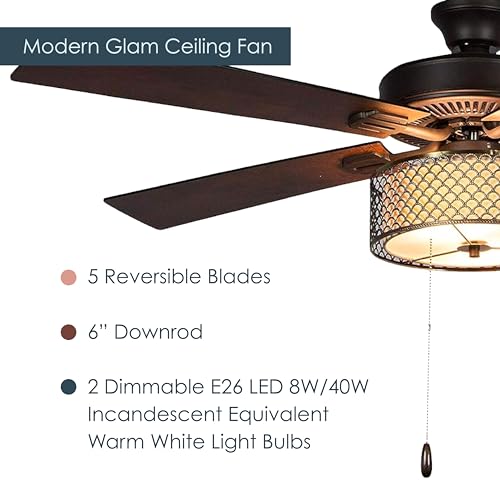
52-inch blade span – That’s a standard size for living rooms and large bedrooms. It moves enough air for a typical 15 by 20 foot room without looking comically small under a higher ceiling.
LED light with fabric shade – The shade spreads the light out and warms it up. You won’t feel like you’re staring into a bare bulb, which is the main reason people keep this fan on even when the air doesn’t need moving.
Barnwood/driftwood blades – The wood-grain finish is what separates it from generic black and white fans. It picks up the warmth of oak floors, walnut tables, and rattan chairs without committing to a full-wood fixture.
Bronze/chrome metallic housing – The mixed metal look is more interesting than a single finish. It lets the fan work in rooms with either brass or silver accents, though it’s not trying to match either perfectly.
Transitional mid-century styling – The lines are clean but not severe. If your sofa is modern and your coffee table is mid-century, this fan will nod to both.
Fit for You
You have a living room that needs airflow but also needs to look like someone actually decorated it.
You’re putting together a mid-century modern or transitional home and want fans that match the era without being antique reproductions.
You want a fan light that’s pleasant to sit under, not a glaring bulb that turns the room into a workshop.
You’re paying out of pocket for a renovation and would rather spend the savings on a rug or a better sofa.
You have a bedroom with light oak or driftwood furniture, and the warm blades would tie it together.
You don’t care about app controls or smart-home integration; you just want a pull chain and an honest fan.
Uses
Afternoon heat is the obvious one. On a warm day, run it at medium in a living room and the air starts moving without the noise of an AC unit. You’ll still feel warm pockets near windows, but the fan keeps the room from getting stuffy.
At night, use the light instead of a table lamp. The fabric shade softens the LED, so it works well for reading, watching TV, or just sitting with a drink. It won’t replace task lighting in a kitchen, but it’s better than most fan lights at this price.
In a dining room or open hallway, the fan earns its keep even when it’s off. The barnwood blades and metal housing give the ceiling a focal point. That matters more than you’d think in an open floor plan where the ceiling is the bare fifth wall.
Experience: River of Goods ceiling fan review in a real room
Setup is standard ceiling fan work. If you’ve installed a fan before, budget about an hour. The most awkward part is the fabric shade; it’s larger than a typical glass bowl and needs a steady hand. A second person helps, not because the wiring is hard, but because holding the housing while connecting wires is much easier with someone else.
The pull chains are the least premium part of the fan. They work, but they feel lighter than the rest of the fixture. It’s a small annoyance, not a dealbreaker. If a wall control or remote matters to you, plan to add one; this price point rarely includes it.
Day to day, the fan’s best quality is how it looks in the room. The wood grain on the blades doesn’t fool you up close, but from arm’s length it reads as real. The mixed bronze and chrome metal catches light from windows and lamps, so the fan doesn’t disappear into the ceiling the way white fans do.
Cleaning is manageable. The blades catch dust like any fan, and a microfiber duster handles them. The fabric shade needs more care. You can wipe it gently, but don’t soak it. If you leave it for months, the dust will show.
Noise is fine. Low and medium speeds are quiet for the price. At high speed, you hear air movement rather than mechanical rattle. The motor doesn’t hum, and the blades don’t click unless you over-tighten the screws during install.
Pros and Cons: River of Goods ceiling fan pros and cons
Pros
Looks more expensive than it is – The combination of barnwood blades and bronze/chrome metal gets compliments. No one will guess it cost $132.99.
Right size for most rooms – 52 inches covers a standard living room or master bedroom without dominating the space.
Soft, usable light – The fabric shade turns the LED into a gentle ambient glow instead of a harsh downlight.
Fits modern and mid-century rooms – If your furniture mixes eras, this won’t clash with either side.
Good price for the style – Comparable transitional fans usually cost more. The Hunter equivalent is typically $50 to $100 higher.
Cons
No remote in the box – Pull chains work, but they’re the least premium part. Adding a remote costs extra and takes a little wiring time.
Wood grain is a laminate, not real timber – It looks good from across a room, but up close you can tell. Real wood blades would push the price much higher.
Fabric shade traps dust – It softens the light, but it also shows lint and dust more than a glass shade would.
Light output is for ambience – Don’t plan on using this as your only kitchen or garage light; it’s not bright enough for task work.
Mixed metal finish isn’t for everyone – Bronze plus chrome is stylish, but busier than a single finish. If you want a perfectly uniform fixture, you’ll notice the mix.
Advantages: River of Goods vs Hunter ceiling fan
The honest answer to River of Goods vs Hunter ceiling fan is that Hunter is the safer bet for long-term reliability, while River of Goods wins on style and price. Hunter’s comparable mid-century or transitional fans usually cost more and still have a more conservative look. This fan gives you the same practical 52-inch size, an integrated LED, and a warmer visual tone for under $140.
Where it beats typical alternatives:
Style per dollar – Most fans in the $150-and-under range are either basic white, basic black, or fake industrial. This one has actual design personality.
Mixed materials – Barnwood blades and a fabric shade are rarely combined at this price. It feels more finished than a fan with plain metal blades.
Integrated LED – You don’t have to guess the bulb size or buy a separate light kit; it’s built in and the shade does the diffusing.
Who Should Buy
Buy it if you’re decorating a modern home on a budget and want a fan that contributes to the design, not just the airflow.
Buy it if you have mid-century furniture and need a ceiling fixture that doesn’t fight the grain of the wood.
Buy it if you’re okay with pull chains and don’t need smart-home or remote control.
Skip it if you need a fan for a porch or outdoor room; this is an indoor fan, not damp-rated.
Skip it if you’re a stickler for perfect detail; the wood grain is printed and the fabric shade needs gentle care.
Skip it if you want the absolute longest service life with zero compromises; look at a Hunter or another established brand instead.
FAQ
Is the River of Goods ceiling fan worth it?
Yes, if you’re buying for style and price. At $132.99, it gives you a 52-inch transitional fan with LED light and barnwood blades for about half what a comparable Hunter costs. It’s not the most refined fan ever made, but it’s one of the best-looking ones at this price.
How long does it last?
Expect many years of normal indoor use, but the cosmetic parts will wear before the motor does. The printed wood finish and fabric shade are the first to show age, especially in dusty rooms or strong sunlight. Keeping both clean makes a noticeable difference.
Does the River of Goods ceiling fan come with a remote?
At this price, expect pull chains instead of a remote. Most versions of this fan ship with a standard pull-chain control, which is fine for everyday use but not convenient on a high ceiling. If you want remote control, set aside $20 to $40 for an aftermarket kit plus installation time.
Is the River of Goods ceiling fan noisy?
At low and medium speeds, it’s quiet enough for a bedroom or office. At high speed, you hear air movement rather than motor rattle. The more noticeable noise is the pull chain if it taps the shade, so tuck it when you change speeds.
Is it safe for outdoor or covered porch use?
No, this is an indoor ceiling fan. The wood-look blades and fabric shade aren’t rated for moisture or humidity, so a covered porch can still cause warping or mildew. Use a damp-rated or outdoor-rated fan for patios, sunrooms, and breezeways.
Can it be installed on a sloped ceiling?
Yes, if the ceiling angle isn’t extreme. This type of fan typically uses a standard mounting ball that works with sloped ceilings up to a point. For a steep vault or cathedral ceiling, buy a longer downrod and check the slope limit in the instructions.
Final Verdict: River of Goods ceiling fan review
The short version of this River of Goods ceiling fan review: buy it for the look, manage your expectations about the extras. At $132.99, that combination makes it a real contender for best transitional ceiling fan for modern home. The barnwood blades, fabric shade, and mixed metal housing make it the centerpiece of a room, not just a ceiling appliance.
If you want a fan that will outlast the furniture and never require a second thought, a Hunter is the more reliable road. But if you want a 52-inch LED fan that looks like it belongs in a catalog and doesn’t cost $400, this is the one to get.
River of Goods ceiling fan vs the Competition in 2026
At $132.99, the River of Goods 52-inch LED ceiling fan with barnwood blades lands in a sweet spot—cheaper than the big-name mid-tier fans but not as flimsy as the absolute budget stuff. It’s got the looks (that bronze chrome + driftwood combo is a genuine head-turner) and a decent 4.2-star average, but the question is whether it holds up against the established players. Below I stack it against three real alternatives you’ll actually run into while shopping for the best transitional ceiling fan for your modern home. No fluff, no nonsense.
This is the comparison most people need. The River of Goods ceiling fan vs Hunter ceiling fan debate really comes down to whether you want a specific look or a more reliable machine. The Hunter Dempsey uses their proprietary SureSpeed motor—dead quiet, no flutter at high speed, and it moves air better than the River of Goods fan at the same 52-inch span. But the Dempsey’s blades are a ho-hum “matte wood” laminate that looks okay from ten feet away and blah up close. River of Goods gives you actual rich barnwood and light driftwood finishes that catch the light. The fabric shade on the River of Goods is also a nice touch—the Dempsey’s light kit is an optional extra that raises the total above $200. If you’re okay with a less distinct fan that runs silently for decades, go Hunter. If you want your ceiling fan to be a conversation piece and save fifty bucks, the River of Goods wins.
River of Goods ceiling fan vs Minka Aire Artemis
The Minka Aire Artemis is the premium competitor here, and you get what you pay for—thick steel housing, a motor that barely hums, and an integrated dimmable LED that actually goes warm to cool. But it’s also $130 more than the River of Goods, and the Artemis doesn’t come with a remote out of the box (you’ll drop another $40). The River of Goods fan includes a wall control and a pull chain, which is basic but functional. The Artemis wins on build quality and light adjustability; the River of Goods wins on style and upfront cost. If you’re furnishing a home office that needs a strong, quiet breeze and you don’t care about the blade look, the Artemis is worth the stretch. But for a guest room or a reading nook where the fan is more decoration than workhorse, the River of Goods is a smarter buy. Is River of Goods ceiling fan worth it? In this matchup, absolutely—unless you have money to burn.
River of Goods ceiling fan vs Hampton Bay Marnie
The Hampton Bay Marnie is what you grab when you need a 52-inch LED ceiling fan with barnwood blades *right now* from the orange store and don’t plan to stay in the house more than two years. Its blades are a printed-on texture, the motor wobbles on medium speed, and the pull chain on the Hampton Bay feels like it’ll snap on the third tug. The River of Goods fan costs about thirty bucks more but gives you real wood veneer blades, a metal housing (the Marnie is mostly plastic), and an actual fabric shade that filters the light instead of blasting your eyes. If your budget is literally under $100, the Hampton Bay will spin—but the River of Goods is the clear winner for anyone who wants a transitional ceiling fan that doesn’t look and feel like a contractor special. For a modern home, the River of Goods is a much stronger alternative.
So who should click “buy” on the River of Goods ceiling fan? You, if you want a distinctive mid-century/modern look, the barnwood blades are a key part of your room’s palette, and you don’t mind a fan that runs a tiny bit less efficiently than a premium model. Skip it if you’re putting it in a high-traffic living room where you’ll run it twelve hours a day—the Hunter Dempsey is a better investment there. And if you’re dead set on top-tier build with a dimmable light that remembers your last setting, save up for the Minka Aire Artemis. But for $132.99, the River of Goods delivers a specific aesthetic that most competitors can’t touch at this price point. That’s its real trick.
Ready to decide on the River of Goods ceiling fan?
See today’s price, stock and delivery options on Amazon.