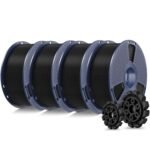
If you’re looking for an ELEGOO PLA Plus review, the short answer is yes: this $12.59 white 1.75mm filament delivers tougher prints than standard PLA without demanding exotic settings. It’s not perfect, but for functional parts, brackets, and prototypes that need to survive a little abuse, it’s one of the best deals in 3D printing.
Priced well below typical PLA Plus offerings while maintaining excellent user satisfaction, delivering outstanding value for cost-conscious makers.
Price vs. rivals
Cheaper
CheaperTypicalPricier
This ELEGOO PLA Plus filament is priced well below typical competitors in the same category, making it a budget-friendly option while maintaining a high user rating.
Ease of use
Excellent 85/100
The filament is straightforward to load and use in compatible 3D printers, with a high user rating indicating reliable and easy printing.
Overview: ELEGOO PLA Plus review
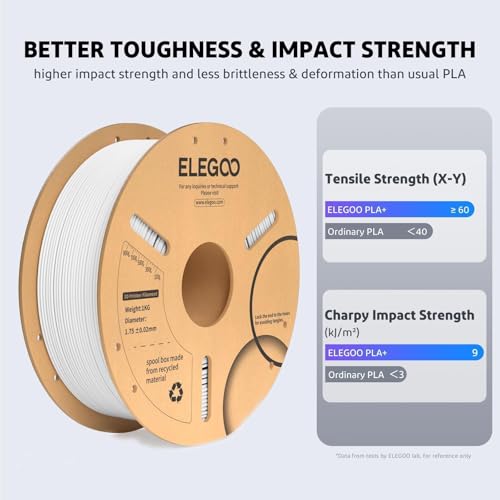
Standard PLA prints fine until they don’t. A part snaps during support removal, or a bracket cracks after a week. ELEGOO PLA Plus is made to reduce that kind of frustration. It’s still PLA, so it’s easy to print with, but the blend is tougher and a little more heat-resistant than ordinary PLA.
This is for anyone printing mechanical brackets, phone stands, jigs, or parts that get handled. If you only print decorative figurines, regular PLA does the job for less. But if you’ve watched a printed part fail at the layer line, this ELEGOO PLA Plus review is aimed at you: buy it for toughness, not for heat resistance.
Key Features
The easiest way to understand ELEGOO PLA Plus vs standard PLA is to look at the material’s specs and then print a part. The Plus formula is less brittle, which means it handles stress without the sudden cracks you get from regular PLA.
Impact-resistant formula: The Plus blend doesn’t shatter the way regular PLA can. A drop from a desk is more likely to bounce than crack.
Solid layer adhesion: Parts come out with strong layer lines, so a thin-walled bracket won’t split along a seam under tension.
Easy printing behavior: It extrudes like a standard PLA, so you don’t need an enclosure or a heated chamber. Your existing Ender-style printer handles it fine.
Consistent 1.75mm diameter: The filament stays within a tight tolerance, so you won’t get under-extrusion gaps or blobs in the middle of a print.
Clean white color: This white spool gives you a good surface for checking layer quality, and it looks neutral on finished parts.
Fit for You
You print functional parts like drawer organizers, cable clips, or hinge replacements and want them to last past the first week.
You’re tired of standard PLA snapping at the layer line when you tighten a screw a little too far.
You want a white filament that stays neutral and doesn’t yellow too quickly on a shelf near a window.
You’re new to printing more durable materials but don’t want the ventilation hassle of ABS or PETG.
You need a big 1kg spool for prototyping a mechanical design through many iterations.
Uses
Imagine you need a replacement foot for a chair. Regular PLA will probably dent or crack within a month. This white ELEGOO PLA Plus holds up better because the layer adhesion is stronger, and you can print it with the same settings you already know.
A phone stand printed in this 1.75mm white PLA Plus filament for 3D printers survives daily use. The white finish shows scuffs, but that’s true of any white plastic, and a quick sanding fixes most of it.
Then there’s the shop scenario: a jig that aligns two pieces of wood while you drill. That part gets knocked around. With standard PLA, you’d print two copies just in case. With this, one copy usually does the job.
Experience: ELEGOO PLA Plus review
Few things spoil a print more than a spool that tangles itself. ELEGOO winds this filament neatly, so you’re less likely to wake up to a failed print and a knot in the middle of the night. The spool itself is standard, fits most holders, and doesn’t need a printed adapter.
Printing temperature matters. Start around 210°C for the nozzle and 60°C for the bed. You can go a little hotter if you want extra layer adhesion, but 210 is a reliable baseline. The first layer sticks well to a clean glass bed with a light coat of glue stick or hairspray. Purists can skip the adhesive; the filament generally behaves.
If you want a casual ELEGOO PLA Plus strength test, print a thin clip and squeeze it. It flexes more than you’d expect from PLA, then springs back. That’s the difference you’ll feel compared with a standard spool.
The white color is opaque and a bit on the cool side. It doesn’t hide every surface flaw, but it does make layer lines easy to inspect. If you’re slicing a mechanical part, you’ll appreciate seeing exactly where the perimeters are.
There are a few small annoyances. The spool can be a bit too full near the flanges, which means the filament sometimes catches for a second when printing near the top of the roll. Not a dealbreaker, and not every spool does it, but it’s worth knowing. You’ll also want to store it in a dry bag or box. PLA Plus absorbs moisture, and a wet spool loses its smooth printing behavior. No unusual noise, either; a dry roll feeds through a Bowden tube about as quietly as standard PLA.
Pros and Cons
Pros
Tougher than standard PLA: You can bend a printed part a little without it snapping, which is exactly what you want for clips and brackets.
Easy to print: It stays close to PLA temperature ranges, so you don’t need to learn a new profile or enclose your printer.
Consistent diameter: Less extruder clicking, fewer gaps, easier first layers.
Low price: At $12.59 per 1kg, it’s cheaper than many ordinary PLA spools, so the upgrade costs almost nothing.
Good layer visibility: The white finish lets you inspect wall thickness and layer quality at a glance.
Cons
Not as strong as ABS or PETG: It’s tougher than PLA, but if you need heat resistance over 60°C or a part that flexes repeatedly, choose PETG or ABS instead.
White shows dirt and scuffs: Expect fingerprints and marks on high-contact surfaces; you’ll be sanding or painting if you want a clean look.
Some spool winding quirks: A few spools are overfull at the edges, which can cause a momentary catch when the filament crosses the flange.
Moisture-sensitive over time: If you leave it out for weeks, it becomes brittle and can snap inside the Bowden tube. Dry it or store it sealed.
Advantages
If you’re hunting for the best PLA Plus filament for functional prints without spending a fortune, this is the one to beat. The biggest advantage is how little you have to change. Standard PLA profiles often work as-is; you just get a tougher result.
Price-to-strength: You’re paying about the same as regular PLA, but the parts survive more real-world abuse.
Same hardware: No hardened nozzle needed, no high bed temperature, no toxic fumes like ABS. It’s a simple swap.
Good for prototypes: A functional design needs to be tested, not babied. This filament lets you test the part, not the material.
Who Should Buy
Buy it if you print mechanical parts: Fixtures, brackets, enclosures, tool holders, and anything that gets pulled, pressed, or knocked.
Buy it if you want an easy upgrade: It’s a small price increase over standard PLA for a meaningful toughness gain.
Skip it if you only print miniatures or vases: Regular PLA is cheaper and gives the same smooth surface on low-stress parts.
Skip it if you need real heat resistance: For a phone mount left in a car, you want PETG or ABS, not PLA Plus.
Consider it if you share a printer: Because it prints at standard PLA temperatures, it’s a safe choice for a community printer or a kid’s first “strong” material.
FAQ
Is the ELEGOO PLA Plus Filament worth it?
Yes, if you print functional parts and want better strength without changing your workflow. At $12.59 per spool, it costs about the same as standard PLA. The toughness gain is a real benefit. For decorative prints, you won’t notice the difference, so stick with cheaper filament.
How is ELEGOO PLA Plus vs standard PLA different?
Compared with standard PLA, the blend is tougher and less brittle, so printed parts can bend a bit before they crack. It’s still easy to print like PLA, but the layer adhesion is stronger. That means a bracket or clip that would snap under stress with regular PLA has a much better chance of surviving.
What temperature should you print ELEGOO PLA Plus at?
Start with a nozzle temperature around 210°C and a bed at 60°C. If layers look weak or parts split, raise the nozzle to 220°C. If you see stringing, lower it a few degrees. A clean bed matters more than minor temperature tweaks.
Is ELEGOO PLA Plus safe for food-contact prints?
Not really. PLA Plus contains additives and coloring that are not approved for safe direct food contact. Even a “food-safe” filament printed on a standard nozzle can harbor bacteria in layer lines. If you need a food-safe part, use a certified material, not a general-purpose PLA Plus.
How long does a 1kg spool of ELEGOO PLA Plus last?
The answer depends on your print sizes and infill. A 1kg spool is around 330 meters of 1.75mm filament. A small phone stand uses 20–30 grams, while a large bracket can use 80 grams or more. Expect 30–50 typical parts per spool.
Can you paint ELEGOO PLA Plus?
Yes. White PLA Plus takes acrylic paint and spray primer well. Clean the part with warm soapy water to remove grease, then prime and paint. Light sanding helps if you want a smooth finish. The white color also gives a neutral base for lighter colors.
Final Verdict: ELEGOO PLA Plus review
At $12.59, this filament is a quick recommendation for anyone who prints useful things. It’s not a miracle material; it won’t survive a car dashboard in summer or repeated hard flexing. But the jump in toughness over standard PLA is real, and you don’t have to change your printer or your slicing basics to get it.
If you’re still reading this ELEGOO PLA Plus review because you’re not sure whether to buy it, here’s the bottom line: buy it if you’ve ever broken a PLA part. Skip it if you’re happy with decorative printing. And if you do order a spool, keep it dry.
ELEGOO PLA Plus Filament vs the Competition in 2026
Right now, the budget end of the PLA Plus market is weirdly crowded. You’ve got ELEGOO sitting at twelve dollars and change, which is hard to ignore, but price alone doesn’t tell you if the stuff prints clean or snaps under load. Over the past couple of years, ELEGOO’s white PLA Plus has built a reputation for being tougher than standard PLA without demanding exotic hotend temperatures. But it has real rivals—some cheaper per gram, some pricier but with a smoother finish. This comparison puts the ELEGOO PLA Plus review head-to-head with three well-known alternatives so you can decide where your money goes.
Product
Price Range
Key Strength
Key Weakness
Best For
ELEGOO PLA Plus 1.75mm White
Budget (≈$12–13)
Impact resistance that beats standard PLA, low price
Slightly more stringing than premium brands; spool can be a bit rough
Functional prints where cost matters more than surface finish
eSun PLA+ 1.75mm
Mid ($18–22)
Very consistent diameter, broad color range, reliable layer adhesion
Notably pricier than ELEGOO; less impact toughness per weight
Everyday printing where tolerance consistency is king
Sunlu PLA+ 1.75mm
Budget (≈$13–16)
Cheap, silky matte finish in some colors, good for visual prints
Quality can vary between colors; sometimes brittle in thin sections
Cosmetic parts on a tight budget
Overture PLA Pro 1.75mm
Mid ($17–20)
Excellent layer bonding with a slightly matte surface, less prone to warping
Not as impact-resistant as ELEGOO’s blend; limited color selection
Large flat prints or parts needing dimensional stability
ELEGOO PLA Plus Filament vs eSun PLA+
eSun’s PLA+ is the default recommendation in a lot of forums, and for good reason: the diameter tolerance is tight, and the stuff flows predictably even at 200°C. But it costs about six to nine dollars more per kilo than the ELEGOO. That difference adds up when you’re burning through two or three spools a month for prototype runs or club projects. The trade-off? eSun gives you fewer stringing artifacts on retraction towers and a slightly glossier finish in white. If you print mostly small, detail-oriented parts—say, miniatures or brackets with tight clearances—the extra consistency might justify the price. But for a big functional bracket that just needs to hold a shelf up, the ELEGOO PLA Plus filament offers all the toughness you need and leaves you with change for a coffee.
ELEGOO PLA Plus Filament vs Sunlu PLA+
Sunlu’s PLA+ is the awkward cousin at the party. It lands at roughly the same price point as ELEGOO, sometimes a dollar more, sometimes a dollar less. The problem is inconsistency. I’ve had a spool of Sunlu gray that printed like butter, and another of their white that snapped mid-print on a simple calibration cube. ELEGOO’s white, by contrast, has been boringly reliable in the toughness department—no snaps, just clean layer lines even when I ran it at 210°C with a 0.6mm nozzle. But Sunlu does one thing better: its matte surface hides layer lines beautifully. If you’re making a cosplay prop or a display piece where cosmetics matter more than brute strength, pick Sunlu. For a gear that has to survive a drop from the workbench, stick with the ELEGOO.
ELEGOO PLA Plus Filament vs Overture PLA Pro
Overture calls its material “PLA Pro” rather than “PLA Plus,” but functionally they’re competing in the same niche: a tougher, more heat-resistant PLA that still prints easily. Overture’s big selling point is its layer adhesion on large, flat surfaces. I’ve printed a 250mm square base with Overture PLA Pro and got almost zero corner lift, while the same model in ELEGOO’s white curled up slightly at one edge (still usable, but annoying). That makes Overture the better choice for things like enclosure panels or lithophanes where flatness is critical. But Overture’s impact resistance is noticeably lower—it chips rather than bends when struck. For a part that takes sudden hits, like a protective cover or a cable clip, the ELEGOO PLA Plus filament absorbs the abuse better. And at nearly eight dollars less per kilo, it’s the smarter buy unless you’re fighting bed adhesion problems constantly.
If you need a PLA Plus that’s genuinely tough enough for functional prints and you aren’t obsessed with having the glossiest surface or the absolute best flat-bed performance, the ELEGOO white is the value champion. It survives drop tests that crack standard PLA, and at $12.59 it’s the cheapest reliable option I’ve seen in this category. Skip it, though, if your prints rely on pristine matte finishes—go with Sunlu. Or if you have a large, flat model that absolutely cannot warp, spend the extra on Overture PLA Pro and save yourself the reprint headache. Everything else? The ELEGOO PLA Plus review makes a strong case for keeping your wallet happy and your prints sturdy.
Ready to decide on the ELEGOO PLA Plus Filament?
See today’s price, stock and delivery options on Amazon.