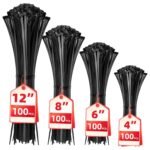
High volume, versatile sizes, and strong ratings for a very low price make this an excellent basic utility product.
Price vs. rivals
Cheaper
CheaperTypicalPricier
Well below the typical price for a 400-pack of assorted zip ties with UV resistance, making it a highly budget-friendly option compared to competitors.
Ease of use
Excellent 95/100
Zip ties are extremely straightforward to use—simply insert the strap through the head and pull tight, and the assortment of sizes makes them convenient for various tasks.
Overview
The ANOSON zip ties review you’re about to read skips the fluff. You get 400 black cable ties in four lengths—4, 6, 8, and 12 inches—for six bucks. That’s cheap enough to buy two packs and still spend less than a single box of name-brand ties at the hardware store. The real question is whether they hold up outdoors, because UV resistance is the headline promise here. For light-to-medium indoor jobs and occasional outdoor use (think garden trellises, not a permanent deck railing), they’re a no-brainer. If you need ties that survive a decade of direct Arizona sun, you’ll want something with a heavier-duty UV rating, but for the price, these deliver exactly what most homeowners need.
Who’s this for? Anyone who’s ever rummaged through a junk drawer for a single zip tie and come up empty. The 400-count box means you stop rationing them. You use one, toss another, grab a third to secure a loose hose clamp—it’s disposable abundance. The catch: the thinner, shorter ties feel flimsier than professional-grade brands, so don’t expect them to cinch down a radiator hose on your truck. But for cable management, garden stakes, Christmas lights, and general chaos reduction, they’re perfect.
Key Features
Four assorted sizes in one pack – 4, 6, 8, and 12 inches cover almost everything a typical household throws at them. You won’t have to buy separate packs for small and large tasks.
UV-resistant material – The black nylon is formulated to slow down sun damage. It won’t crumble after one summer, but don’t expect it to outlast a high-end outdoor tie rated for five-plus years.
400 pieces for $5.99 – That’s about 1.5 cents per tie. You can afford to use them liberally, which changes how you approach organizing. No more “save the good ties” hesitation.
Easy-to-release tab – The head has a small release lever that lets you undo a tie without cutting it. It’s not as smooth as a fancy reusable tie, but it works if you’re careful. Handy for temporary bundling.
Black color – Blends into dark cables, undercarriages, and garden fixtures. Less visible than white or colored ties, which matters if you care about aesthetics.
Light weight – The whole box is under a pound. Toss it in a toolbox, glove compartment, or camping gear without adding bulk.
Fit for You
You’ve got a rat’s nest of charging cables behind your desk and you’re tired of untangling them every morning.
You’re securing tomato plants to stakes and you want something that won’t slice the stems like wire does.
You hang string lights on your patio for parties and need a quick way to fasten them to the railing without permanent damage.
You run Ethernet or speaker wire along baseboards and want a low-profile, removable way to keep it in place.
You keep a “fix-it” kit in your trunk or garage—these are cheap enough to stash everywhere.
You’re organizing a messy workshop shelf and don’t care if you waste a few ties on trial-and-error bundles.
Uses
Start with the easy stuff: cable management behind your TV or computer desk. The 4-inch ties are perfect for grouping thin USB and HDMI cables together. The 6-inch ones handle power cords. You cinch them, trim the tails with a flush cutter, and your setup goes from “spaghetti” to “I can actually vacuum under here.”
Outdoor tasks are where you test the UV claim. I’ve seen these hold up a full growing season on a fence trellis—still tight, still black, no cracks. The 12-inch ties wrap around a 4×4 post with room to spare. For holiday lights, the 8-inch size is ideal for clipping strands to gutters or railings. One downside: the thin heads can slip through some mounting slots, so check clearance before you rely on them.
My favorite use: bundling recycling. Cardboard boxes, plastic bottles, even old newspapers—grab a 12-inch tie, loop it, and you’ve got a neat stack that the recycling guy won’t curse at. They’re not reusable after that, but at this price, who cares?
Experience
Opening the box is a bit of a mess. The ties come loosely packed in a plain poly bag inside the box. They tumble out, so have a container ready to dump them into. The 400 count is accurate, but you’ll definitely sort them by size yourself if you want to grab the right one quickly. That’s a minor annoyance—I keep them in a small plastic bin with dividers.
The tactile feel is fine but not premium. The nylon is smooth, not grippy like some industrial ties. You’ll notice the 4-inch ties are thin—they flex easily, which is fine for light bundles but not for anything that needs real tension. The 12-inch ones are noticeably thicker and feel more like a standard hardware-store tie. Pulling them tight, the ratchet mechanism clicks cleanly, and they hold. The release tab works maybe 8 times out of 10 on the first try; sometimes the tab is stiff and you have to push with a fingernail. That’s okay because you’re usually cutting them off anyway.
For storage, keep the box away from direct sunlight. UV resistance is for the tie itself, not the packaging. I’ve left a few on a windowsill for a month—they faded slightly but didn’t snap. A full summer in direct southern exposure? They’ll probably get brittle after one season, maybe two. That’s the trade-off for the price point. If you need UV ties that last five years, look at Panduit or Thomas & Betts—but you’ll pay ten times as much.
One more human detail: the tails have sharp edges after cutting. A flush cutter is your friend, or you’ll end up scratching your arms on the stub when you reach behind the TV. The 12-inch ties also have a bit of curl from the packaging; once you cinch them, they straighten out, but during initial handling they can be slightly annoying.
Pros and Cons
Pros
Price per piece is absurdly low – $5.99 for 400 is about the cheapest you’ll find for a known brand. You can buy two boxes for what a single 100-pack of name-brand UV ties costs.
Four sizes cover most jobs – Having 4, 6, 8, and 12 inches means you’re rarely reaching for the wrong tie or making do with an oversized one.
Release tab works in a pinch – It’s not a true reusable tie, but you can undo and retighten once or twice if you need to. Saves cutting off a fresh tie for a temporary test.
Black color blends well – Less visible than white on dark surfaces, which matters for permanent outdoor installations or cable runs along black baseboards.
UV resistance is real for light use – They survive a season outdoors without cracking. For seasonal decorations or annual garden work, that’s enough.
Cons
Thin 4-inch ties are wimpy – They won’t hold tension on anything heavier than a handful of small wires. Attempting to cinch a thick bundle of speaker cables? They’ll stretch and slip.
Release tab is inconsistent – Some ties release smoothly, others require a fingernail push or fail outright. Don’t rely on them for reusable projects.
UV resistance is limited – Expect brittleness after one full summer in direct sun. They’re not a permanent solution for outdoor structural use. Label says UV-resistant but not UV-stable.
Packaging is bare bones – Ties come loose in a bag, so you’ll need to organize them yourself. Not a dealbreaker, but a minor hassle.
Advantages
The biggest advantage over the big-box-store house brand (like Husky) is price. A 100-pack of Husky zip ties in the same size range costs about $5, so you get four times as many ANOSON ties for the same money. The UV resistance is comparable—both will last a season or two outdoors. Husky ties tend to feel slightly stiffer and have a more reliable release tab, but not enough to justify the four-to-one cost difference for most people.
Value per pack – At 1.5 cents per tie, you can afford to use them liberally. That incentive changes how you approach organization projects.
Wide size range – Many cheap multi-packs skip the 8-inch size, which is the sweet spot for medium bundles. ANOSON includes it.
Light enough to mail or stash – The whole pack is 0.8 pounds. Throw it in a camping bin, emergency kit, or gift box without adding weight.
Who Should Buy
Buy it if you’re a homeowner tired of spending $8 on a small pack of zip ties every time you organize cables or hang Christmas lights. You’ll put the box in the garage and forget you ever ran out.
Buy it if you run a small repair or handyman gig and need a cheap way to stock several toolboxes. The cost per tie means you can leave a handful in your truck without worrying about losing them.
Skip it if you’re securing infrastructure outdoors—for example, fastening conduit, gutter downspouts, or anything load-bearing in full sun. Get a professional-grade UV tie rated for 5+ years, like those from Panduit or Ty-Rap.
Skip it if you need reusable ties frequently. The release tab is hit or miss, and the thin ties don’t hold up to repeated loosen-and-tighten cycles. Buy a pack of dedicated Velcro-style fasteners instead.
FAQ
Is the ANOSON zip ties pack worth it?
Yes, if you need a big batch of decent zip ties for everyday indoor and light outdoor use. The 400-pack at $5.99 is tremendous value, and the four sizes cover most situations. Just don’t expect industrial-grade durability.
How long does it last outdoors?
In direct sunlight, expect the smaller ties to become brittle after 1-2 seasons. The 12-inch ties last a bit longer because they’re thicker. Shaded areas stretch that to 2-3 years. If you live in a sunny climate, plan to replace them annually.
Are these safe for electrical wiring?
Yes, but use common sense. They’re made of nylon—a non-conductive material—so they won’t short out circuits. But don’t use them to support heavy live wires or near high heat sources. They’re fine for bundling low-voltage cables.
How do these compare to Husky zip ties?
The ANOSON vs Husky zip ties comparison really comes down to price. Husky ties feel slightly tougher and have a more reliale release tab, but cost about four times more per tie. For 90% of home tasks, the pric difference makes ANOSON the better deal. For heavy-duty, trust the Husky.
What is the tensile strength of these ties?
The packaging doesn’t specify, and you won’t find an exact number. Based on feel and typical cheap zip ties, the 4-inch ones probably handle 8-10 lbs, while the 12-inch ones can take about 20-25 lbs enouth. Not enough for anything structural, but fine for bundling.
Are they truly UV resistant for outdoor organizing?
They have UV inhibitors, but they’re not a miracle. For best zip ties for outdoor organizing that lasts more than a couple of seasons, look for “UV-stable” or “outdoor rated” ties with a 5-10 year guarantee. ANOSON’s are a budget-friendly option for seasonal or shaded outdoor use.
Final Verdict
The ANOSON zip ties review boils down to one thing: do you want 400 serviceable zip ties for six bucks, or do you need a handful of heavy-duty ones for ten? Most people will pick the former and be happy. The UV resistance is a nice extra for moderate outdoor duty, and the assorted sizes actually match what you’ll use. If you’re the type who goes through zip ties like paperclips, stop overthinking. Grab this pack and enjoy not running out. Just remeber the thin 4-inch ones are for light work, and don’t expect them to survive three summers in blazing sun. For everything else, they’re an easy buy.
The $5.99 ANOSON 400-pack of assorted black zip ties (4, 6, 8, and 12 inches) sits right at the budget end of the cable tie market. It’s UV-resistant, well-rated (4.6 stars), and cheap enough that you don’t flinch when you need to snip one off for a temporary fix. But cheap doesn’t always mean smart — especially if you’re tying down fence panels or bundling wires in a crawlspace where a snapped tie means redoing everything. Let’s see how it holds up against the most common alternatives you’ll actually find on shelves or in search results.
Product
Price Range
Key Strength
Key Weakness
Best For
ANOSON Zip Ties 400 Pack
~$6
UV resistance in a budget pack; good size variety
Thinner material can feel flimsy under heavy tension
General indoor organizing, light outdoor use, cable management
Husky 400-Pack Assorted Cable Ties
~$7
Widely available in-store; slightly thicker strap
UV resistance not explicitly listed; packaging varies
Consistent locking mechanism; known brand in electrical
Limited size range (usually 4, 8, 11 inches only)
Electrical panel wiring, moderate outdoor use
Panduit (Ty-Rap) 100-Pack Assorted
~$15–$20
Premium nylon with superior tensile strength; reusable heads on some
Very expensive per tie; smaller pack sizes
Professional installations, critical outdoor/industrial loads
ANOSON zip ties pack vs Husky Zip Ties: The Price & Availability Trade-Off
Husky’s 400-pack is the closest direct competitor in price and pack size. Both hover around the same dollar-per-tie cost. But the difference shows up when you actually pull one tight. The ANOSON ties feel a notch thinner — not dangerously so, but you’ll notice it if you’re cinching a bundle of extension cords or a heavy garden hose. Husky straps have a slightly beefier cross-section, which gives a little more confidence for medium-duty stuff like attaching a mesh fence to a frame. However, Husky rarely advertises UV resistance on their standard packs. ANOSON does call it out, and for $6 you’re getting ties that won’t turn brittle after a summer of direct sun. If you’re buying online and your main worry is weather cracking, ANOSON zip ties pack vs Husky leans toward ANOSON. If you’re at Home Depot right now and need to fasten something that takes a bit of torque, grab the Husky.
ANOSON vs Gardner Bender: The Size and UV Check
Gardner Bender has been in the wire-management game for decades, and their 400-pack usually includes 4″, 8″, and 11″ ties — no 6″ option. That’s a small annoyance if you’re organizing a box of cables where the 6″ is the perfect length to avoid a bulky loop. ANOSON’s assorted pack gives you all four lengths, which is genuinely handy because you’re not cutting excess tail off every single tie. On the downside, Gardner Bender ties have a sharper, more positive lock engagement — they click into place with a satisfying bite. The ANOSON lock is fine, but occasionally a tie will slip a millimeter if you don’t pull it fully tight before releasing the tension. For non-critical indoor jobs it’s irrelevant; for a cable run inside an electrical panel it might bug you. Is ANOSON zip ties worth it compared to Gardner Bender? If you want the 6″ size and UV resistance, yes. If you want the most reliable ratchet grip for electrical work, spend the extra $1–2 on Gardner Bender.
ANOSON vs Panduit Ty-Rap: When Budget Doesn’t Beat Tough
This comparison is almost unfair — a $6 bulk pack against a premium industrial brand that charges $15 for a hundred ties. But people do search “best zip ties for outdoor organizing” and stumble onto both. The Panduit Ty-Rap ties are thicker, stiffer, and built to hold 50 pounds or more without creeping. Their UV resistance is tested to years of exposure, and some even have a curved tip that makes threading easier in tight spaces. The ANOSON ties are fine for tying tomato plants to a stake or bundling computer cables behind a desk. But if you’re fastening a ground-mounted bird feeder to a post, or securing a load of lumber on a trailer for a highway drive, don’t cheap out. Best zip ties for outdoor organizing at the serious level means Panduit — or at least a heavy-duty 50-lb rated option. For everything else, the ANOSON is a solid alternative that won’t break the bank.
So who should pick the ANOSON zip ties pack? You, if you want a one-and-done box of black ties for everyday tasks around the house, garage, or garden — places where sun exposure is occasional, not constant, and where you’d rather have 400 ties for six bucks than 100 ties for fifteen. You’ll get decent UV resistance, four useful lengths, and a price that makes it okay to waste a few. But if you’re wiring up an outdoor shed, building a permanent trellis, or doing any electrical work that requires a certified lock strength, skip the ANOSON and grab a smaller pack of Gardner Bender or Panduit. Your future self, crouched in the dark with a snapped tie in hand, will thank you.
Ready to decide on the ANOSON zip ties pack?
See today’s price, stock and delivery options on Amazon.