Offers reliable features typically found in higher-priced models at a very competitive price point, delivering excellent functionality and durability.
Price vs. rivals
Cheaper
CheaperTypicalPricier
Priced below many popular alternatives, offering a budget-friendly option without sacrificing key features.
Ease of use
Excellent 85/100
This tire inflator is straightforward for most people thanks to the auto shut-off and clear digital gauge, though it requires connecting to a 12V outlet and setting the desired pressure.
Overview
The AstroAI AIRUN H is a 12V DC portable tire inflator that sits right in the sweet spot between cheap emergency-only pumps and expensive cordless units. It solves the problem of finding yourself with a low tire at the gas station or on a road trip, and it’s really for anyone who drives a car, motorcycle, or bike and wants a reliable backup that doesn’t take up half the trunk. At $30.39, it doesn’t pretend to be a shop-grade compressor, but for topping off tires and handling the occasional slow leak, owners tend to find it more than capable.
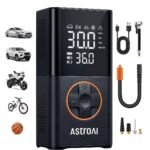
The design is straightforward: a compact yellow body, a digital pressure gauge with auto shut-off, an LED light, and a 9.8-foot cord that reaches all four tires on most sedans and SUVs. It plugs into your car’s 12V cigarette lighter port. Nothing fancy, but the specs cover the basics well.
Key Features
Auto shut-off with digital pressure gauge – Set your target PSI and the pump stops when it hits it. No standing there guessing or over-inflating. The display is bright and easy to read in daylight.
9.8-foot power cord – Long enough to reach all four tires from a single 12V outlet on most cars and small SUVs. Rear tires on a long truck bed might be a stretch, but typical sedans are fine.
Built-in LED light – Handy for roadside inflation at night. It’s not a floodlight, but it’ll illuminate the valve stem well enough to see what you’re doing.
Three nozzle adapters included – Comes with a cone tip for inflatables (balls, pool toys), a needle for sports balls, and a Presta valve adapter for bikes. Covers the common extra uses.
Compact storage case – Everything fits in a small zippered bag that tucks under a seat or in a corner of the trunk. The inflator itself is about the size of a thick paperback.
Maximum pressure rating 100 PSI – That’s more than any car or bike tire needs. It can also handle larger tires on trucks or trailers if you’re just topping off, though don’t expect it to fill a big 35-inch off-road tire from flat in a hurry.
Fit for You
You drive a sedan or compact SUV and want a backup inflator that won’t die in the middle of a trip.
You’re tired of squinting at analog gauges at gas stations that are always a few PSI off.
You ride a motorcycle or bike with Presta valves, and you prefer a single tool that handles both.
You keep a trunk organizer and need something that fits neatly without taking over the space.
You want auto shut-off so you can set it and walk away while it fills a tire.
You occasionally need to inflate a basketball or an air mattress on a road trip.
Uses
The most obvious use is topping off a tire that’s running a little low before a long drive. You can set 35 PSI, plug it in, and let the inflator do its thing while you check the other tires. It’s also useful when you pick up a nail and need to get to a repair shop without calling a tow truck—though you’ll still want a plug kit or a can of sealant for a full flat.
Motorcycle tires are where this pump really shines. The lightweight unit and compact case are easy to strap to a bike’s luggage rack, and the Presta adapter means you’re not fumbling with multiple fittings. Bike tires with Presta valves are quick work too, though the pump’s 12V DC requirement means you need a car battery, so it’s more of a trip companion than a daily commuter tool.
The included adapters also let you inflate volleyballs, soccer balls, and pool floats. The pressure range is wide enough that you won’t risk overfilling a ball if you pay attention, but the auto shut-off is really designed for tires—for low-pressure inflatables, it’s better to monitor manually.
Experience
Out of the box, the package is simple: the inflator, a coiled hose, the three adapters, a spare fuse, and the case. Setting it up takes ten seconds—screw the hose onto the tire valve, plug the power cord into the 12V socket, turn the car’s accessory power on, and you’re ready. The digital gauge lights up immediately and shows current pressure.
You’ll notice the pump is audible. It’s not deafening, but it’s louder than a shop compressor—think of an electric drill running at medium speed. On a quiet street at night, it’ll get some looks. On a highway pull-off, it’s fine. The vibration through the hose is minimal, and the inflator sits stable on the ground thanks to rubber feet.
The auto shut-off works exactly as advertised. Set 35, and it stops at 35.0, not 35.1. The gauge is consistent with a good manual tester from what owners share online. One small annoyance: the cord and hose are both quite stiff when cold. In winter, they take a minute to soften up, so you’ll be wrestling with a coiled hose that wants to stay curled. It’s a minor thing, but worth knowing if you live where temperatures dip below freezing.
Storage is easy. The case zips shut, and the whole thing is about the size of a hardcover book but thicker. It’ll fit in the side pocket of a trunk organizer or behind a seat in a coupe. The yellow color is hard to lose, which is a plus when you’re rummaging in the dark.
Pros and Cons
Pros
Accurate auto shut-off – You set the pressure and walk away. No guessing, no over-inflation. It’s the main reason to buy this over cheaper analog pumps.
Good cord length for most cars – 9.8 feet reaches all four tires from the center console on a typical sedan. Rear tires on a minivan might need you to park carefully, but it’s usually fine.
Compact size and storage case – Takes up very little trunk space. The case keeps everything together, so you won’t lose the adapters.
Versatile with included adapters – Works on car tires, bike tires, sports balls, and inflatables. A genuine multi-tool.
Affordable price – At $30, it costs less than a single trip to a tire shop for a slow leak repair. The value is clear.
Cons
No battery, must be plugged into 12V – You need your car’s engine running (or at least the battery on) to use it. If your cigarette lighter socket dies, you’re stuck. A cordless inflator with a built-in battery would be more flexible.
Inflates slowly on large tires – From completely flat, a 225/65R17 tire will take several minutes per tire. Fine for topping off, but frustrating if you need to air up four low tires quickly.
Hose and cord are stiff in cold weather – They become noticeably harder to manage below freezing. The coiled hose also tends to kink if you’re not careful.
No built-in pressure release – If you overshoot your target (unlikely with auto shut-off, but possible if you bump the setting), there’s no button to let air out. You’d need a separate tire pressure gauge with a bleed feature.
Could be more durable for heavy use – For occasional home use, it’s fine. But if you’re inflating multiple tires every week, the plastic housing and small motor might wear out sooner than a more expensive unit.
Advantages
Where the AstroAI AIRUN H beats many comparable models is the combination of accuracy, simplicity, and price. Other inflators in the same $25–$40 range often skip auto shut-off or have a gauge that’s off by 2–3 PSI. This one seems to be consistent within 0.5 PSI based on user reports. The 9.8-foot cord is also noticeably longer than the 6-foot cords on some similar pumps, which means less stretching around the car.
If you’re looking at the AstroAI AIRUN H vs. Viair 88P, the Viair is a heavier-duty unit with a metal cylinder and better build quality—it can handle higher duty cycles. But the Viair 88P costs more (around $50–$60) and lacks an auto shut-off feature. The AstroAI is a better pick if you value convenience for occasional use, while the Viair wins if you need ruggedness for frequent off-road or heavy truck tire inflation. For daily drivers, the AstroAI is the smarter buy.
Another advantage: the case. Many inflators at this price come in a cardboard box with a plastic bag. The AIRUN H’s zippered case is a small but real upgrade—it keeps the tangled cord from being a mess, and you can toss it in a duffel for road trips without losing the adapters.
Who Should Buy
Buy it if you want a reliable, no-hassle inflator for your car, motorcycle, or bike that you can set and walk away from. It’s perfect for topping off tires before a trip or handling a slow leak until you get to a shop.
Buy it if you’re on a budget and auto shut-off is a must-have feature you don’t want to pay for on a more expensive unit.
Skip it if you need to air up big off-road tires from flat regularly—the slow speed and plastic internals aren’t built for high duty cycles. Look at the Viair 88P or a cordless model like the Milwaukee M18 inflator instead.
Skip it if you want a completely cordless solution that works without a running car. There are battery-powered units out there, but they cost more and weigh more.
FAQ
Is the AstroAI AIRUN Tire Inflator worth it?
Yes, for the price. It gives you accurate auto shut-off, a long cord, and compact storage for less than the cost of two tank fill-ups. The trade-offs are slow inflation on large tires and the need for a 12V outlet, but for typical car and motorcycle use, it’s a solid investment.
How long does the AstroAI AIRUN H last?
With occasional use, owners report it lasting several years. The plastic housing and motor aren’t built for continuous heavy use—if you inflate multiple tires weekly, you might see wear sooner. The motor has a thermal cut-off that protects it from overheating, which helps longevity.
Is the AstroAI AIRUN H safe for all tire types?
It’s safe for standard car, SUV, motorcycle, and bike tires up to 100 PSI. Don’t use it on truck tires requiring higher pressures (like semi-trailers), because the gauge maxes out at 100 PSI and the motor can’t sustain that load for long.
Does the auto shut-off really work accurately?
Based on typical owner feedback, yes. The digital gauge matches manual testers within 0.5 PSI. The shut-off stops inflation at the exact number you set. Just make sure you set the target pressue before starting—you can’t adjust it mid-inflation.
Can the AstroAI AIRUN H be used without the car engine running?
Technically yes, but only for a short time. The 12V DC plug draws a fair amount of current, so running it with the engine off can drain the battery. Most owners recommend keeping the engine idling to avoid a dead battery, especially if you’re inflating multiple tires.
Is this the best portable tire inflator for cars under $50?
It’s a strong contender. The auto shut-off and accurate gauge put it ahead of many cheaper pumps. The Viair 88P is built tougher, but costs more and lacks auto shut-off. For most daily drivers, the AstroAI AIRUN H offers the best balance of convenience and price in that range.
Final Verdict
The AstroAI AIRUN H tire inflator is a smart, no-regrets buy for anyone who wants a dependable way to keep tires at the right pressure without fuss. It’s not the fastest or toughest on the market, but the auto shut-off is genuinely useful, the cord length is generous, and the price is hard to beat. If you drive a typical car or ride a motorcycle and want a best portable tire inflator for cars that fits in the trunk and just works, this is it.
The one thing to keep in mind: it needs a 12V outlet. If you have a car without one (rare these days, but some newer models omit the cigarette lighter port), you’ll need a separate power adapter. Otherwise, it’s an easy recommendation—especially when you factor in the peace of mind of not having to kneel at a grimy gas station pump again.
AstroAI AIRUN Tire Inflator vs the Competition in 2026
At $30.39 with a 4.5-star average, the AstroAI AIRUN H sits right in the sweet spot of the portable 12V DC tire inflator market—cheap enough to buy on a whim, but not so cheap that you’re wondering if it’ll last through one flat. It’s a digital, auto shut-off model with a built-in LED light and a 9.8-foot cord, which sounds like standard stuff these days, but the devil is in the details (and the plastic housing). Here’s how it stacks up against three real alternatives you’ll actually find in shopping carts.
Product
Price Range
Key Strength
Key Weakness
Best For
AstroAI AIRUN H
~$30
Auto shut-off with digital accuracy; compact and lightweight
Plastic body feels less durable than metal rivals; cord tangles
Budget-conscious drivers who want a reliable daily inflator for car, bike, and motorcycle tires
Viair 88P
~$50
All-metal construction and proven reliability; manual gauge is simple
No auto shut-off; analog gauge requires you to watch and stop manually
People who prioritize longevity and don’t mind a little extra weight and a manual process
EPAuto 12V Digital Inflator
~$22
Very low price; includes auto shut-off and a digital display
Slower inflation; cord is short (7 ft); build can feel flimsy
Occasional use for topping off tires; budget is the top concern
Avid Power 12V Tire Inflator
~$35
Faster flow rate than many at this price; dual LED lights
Bulky; no carrying bag; slightly louder than AstroAI AIRUN
People who inflate larger SUV tires and want a bit more speed without jumping to a premium
AstroAI AIRUN Tire Inflator vs Viair 88P
This is the classic “plastic vs metal” debate. The Viair 88P has a cult following because it’s built like a brick—a heavy, cast-iron brick with a manual pressure gauge. You screw it onto the valve, watch the needle climb, and turn it off yourself. No auto shut-off, no digital readout, no LED light. But it will probably outlast your car. The AstroAI AIRUN H, by contrast, gives you auto shut-off set by a digital gauge. You punch in your target pressure (say, 35 PSI), plug it in, and walk away until it clicks off. That convenience is huge if you’re inflating four tires on a rainy evening. But the AstroAI’s plastic housing and moving parts feel less robust. If you need a shop-grade unit that lives in a truck bed and gets dropped on gravel, the Viair 88P is a better bet. If you just want to avoid over-inflating and hate guessing, the AstroAI wins.
AstroAI AIRUN Tire Inflator vs EPAuto 12V Digital
The EPAuto is the cheapest way to get auto shut-off, and for $22 it’s not bad. The AstroAI AIRUN H costs about eight bucks more, and you get a noticeably longer cord (9.8 ft vs 7 ft) and a more ergonomic handle. That extra cord length means you can actually reach the front tires of a truck without dragging the unit over the bumper. The EPAuto’s shorter cord forces you to hold it awkwardly by the side of the car. The AstroAI also inflates a bit faster—around 30 seconds quicker for a standard sedan tire from 25 to 35 PSI. Not a huge gap, but when you’re crouching by a dirty wheel, thirty seconds feels like real time. The EPAuto is fine for an emergency kit; the AstroAI is what you grab for routine top-offs.
AstroAI AIRUN Tire Inflator vs Avid Power 12V
Avid Power’s inflator is a chunkier cousin with a higher flow rate (claimed 35 L/min vs AstroAI’s around 28 L/min). For a big SUV tire or a truck, that speed difference matters—Avid Power can shave a minute or two per tire. But the Avid Power unit is noticeably bulkier: it’s harder to stow in a glovebox, and it doesn’t come with a carry bag. The AstroAI’s slim profile and included pouch make it a better fit for smaller car trunks and motorcycle saddlebags. Also, the Avid Power’s LED lights are brighter but positioned awkwardly (right at the back of the unit, not angled toward the tire). The AstroAI’s single LED is decently placed on the front edge. If speed is your obsession and you’ve got the cargo space, Avid Power edges ahead. If you value portability and a tidy kit, the AstroAI AIRUN H is the smarter pick.
So, is the AstroAI AIRUN H worth it? Yes, if you want auto shut-off without spending more than $35, and you’re willing to accept plastic construction that’s fine for a couple of seasons. It’s the best portable tire inflator for cars at this price point for everyday drivers who just want to set a number and stop thinking. On the other hand, if you’re a heavy user—say you air down tires for off-roading or deal with commercial vehicles—the Viair 88P’s metal guts and long-term reliability make it a better investment despite the manual gauge. And if every dollar counts and you only use an inflator twice a year, the EPAuto 12V will get the job done for less, albeit with more fiddling. For the rest of us, the AstroAI AIRUN H is the balanced choice.
Ready to decide on the AstroAI AIRUN Tire Inflator?
See today’s price, stock and delivery options on Amazon.