Excellent reliability and high user satisfaction make this a strong mid-range value proposition.
Price vs. rivals
Typical
CheaperTypicalPricier
This portable jump starter is priced a bit above mid-range, reflecting its strong brand reputation and solid performance, but still competitive with other popular alternatives.
Ease of use
Excellent 85/100
Its safety features and clear instructions make it simple for most people to use despite some initial learning.
Overview
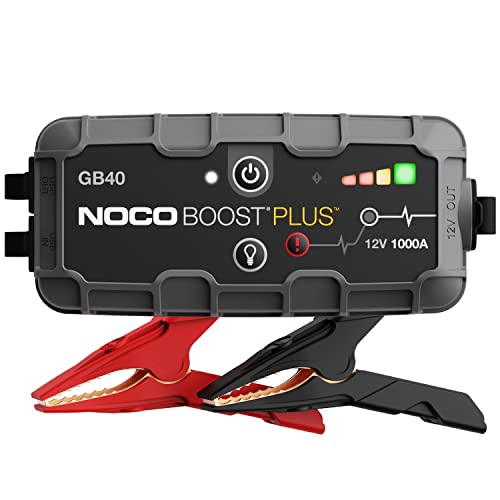
Any serious NOCO Boost GB40 review starts with the same question: Is the NOCO Boost GB40 worth it? For most people with a small to midsize car, the short answer is yes — it’s a compact, no-drama way to jump-start a dead battery without needing a second car or a heavy lead-acid box. It’s not a truck puller, but for the Civic, Corolla, or Mini in your driveway, it’s the difference between a ten-minute fix and an hour of flailing with cables.
The GB40 sits in that sweet spot between keychain-sized emergency puck and full-on booster pack for diesel pickups. NOCO has been making these lithium jump starters for years, and this model is basically the Goldilocks option: small enough to keep in the glovebox, strong enough to start most four-cylinder and smaller V6 engines multiple times on a single charge.
Key Features
1000A peak current — That’s enough to start gasoline engines up to 6.0L. It’ll handle your typical sedan, hatchback, and even some smaller SUVs. It won’t touch a big diesel, but for the vast majority of cars on the road, it’s plenty.
UltraSafe technology — The clamps are spark-proof, reverse-polarity protected, and won’t fry your car’s electronics. You can literally touch the red and black clamps together while the unit is on, and nothing happens. That peace of mind is worth a lot when you’re standing in a rain-soaked parking lot.
Recharge via USB-C or micro USB — It charges from a wall adapter, a laptop USB port, or even a car’s 12V outlet with a USB adapter. The USB-C port is welcome, though it’s only input (you can’t use it to charge your phone fast).
Built-in LED flashlight with emergency modes — Seven light modes including SOS and strobe. It’s not a tactical beam, but it’s bright enough to change a tire at night or signal for help. The magnetic back lets you stick it to a metal surface while you work.
Rugged, water-resistant casing (IP65) — Drops, splashes, dust — it handles real-world garage and roadside abuse. The rubberized bumpers on the corners actually do their job.
3.0 Ah lithium-ion battery — It holds a charge for months (NOCO says up to 12 months in storage). You can throw it under a seat in the spring and find it ready in the fall, which is the whole point of an emergency device.
Fit for You
You drive a small to midsize car (sedan, hatchback, crossover) and want one device that does jump-starting, phone charging, and emergency lighting.
You’re tired of jumper cable conversations with strangers — the GB40 lets you solve the problem yourself in under five minutes.
You road-trip in areas where help is an hour away and you’d rather not wait.
You park on a street or in a garage where you can’t reach another car’s battery easily.
You own a motorcycle, lawn tractor, or ATV — the GB40 starts those with zero fuss and is small enough to strap to a bike.
You want the best jump starter for small cars without spending $200 on a truck-grade unit you’ll never use.
Uses
The classic scenario: it’s a Tuesday morning, you’re already late, and the dashboard lights up like a slot machine before flickering dead. You pull the GB40 from the glovebox, plug the clamps into the unit (they’re attached, so no fumbling for a pigtail), connect red to positive, black to a ground, and within thirty seconds the car turns over. You disconnect, toss it back in the glovebox, and go. No second car, no waiting for AAA.
It also doubles as a portable phone charger — 3.0 amp USB-A output, which isn’t fast-charge territory but will top up an iPhone twice over. Useful on long flights when the airport outlets are all taken. Just remember that running it as a power bank eats into the jump-start reserve, so don’t drain it dead before you need it to start the car.
The LED light has saved a few people I know from changing a flat in total darkness. The strobe mode works as a roadside warning light. It’s not a dedicated work light, but when you’re stuck, any light beats no light.
Experience
First thing you’ll notice is the weight — it’s heavy for its size. That’s the lithium cells and the rubber armor. It feels solid in the hand, not like a cheap plastic toy. The clamps have satisfying spring tension and a rubberized grip. No bare metal to accidentally short against the frame.
Charging out of the box took about four hours via a 5V/2A wall charger. The unit came with about 40% charge, which is typical. You’ll want to top it off before tossing it in the car, and then forget about it for six months. The battery indicator (four white LEDs) lets you check status at a glance — no app, no Bluetooth nonsense.
One small annoyance: the rubber cover over the charging ports is a bit stiff. It seals well, but you’ll need to use both hands to pry it open. That’s a trade-off for the water resistance, and I’ll take it over a loose flap that lets in moisture.
The clamps are attached to a short cable — about a foot long — so you’re clamping directly onto the battery terminals, not reaching around the engine bay. That’s fine for 90% of cars. On a few models with deeply buried batteries (looking at you, some BMWs and VWs), the cable might be too short. You can buy an extension cable from NOCO separately, but it’s something to keep in mind if you own a car where the battery is under the rear seat or behind a wheel well.
It’s also worth noting that the unit itself gets warm during a jump start. Not hot, but noticeably warm. That’s normal for lithium packs under load. Let it cool down between attempts if you need multiple starts.
Pros and Cons
Pros
Incredibly easy to use — The spark-proof clamps mean you can connect without fear. Even a total beginner can follow the color-coded diagram on the unit.
Compact and portable — Fits in a glovebox, center console, or a motorcycle top bag. Weighs about a pound and a half.
Long shelf life — Loses less than 5% charge per month in storage. You don’t have to think about it until you need it.
Built like a brick — The IP65 rating and rubber bumpers mean it survives drops, dust, and light rain without flinching.
Versatile — Jump-starts cars, charges phones, lights up a dark roadside. One tool replaces three.
Good value at $100 — Considering that a single tow-truck call costs more than that, the GB40 pays for itself the first time it works.
Cons
Not powerful enough for large V8s or diesel engines — If you drive a Ram 2500 or a big boat, you need the GB50 or GB150. The GB40 is for the small-engine crowd.
Short cable on the clamps — Fine for top-post batteries, but can be a stretch for side-post setups or batteries mounted in odd locations.
Charging port cover is stiff — A minor gripe, but you’ll need to jam a fingernail under it. Over time it might loosen up.
No fast charging — The USB output is standard 5V/3A, not Qualcomm Quick Charge or USB-PD. Your phone will charge, but slowly.
Battery indicator can be misleading — The four LEDs are rough estimates. You might see three lights and then try to start a car and find it only has enough juice for one crank. Best to keep it topped off before long trips.
Advantages
Compared to the older lead-acid jump boxes that weigh 15 pounds and need to be plugged in every month, the GB40 is a generational leap. It’s small enough to live in a backpack, holds a charge for months, and has safety features that make it nearly idiot-proof. The NOCO Boost GB40 vs NOCO Boost Plus GB50 decision comes down to engine size — the GB50 can handle larger V8s and some diesel, but the GB40 is lighter and cheaper. For the vast majority of small cars, the GB40 is the smarter buy.
Against other 1000A units from brands like Clore or Audew, the NOCO wins on build quality and the UltraSafe clamp design. The spark-proofing alone justifies the extra few dollars over generic no-name packs. Reliability of a 1000A jump starter like the GB40 is well-documented in user forums — it consistently works when called upon, which is the only stat that matters.
It also charges via USB-C, which is still rare in this category as of 2026. Many competitors still ship with micro-USB only. The GB40 includes both, so no compatibility issues.
Who Should Buy
Daily drivers of small to midsize cars — This is the core audience. If you own a Honda Civic, Toyota Corolla, Hyundai Elantra, Mazda3, or similar, the GB40 is all you need.
Motorcycle and powersport owners — Lightweight, waterproof, and powerful enough for any single-cylinder or twin engine. Throw it in a saddlebag and forget it.
First-time jump starter buyers — Because it’s so easy to use, you don’t need to be a mechanic to operate it safely. The manual is actually clear and short.
Skip it if you drive a heavy truck, large SUV with a V8, or any diesel — Go for the NOCO Boost Plus GB50 (1500A) or GB70 (2000A). The GB40 will struggle and might not crank a cold diesel at all.
Skip it if you absolutely need to jump a car every week — As a daily jump pack for a business fleet, the lithium battery will wear faster than a lead-acid unit. The GB40 is for occasional emergency use, not shop duty.
FAQ
Is the NOCO Boost GB40 worth it?
Yes, for the average small-car owner. At $100, it’s cheaper than a single tow truck visit, and it works reliably on nearly every four-cylinder and smaller V6 engine. It’s a buy-once, forget-for-years kind of tool.
How long does the NOCO Boost GB40 hold a charge?
NOCO claims up to 12 months in storage. Realistically, expect it to hold a useable charge for about six months. Check the indicator lights before a long trip; top it off if it’s below three LEDs.
Can the NOCO Boost GB40 jump-start a diesel engine?
Only very small diesels (like a 1.4L or 2.0L in a compact tractor or some older Golf TDIs). Full-size truck diesels and even many 3.0L V6 diesels need more than 1000A peak. Look at the GB50 or GB70 for those.
Is it safe to use on modern cars with sensitive electronics?
Yes. The GB40 has reverse-polarity protection and a built-in surge suppressor. It won’t spike your car’s 12V system. Thousands of owners use it on BMWs, Audis, and Teslas for the 12V auxiliary battery without issues.
Can you charge your phone while the GB40 is jumped to a car?
Technically yes — the USB port is independent of the jump-start circuit. But it’s not recommended. If the car’s battery is completely dead, the GB40 may shut off its USB output to preserve jump-start power. Use the power bank function only when not connected to a vehicle.
How does the NOCO Boost GB40 compare to the GB50?
The GB50 delivers 1500A peak and can start larger V8s and small diesels. It’s physically larger and about $50 more. For small cars, the GB40 is the better value; for trucks and SUVs, the GB50 is the safer bet.
Final Verdict
The NOCO Boost GB40 is a smart, reliable tool that solves a specific problem — dead car battery — in the most portable, user-friendly way available at this price. It’s not perfect: the cable could be longer, the USB output could be faster, and it won’t jump-start your neighbor’s diesel pickup. But for the cars that 80% of us drive, it’s the best jump starter you can keep in the glovebox. Is the NOCO Boost GB40 worth it? For anyone who drives a small car and hates waiting for roadside assistance, absolutely. Keep it charged, keep it handy, and you might never need a jump from a stranger again.
The NOCO Boost GB40 has been the default recommendation for small-car owners for years—and in 2026 it still holds that spot. It’s a 1000A lithium jump starter that costs about $100, packs UltraSafe spark-proof tech, and fits in a glovebox without complaining. That’s a hard combo to beat. But the market has shifted: cheaper rivals now offer higher peak amps, and NOCO’s own Plus GB50 looms above it. So where does the GB40 really sit? Below I’ve lined up three real alternatives so you can decide if the GB40 is your buy or if one of them makes more sense.
Build quality feels cheaper; compressor is slow and loud
Budget buyers who also need to top up tires
Audew 2000A
~$90
High peak amps at a similar price to GB40; USB-C charging
Clamps feel flimsy; no battery status indicator while storing
Drivers with small diesels or larger 4-cyl gas engines
NOCO Boost GB40 vs NOCO Boost Plus GB50
This is the obvious comparison—same brand, same safety obsession, just more amps. The GB50 puts out 1500A and has a bigger internal battery, so it can jump a 6-cylinder sedan without breaking a sweat. But it’s also about $50 more and noticeably heavier. If you drive a Toyota Corolla or a Honda Civic, the GB40 already has enough grunt. You’re paying extra for headroom you probably won’t use. The trade-off? The GB50 charges your phone faster through its USB port, and if you ever upgrade to a midsize SUV, you won’t need to buy a new jump starter. So if your car’s engine is 2.0L or less, stick with the GB40. If you have a larger engine or plan to, the GB50 is worth the stretch.
NOCO Boost GB40 vs Gooloo GP4000
Gooloo GP4000 is the “I want everything for less” option. It claims 2000A, includes a digital tire inflator, and costs about $20 less than the GB40. On paper that looks like a steal. In practice the plastic casing creaks a little, the clamp cables are shorter, and the air compressor—while handy—sounds like a angry blender and takes forever to pump a flat tire from 20 to 35 PSI. The GB40 is built to tighter tolerances; the rubberized overmold actually protects it if you drop it on gravel. The UltraSafe feature (no sparks, no reverse polarity damage) is also more refined on the NOCO—Gooloo’s version works, but it’s more prone to false alarms. If your budget is tight and you really want that built-in compressor for occasional topping off, the GP4000 is a viable alternative. But if reliability and polish matter more than a few dollars, the GB40 is the safer call.
NOCO Boost GB40 vs Audew 2000A
Audew 2000A is the closest competitor on price—just a few bucks under $100. It gives you double the peak amps of the GB40 and adds USB-C charging, which the NOCO still lacks (it uses micro-USB, a minor annoyance). So why isn’t Audew the automatic winner? Because peak amps aren’t everything. The GB40’s 1000A is a sustained rating, while Audew’s 2000A is a brief spike—real-world cranking power is closer to 1200A. Also, the Audew’s battery indicator is a simple LED that doesn’t tell you charge level when it’s sitting in your trunk; you have to plug it in to check. The NOCO’s built-in voltmeter and seven-segment display let you see the state of charge at a glance. And those clamps on the Audew? They’re thinner and harder to get a solid bite on a corroded terminal. For a small gas car, the GB40’s clamp feel and display win. For someone with a small diesel or a 2.5L gas engine that’s borderline, the Audew’s extra headroom might matter more—just budget for better clamps later.
So who should buy the NOCO Boost GB40? If you drive a four-cylinder gas car, hatchback, or compact crossover, and you want a jump starter that’s compact, dead-simple to use, and built to last years without fuss, this is your pick. It’s not the cheapest, not the most powerful, but it nails the reliability part better than anything else under $100. Who should look elsewhere? If you need to jump a V6 or a small diesel, grab the NOCO Boost Plus GB50 instead—or, if you’re on a strict budget and want a compressor too, the Gooloo GP4000 is a tolerable compromise. For everyone else, the GB40 is still the one to beat in 2026.
Ready to decide on the NOCO Boost GB40?
See today’s price, stock and delivery options on Amazon.