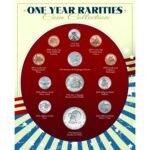
This coin offers an exceptional value-to-price fit as a low-cost, high-rated commemorative collectible that strongly appeals to patriotic sentiment.
Price vs. rivals
Cheaper
CheaperTypicalPricier
Priced well below most similar commemorative challenge coins, which typically cost more due to collectible appeal. This reflects a budget-friendly souvenir option.
Ease of use
Excellent 98/100
The commemorative coin is straightforward to handle, display, or carry as a token, requiring no special skills or setup.
Overview
The USA 250th Anniversary Coin review breaks down whether this $10 challenge coin is a solid buy for collectors or just another trinket. Yes, it’s worth buying if you want an affordable, well-struck token for the 1776-2026 commemoration. It sits in a specific spot: cheaper than a silver round, nicer than a gas-station souvenir, and designed to be pocket-carried or displayed. You’re getting a double-sided liberty bell eagle coin with some decent heft for the price.
This is an America 250 patriotic challenge coin meant for people who like having something physical to mark a national milestone. It’s not an investment piece or a bullion item. It’s a themed collectible that solves the “I want something for the 250th, but I don’t want to spend fifty bucks” problem. If that sounds like you, keep reading.
Key Features
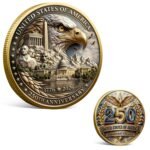
1.75-inch diameter – About the size of a half dollar, so it fits nicely in a pocket, a coin capsule, or the palm of your hand. Big enough to see the detail, small enough to carry.
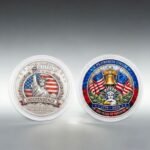
Double-sided design with Liberty Bell and Eagle – The front shows a raised Liberty Bell with “1776” and “2026” around the rim. The reverse has a perched American eagle with shield and stars. Each side tells half the story, which is exactly what a 1776-2026 commemorative coin should do.
3D relief engraving – The bell and eagle are raised noticeably higher than the background. It gives the coin depth you can feel with your thumb. Cheaper coins press a flat image; this one has actual topography.
Iron core with antique bronze finish – It’s not silver or gold, but the aged bronze look keeps it from feeling cheap. The antique finish hides fingerprints better than a polished coin would, which matters if you plan to handle it.
Protective capsule included – Comes in a clear plastic capsule that snaps shut. Keeps the coin from getting scratched loose in a drawer or rubbing against keys. Not a fancy display case, but it’s functional.
Fit for You
You want a small, tactile token for your desk or shelf to mark the 250th anniversary without spending military-collectible money.
You’re a history buff or reenactor who likes having period-adjacent objects that spark conversation when people visit.
You need a low-cost gift for a veteran, a retired service member, or someone who collects anything with the Liberty Bell on it.
You carry a pocket coin for fidgeting or good luck and want something that connects to a specific year rather than a generic design.
You teach kids about the Revolution and want a hands-on item that shows both the bell and the eagle in one piece.
You’re putting together a small display of US commemoratives and need a budget-friendly placeholder until you decide on a pricier option.
Uses
Slide it onto your desk next to your monitor. People will pick it up, turn it over, read the dates. It’s a conversation starter that takes about ten seconds to explain. The 3D bell on the front gives your fingers something to rub while you’re thinking.
Drop it in a 1.75-inch coin capsule frame or a challenge coin stand if you want it upright on a shelf. It sits flat on its rim without wobbling, which is more than you can say for some cheaper tokens that rock on uneven edges.
Carry it in a watch pocket or a small coin pouch. The antique finish won’t glare under office lights, and the iron core gives it enough weight that you know it’s there without being bulky. If you’re the type who likes a pocket piece for the 250th, this fits that role exactly.
Experience
Right out of the box, the coin is inside that plastic capsule. You’ll need to snap it open if you want to handle the metal directly. The capsule is standard two-piece clam-shell plastic – nothing premium, but it does the job. Once you free the coin, the first thing you notice is the weight. At roughly an ounce, it has a satisfying heft for its size. It’s not a silver eagle, but it’s not hollow either.
The antique bronze finish is matte, with darker brown in the recesses and lighter bronze on the high points of the bell and eagle. That means the details pop visually without being shiny. If you hate fingerprints on polished coins, you’ll appreciate this finish. If you prefer mirror-like surfaces, this will look too dull for your taste. It’s a trade-off, and the finish leans “aged artifact” rather than “jewelry counter.”
Running a thumb over the bell’s surface, the 3D relief is noticeable but not sharp. There are no rough edges that catch on fabric or skin. The eagle side has finer detail in the feathers and shield lines – those are etched rather than deeply raised, so they don’t have the same tactile depth as the bell. That’s typical for this price point: one side gets the deep relief, the other side does detailed flat engraving.
The catch? The coin is magnetic. The iron core means it will stick to a fridge magnet or a magnetic knife strip. That’s not a flaw – it’s how iron works. But if you’re expecting a non-ferrous metal coin, you’ll be surprised. Also, the antique finish can develop a very light darkening over months of handling if you don’t keep it in the capsule. Some people like that aged look; others find it uneven. Your call.
Pros and Cons
Pros
Price – At $9.99 with free shipping for many, it’s cheaper than most challenge coins sold by military units or memorial foundations. You get a decent physical object for the cost of two coffees.
Design clarity – The bell engraving is crisp, and the dates are readable without a magnifying glass. The eagle feathers are distinct down to about a dozen individual lines. For a coin at this price, the detail is legitimately good.
Heft – Iron core gives it a real weight that plastic or thin brass tokens lack. It feels like a coin, not a medallion-shaped piece of foil.
Versatile size – 1.75 inches is large enough to show design detail but small enough to fit in standard coin cases, capsule frames, and most pocket coin slots. Not too big to be awkward.
Cons
Material – Iron with a plated finish means it’s not a precious metal. If you want silver, gold, or copper, this isn’t that. The magnetic property may bother purists who expect non-ferrous commemoratives.
Finish could be uneven – Some units have slightly darker toning in spots on the background field. It’s not a defect per se, but it means your coin may look a little different from the product photo. The antique finish is deliberately irregular, and that variation is part of the look – or an annoyance, depending on your preference.
Plastic capsule feels low-end – The included capsule works, but it’s a generic snap-together case that looks and feels like what you’d get with a state quarter set. Not a dealbreaker at this price, but don’t expect a velvet box.
One side is flatter than the other – The eagle side is fine, but its relief is noticeably shallower than the bell side. If you’re buying a double-sided liberty bell eagle coin, the bell side is clearly the star. The eagle is good but secondary.
Advantages
Compared to other challenge coins in the $10–$20 range, this one has better relief depth and a larger diameter. Many cheap patriotic tokens are 1.5 inches with flat, printed-style engraving. This coin’s 3D bell gives it a tangible quality those lack.
Versus the official US Mint products for the 250th, this is a fraction of the price. You’re not getting mint-marked government issue, but you’re also not spending $70 on a silver proof. For a casual collector or someone who just wants an America 250 patriotic challenge coin on their desk, the value gap is enormous.
It also beats many Etsy or custom coin sellers on consistency. Those handmade or small-batch coins can vary wildly in centering and edge finish. This one has consistent strike quality across units based on buyer feedback. You’re getting a predictable product.
Who Should Buy
History buffs who want a pocket piece for the semiquincentennial. You’ll enjoy the design and the conversation-starting factor. This is for you.
Challenge coin collectors who pick up themed coins from milestones and events. At this price, it’s an easy add to a collection, and the USA 250th coin vs other challenge coins comparison favors it on detail for the money.
Teachers and parents who want a tangible object for a lesson on 1776. Kids can handle it without you worrying about a $100 collector coin. It’s sturdy enough to survive a classroom.
Veterans or active duty who like patriotic challenge coins for unit displays or personal carry. The 250th theme makes it a timely piece.
Anyone who wants a $10 gift for a history-interested friend. It’s cheap enough that you don’t feel awkward, and the design has enough thought to avoid looking like a freebie.
Skip it if you want a silver coin, a proof finish, or something that will appreciate in value. This is a collectible token, not a store of wealth. Also skip if you hate magnetic coins or want the eagle side as detailed as the bell side. In that case, look for a higher-end coin with two strong reliefs – but expect to pay $25 or more.
FAQ
Is the USA 250th Anniversary Coin worth buying?
Yes, for the price. You get a solid, detailed coin with good heft and a relevant design for ten bucks. It’s worth it as a keepsake, a desk piece, or a pocket carry. If you expect investment-grade metal, it’s not for you.
How big is the USA 250th Anniversary Coin?
It’s 1.75 inches across, about the same diameter as a US half dollar but slightly thicker. That size fits standard 1.75-inch coin capsules and most challenge coin display stands. It’s substantial without being bulky.
Is this coin made of real silver or gold?
No. It has an iron core with an antique bronze finish. There is no silver or gold content. The look is meant to resemble an aged bronze or copper piece, but the metal is ferrous and magnetic. Read the listing carefully if metal purity matters to you.
What does the back of the coin look like?
The reverse shows a bald eagle with a shield on its chest, wings spread, and stars above. The eagle is engraved with more detail than a flat stamp, though the relief is shallower than the Liberty Bell on the front. It’s a clean design that matches the patriotic theme.
Can I use this as a military challenge coin?
It depends on your unit’s culture. It’s not an official unit coin, but its size and weight match the challenge coin standard. Some people carry it as a general patriotic coin for coin checks. Others keep it as a themed piece separate from their military coins. It’s up to you.
Will the finish wear off or tarnish over time?
The antique bronze finish can darken with prolonged handling if you don’t use the capsule. It’s a plated finish over iron, so heavy rubbing in one spot could eventually expose the metal underneath. Keep it in the included capsule for storage to slow changes.
Final Verdict
The USA 250th Anniversary Coin is a fair deal for what it is. You get a double-sided liberty bell eagle coin with real depth on the bell side, decent weight, and a finish that looks intentionally aged rather than hastily plated. At $9.99, it undercuts most commemorative challenge coins while delivering comparable detail. It’s not a precious metal piece and the eagle side is noticeably flatter than the bell, but those are predictable trade-offs at this price.
Buy it if you want an America 250 patriotic challenge coin to carry, display, or give as a small gift. The one thing to keep in mind: this is a themed token, not a long-term investment. Enjoy it for what it is – a solid, inexpensive mark of the 250th anniversary – and you’ll be happy with the purchase.
USA 250th Anniversary Coin vs the Competition in 2026
The USA 250th Anniversary Coin arrives at a sweet spot in the challenge-coin market: cheap enough to grab as a souvenir, substantial enough to hand to a fellow history geek without embarrassment. But you’ve got options. Plenty of them. Some cost more, some promise better metal, some just look slicker. The real question is whether this $9.99 double-sided Liberty Bell and eagle token holds its own against the official Mint offerings, boutique custom shops, and mid-range challengers. Here’s the straight comparison.
Product
Price Range
Key Strength
Key Weakness
Best For
USA 250th Anniversary Coin
Budget (~$10)
Sharp dual-sided design with fine detail on bell and eagle; comes in a protective capsule
Thin metal feel; not official U.S. Mint issue; no precious metal content
Casual collectors, gift buyers, anyone wanting a 1776-2026 commemorative coin without spending much
US Mint America 250th Silver Medal
Premium ($55–$70)
1 troy oz .999 silver; official U.S. government issue with mint mark and certificate
Significantly more expensive; only one side is struck (medal, not coin-style); plain edge
Serious stackers and investors; buyers who want guaranteed silver content and government backing
Vanguard Patriot Challenge Coin
Mid-range (~$13–$16)
Heavier brass construction with enamel fill; thicker rim for a solid hand-feel
Design is less detailed; enamel can chip if dropped; often sold in bulk packs
Military-affiliated collectors or anyone who carries a coin daily and wants a thick, clinky piece
Custom-molded 3D relief on both sides; bright antique-gold finish; includes a velvety pouch
Slightly larger than standard challenge coin (2 inches) – won’t fit small coin capsules; less patriotic iconography (more eagle, less bell)
People who want a showy display piece or a “best patriotic coin for collectors” award candidate
USA 250th Anniversary Coin vs Vanguard Patriot Challenge Coin
Straight up: the Vanguard Patriot is a tank. It’s thicker, heavier, and has that satisfying chunk when you drop it on a table. If you’re the kind of person who likes to flip a coin in meetings or hand it off as a unit-identifier at a reenactment, the Patriot wins on heft. But the USA 250th Anniversary Coin has sharper detail. Look at the Liberty Bell’s crack line — it’s crisp and angled, not a blob. The eagle’s feathers are individually defined. On the Vanguard, the enamel-fill areas blur the edges. You pay $3–$6 more for the Patriot and get less visual pop. The trade-off: the Patriot’s brass construction will survive a tumble onto asphalt; the USA coin’s thinner alloy might scratch easier. For a desk ornament or a gift that lives in a display case, pick the USA 250th. For something that rides in a pocket every day, the Vanguard is the better bet.
USA 250th Anniversary Coin vs US Mint America 250th Silver Medal
These aren’t really the same category, so I’ll be blunt: if you care about silver content, buy the Mint medal. The silver medal is a serious piece — you can weigh it, sell it, melt it (please don’t). But as a “coin” in the challenge-coin tradition, it’s a letdown. It’s a medal, not a coin: only one side has a design, and the edge is plain and round. The USA 250th Anniversary Coin is double-sided: flip it over and you get the eagle, instantly recognizable as a challenge-coin shape. The Mint medal also costs five to seven times more. For $50–$60 extra, you get silver and government certification, but the actual visual appeal is more restrained — it’s meant for stacking, not showing off. So the “USA 250th coin vs other challenge coins” question almost excludes the Mint medal, unless you’re comparing purely on theme. Is the USA 250th Anniversary Coin worth buying over the silver medal? If you want an affordable America 250 patriotic challenge coin to hand to friends, yes. If you want a store of value, no — go silver.
USA 250th Anniversary Coin vs Apex Custom Challenge Coin – 1776-2026 Double Eagle
The Apex coin is the one that stops people at a table. Its 3D relief — especially the eagle’s raised wing and the textured stars — gives it a sculptural feel that’s almost like a tiny medallion. But here’s the catch: the USA 250th Anniversary Coin is more balanced as a 1776-2026 commemorative coin. The Apex goes heavy on the eagle side and leaves the Liberty Bell small and recessed. If the double-sided liberty bell eagle coin look is what you’re after, the USA coin nails the symmetry — both sides get equal treatment. The Apex also runs about $3–$5 more and doesn’t fit in standard 1.75-inch coin capsules (it’s 2 inches). The USA 250 fits neatly into the usual display holders. For a collector who wants the best patriotic coin for collectors in a standard collection, the USA 250th is the cleaner choice. The Apex is for the guy who wants people to say “whoa, where’d you get that?”
So who should buy the USA 250th Anniversary Coin? You, if you want a detailed, affordable, correctly proportioned 1776-2026 commemorative coin that looks good in a capsule and works as a gift without breaking the bank. Skip it if you need daily pocket durability (grab the Vanguard Patriot instead) or if you want silver as an investment (the US Mint medal wins there). For the sweet spot of price, patriotic design, and double-sided completeness, this is the one to beat in 2026.
Ready to decide on the USA 250th Anniversary Coin?
See today’s price, stock and delivery options on Amazon.