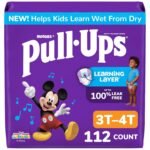
In this Pull-Ups potty training pants review, the short answer is yes: it’s worth it for most families. The 112-count box of 3T-4T pants comes to about 42 cents per pair, which feels fair for something you’ll go through quickly. Pull-Ups don’t do the training for you, but they do make the messy middle stage easier.
This product offers strong brand trust and high user satisfaction at a competitive price for its size.
Price vs. rivals
Pricier
CheaperTypicalPricier
Priced above typical competitors for similar count potty training pants, likely due to brand premium and high customer ratings, but not extreme.
Ease of use
Excellent 95/100
Pull-up design makes them very easy for toddlers and parents to use, supported by an excellent 4.8-star rating.
Pull-Ups Potty Training Pants Overview
Pull-Ups are training pants, not diapers, and that distinction is the whole point. They have a thinner absorbent core so a toddler can feel when they’re wet, which is the feedback loop that encourages them to use the potty. They still contain accidents, just with a lot less bulk than a diaper.
Shopping for the best potty training pants for girls usually lands you here, and for good reason. The 3T-4T size fits most girls who are between toddler and preschool, and the Pull-Ups potty training pants work for daytime training, naps, and car rides. They’re built for the months when your child can do some things on her own but isn’t fully reliable yet.
Key Features of the Pull-Ups Potty Training Pants
Training pants design: The thinner core lets wetness be felt, which is the whole mechanism behind potty training. It’s different from a diaper, where the moisture stays locked away.
Pull-Ups size 3T-4T count 112: You get 112 pairs in one box. It’s a generous supply for a month at typical use, and the price works out to about 42 cents a pair.
Disney character prints: The designs give you a small motivational hook. Some kids respond well to seeing a favorite character and wanting to keep it dry.
Easy-tear sides: You can rip the sides to get the pant off, which is a lifesaver during messy accidents. No need to wrestle a diaper off a squirming toddler.
Stretchy waistband: It feels more like real underwear than a diaper, so the eventual switch to regular underwear is less of a shock. Kids can also pull them up and down themselves, which is the practice they need.
Fit for You
You’re done wrestling diaper tabs on a toddler who insists on doing everything herself.
You’re down to one or two daytime accidents and need a thin backup under her clothes.
You want something daycare staff can change in a hurry, and the easy-tear sides make that possible.
You’re open to using Disney prints as a small motivational tool, because sometimes “keep Elsa dry” actually works.
You have a road trip coming up and would rather handle an accident in a rest stop than a car seat.
Everyday Uses for Pull-Ups
During the day, these are the main event. You swap the morning diaper for a Pull-Up, set a timer for every 30 or 40 minutes, and see if your daughter makes it. When she doesn’t, the cleanup is straightforward. The wetness indicator helps early on.
Naptime is the second big scene. A Pull-Up will handle a normal nap, though a heavy sleeper might leak. You’ll figure that out in the first week and adjust accordingly.
Car rides come next. You can’t always pull over in time, so a Pull-Up is the insurance policy. It beats scrubbing a car seat, and every parent who has done it once knows that’s not an exaggeration.
The last use is less obvious: the “I’m not ready” phase. Your child might insist on wearing a Pull-Up for comfort even after she’s mostly trained. That’s normal, and it fades.
Everyday Experience with Pull-Ups
You’ll notice the fit right away. The waistband sits higher than a diaper and feels closer to underwear, which is the intention. Kids can pull them up and down alone, though they won’t always make it in time. The stretchy sides hold up to repeated tugging better than you might expect.
The wetness indicator is handy for the first couple of weeks. Then you stop looking because you can already tell by the way your daughter moves, or because she announces it, or because the pants are visibly damp. You’ll find your own signal.
The box is big, so you’ll want a bit of storage space. The pants stack flat and don’t take up much room once you break the box open. Keep a few in the diaper bag and a few at grandma’s house.
One small annoyance: kids can strip these off at the wrong moment. Your daughter may decide at the grocery store that she’s done with pants entirely. That’s a potty training stage, not a Pull-Ups flaw, but expect it.
The smell is mild when fresh and inoffensive, but a wet one left in the trash reminds you quickly. Empty the pail often during training.
Pros and Cons of the Pull-Ups Potty Training Pants
Pros
Pull-up design: Kids can practice pulling up and down, which is the exact skill they need for real underwear.
Reliable absorbency: Handles normal daytime accidents without leaking, as long as you change soon after.
Easy-tear sides: Turns a messy change into a quick one, especially with a squirmy toddler.
Disney prints: A small motivational tool; some kids are genuinely proud to wear a favorite character.
Good price per pair at this count: About 42 cents each for the 112-count box is reasonable for the category.
Cons
Not for overnight: The thinner absorbent core means heavy sleepers will leak through, so you’ll still need real diapers for bed.
Price adds up: At 4 to 6 pairs a day, you’re spending $1.70 to $2.50 daily, which is noticeable over a few months.
Easy-tear sides tear a bit too easily: If your child yanks hard or you pull too fast, the seam can split entirely.
Kids can remove them: That’s technically the point, but it also means surprise naked moments in public places.
Advantages Over Other Training Pants
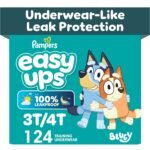
People search for “Pull-Ups vs Huggies pull-ups” and there’s a wrinkle: both come from the same parent company, Kimberly-Clark. Pull-Ups is the training pant line, while Huggies is the diaper line. The real head-to-head comparison is Pull-Ups against Pampers Easy Ups or store-brand training pants.
Against Pampers Easy Ups, Pull-Ups tend to run a bit more snug through the legs, which helps prevent leaks with active kids. Pampers Easy Ups feel softer and more cloth-like at first touch. Store brands cost less per pair, but the lower price shows up as thinner material and less stretchy sides.
None of this makes Pull-Ups the right choice for every family. But when fit and leak protection matter more than the few cents you’d save, they’re the safer pick.
Who Should Buy Pull-Ups
You’re actively potty training: If your daughter is between 2 and 4 and spending most days practicing, this is the right product at the right stage.
You want a big supply: The 112-count box means you won’t restock every week, and the per-pair price is better than smaller boxes.
You’re okay with the upfront cost: At $47.20 a box, it feels high, but the daily cost is comparable to other training pants.
You prefer mainstream brands: If you like knowing exactly what you’re getting, Pull-Ups is the most established name in the category.
Skip these if your child is a heavy sleeper who soaks through overnight. You’ll need an overnight diaper or a specialized overnight pull-up. Also skip them if your daughter is already reliably using the potty. Regular underwear is cheaper and sends a stronger signal that training is over.
FAQ
Is Pull-Ups worth it?
Yes, for most families in the middle of training, the Pull-Ups potty training pants are worth it. At roughly 42 cents per pair, you get a reliable pull-up with easy-tear sides and a fit kids can manage themselves. The main limitation is overnight, where heavy sleepers may still need a diaper.
How many Pull-Ups per day potty training should you plan for?
During active potty training, you’ll probably use 4 to 6 Pull-Ups per day. That covers one for the morning, one for nap, a couple of accidents, and a final pant at bedtime. At that rate, the 112-count box lasts roughly two to four weeks, so the bulk purchase makes sense.
What’s the difference between Pull-Ups and regular diapers?
Pull-Ups have a thinner absorbent core than diapers, so a child can feel wetness and learn to associate it with needing the potty. The stretchy waistband and pull-on design let kids practice dressing themselves. The trade-off is lower absorbency, especially overnight, so you can’t treat them like diapers.
Do Pull-Ups have a wetness indicator?
Yes, most Pull-Ups designs include a wetness indicator. The character graphic fades when the pant gets wet, so you and your child know it’s time to change. It’s especially helpful in the early weeks when kids can’t always tell you they’ve had an accident.
Are Pull-Ups safe for sensitive skin?
Pull-Ups are generally well tolerated, with a soft lining and breathable sides that help prevent rashes. If your child has a known allergy or a persistent rash, check with your pediatrician before switching anything. Most kids do fine with them, but prompt changing matters more than the brand.
What are the best Pull-Ups girls potty training pants alternatives?
The main Pull-Ups girls potty training pants alternatives are Pampers Easy Ups and store-brand options like Parent’s Choice or Up & Up. They run cheaper per pair but often feel bulkier and may not absorb as well. You won’t find a separate “Huggies pull-ups” product, since Pull-Ups and Huggies share the same parent company.
Final Verdict on the Pull-Ups Potty Training Pants
The Pull-Ups potty training pants are a solid buy for most families in the middle of toilet training. The 112-count box at $47.20 covers about a month, the pull-up design works as intended, and the Disney prints give you a small motivational lever. You’ll still need a separate solution for overnight, and the daily cost is nothing to ignore. But as a training tool, these do exactly what they’re supposed to do.
The one thing to keep in mind: these are training pants, not diapers. Use them for daytime, naptime, and the road, then switch to underwear as soon as your daughter can handle it. That’s the plan that saves you money and gets her out of them faster.
Pull-Ups potty training pants vs the Competition in 2026
Pull-Ups Girls’ Potty Training Pants in size 3T‑4T (112 count) hold a commanding position in the potty‑training aisle—mostly because they’ve been doing this long enough to know exactly what annoys parents and what kids ignore. At roughly $0.42 per pant, they sit comfortably in the mid‑price zone, not the cheapest you’ll find but far from the premium stuff. The 4.8‑star rating isn’t accidental; they nail the balance between absorbency, fit, and that “big kid” feel that actually motivates a toddler. Still, you’ve got other options that might suit your kid’s bladder, your budget, or your sanity better. Here’s how the main rivals stack up.
Product
Price Range
Key Strength
Key Weakness
Best For
Pull-Ups Girls’ Potty Training Pants (3T‑4T, 112 ct)
Mid (~$0.42/pant)
Side tear‑away seams that actually work one‑handed; Disney designs that kids beg to wear
No wetness indicator (you have to touch or rely on the fading print)
Parents who want a proven, kid‑motivating pant without fuss
Huggies Pull‑Ups Training Pants (girls, 3T‑4T)
Mid (~$0.40–0.45/pant)
Wetness indicator (the front design disappears when wet); slightly softer inner liner
Side seams are harder to rip open when you’re holding a squirming toddler
Parents who rely on a visual cue to know it’s time for a change
Pampers Easy Ups (girls, 3T‑4T)
Upper‑mid (~$0.48/pant)
Dual leak‑guard barriers and the widest absorbent core; great for overnight use
Bulkier fit; less “underwear‑like” – feels more like a diaper
Heavy wetters or nighttime training where leaks are the main enemy
The Honest Company Training Pants (girls, 3T‑4T)
Premium (~$0.55–0.60/pant)
Plant‑based materials, no chlorine processing, cute prints, wetness indicator
Less absorbent than Pull‑Ups or Pampers – you’ll change more often
Eco‑conscious families whose kid doesn’t flood the pants
Cuties Training Pants (girls, 3T‑4T)
Budget (~$0.30/pant)
Price – you get 100+ pants for under $30
Thinner pad; leaks happen if you wait too long; tear‑away seams are inconsistent
Daytime only, when cost per change matters more than leak protection
Pull‑Ups potty training pants vs Huggies Pull‑Ups: same parent company, different trade‑offs
You’d think two products from the same umbrella would be identical, but they aren’t. The biggest difference is the wetness indicator. Huggies Pull‑Ups have a cute little character that fades when wet – a godsend if you’re the parent who constantly asks “are you wet?” and gets a shrug. Pull‑Ups rely on a subtle fading print that’s harder to spot in dim light. On the flip side, Pull‑Ups’ side seams tear open cleanly with one hand; Huggies’ often require two tugs or a second hand. If you’ve ever tried to hold a wiggly three‑year‑old while ripping a pant leg off, you know which one saves your sanity. For daytime training where you’re actively prompting bathroom trips, the Pull‑Ups design wins. For moms who want a quick visual check, Huggies takes it.
Pull‑Ups potty training pants vs Pampers Easy Ups: the nighttime question
Pampers Easy Ups are noticeably thicker – they’re built like a diaper with a waistband. That means they hold more liquid, and the dual leak‑guard channels actually work overnight without waking the kid (or the sheets). But that bulk also makes them less comfortable for a child who’s supposed to feel “grown‑up.” Pull‑Ups are trimmer, feel more like real underwear, and the Disney characters give your daughter a reason to keep them dry. The real calculus: if your kid is a heavy wetter who still sleeps through the night, Easy Ups are the practical pick. If you’re in the daytime phase where motivation matters more than capacity, Pull‑Ups are better. And at about six cents less per pant, Pull‑Ups won’t punish your wallet for frequent changes – which you’ll be doing a lot of during active training.
Pull‑Ups girls potty training pants alternatives: natural and budget picks
The Honest Company pants are the premium alternative if you care about what touches your child’s skin. They’re free of chlorine, fragrances, and lotions, and the prints are genuinely pretty. But the absorbency is notably lower – you’ll go through more of them per day, which eats into the cost savings of having a slightly cheaper per‑pant price than some might expect. If you’re asking “how many Pull‑Ups per day potty training?” and the answer is eight to ten, Honest will push you closer to twelve. Cuties, on the other hand, are the budget champion. They work fine for a quick trip to the store or a few hours at home, but the thinner pad leaks if you don’t change within an hour of wetness. For the price of one box of Honest, you can buy three boxes of Cuties – a real consideration if you have twins or a slow learner. Neither matches Pull‑Ups for the all‑day reliability and kid‑appeal combo.
So is Pull‑Ups worth it in 2026? Yes, if you want a middle‑of‑the‑road pant that doesn’t embarrass your kid, doesn’t break the bank, and handles daytime training with very few leaks. Pick them when your daughter is motivated by Disney princesses and you value easy tear‑away sides over a wetness indicator. But if you’ve got a nighttime heavy wetter, swap to Pampers Easy Ups for the overnight shift. If you need to stretch every dollar on a tight budget, Cuties will do the job during the day – just carry a spare. And if you’re shopping for the best potty training pants for girls who hate the feel of anything diaper‑like, Pull‑Ups remain the smartest default.
Ready to decide on the Pull-Ups potty training pants?
See today’s price, stock and delivery options on Amazon.