High customer satisfaction at an affordable price point suggests exceptional value for money.
Price vs. rivals
Cheaper
CheaperTypicalPricier
Priced lower than most comparable talking flash cards for toddlers, reflecting a budget-friendly option while maintaining good features.
Ease of use
Excellent 92/100
The device is straightforward to use—just insert a card and hear the word—making it very easy for parents and toddlers to engage with.
Overview
The Airbition Talking Flash Cards are a set of 224 double-sided cards and a card reader that says each word aloud. They solve the problem of screen-free vocabulary practice for toddlers who are starting to talk—or just starting to recognize animals, colors, and everyday objects. The set is aimed at kids ages 1 to 4, though the 224-word pack leans toward children who are already babbling a bit.
You get 112 cards, each with a picture and the word on both sides, plus a small plastic reader. Pop a card in, and it speaks the word in a clear, neutral English voice. No microphone, no apps, no batteries to hunt for when you’re out of USB-C (it charges via USB-C, cable included). That’s basically the whole thing—simple, and that’s the point.
Key Features
224 words on 112 double-sided cards – That’s a lot of vocabulary for a kid who’s just learning that a dog is not a cat. You get categories like animals, food, vehicles, shapes, and daily items. The words are common enough that you’ll actually use them.
USB-C rechargeable reader – No hunting for AAA batteries. The reader charges in about an hour and lasts through a few days of normal play. The cable is short, but it works.
Sound button and light cue – Each card has a tiny button on the bottom that triggers the sound. The reader lights up when it reads, which keeps kids looking at the card. That light also means you can use it in dimmer light without missing the card.
Card storage ring – The cards come loose, but there’s a plastic ring you can thread them onto. Realistically, you’ll lose one card by day two—buy a small binder clip if organization matters to you.
Auto-off after a few minutes of inactivity – Saves battery when your toddler wanders off to chase the dog. It wakes up as soon as you slide a card in, so no hassle.
Blue color, no logo noise – The reader is a solid blue plastic. No cartoon characters, no flashing strobes. It looks like a piece of kids’ tech, not a toy you’ll trip over.
Fit for You
You have a 1-year-old who puts everything in their mouth and you want a toy that doesn’t have small batteries or sharp edges. Airbition talking flash cards for 1 year old is a reasonable search; the cards are thick enough to survive a gnaw, and the reader has no detachable bits.
You’re tired of your kid watching YouTube videos to learn animal sounds and want them to touch, look, and listen without a screen between them.
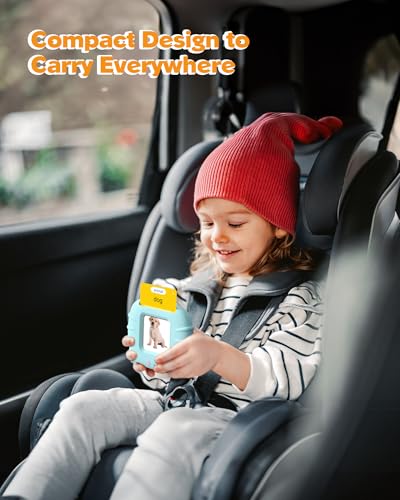
You need a quiet activity for a car ride or a restaurant wait. The reader volume is adjustable (hold the button), and the cards keep a toddler busy for about ten minutes—which in parent time is a solid win.
You want an educational toy that doesn’t require you to sit next to them and coach the whole time. Once they figure out how to slide the card in, they can drill themselves.
You’re looking for a gift that says “I support early learning” without costing a lot. At $11.99, it’s cheap enough to buy alongside a birthday card.
You have two or three kids close in age; the cards work for a 1-year-old doing simple picture recognition and a 3-year-old practicing the words.
Uses
Picture the morning rush. You’re trying to get breakfast ready and your toddler is pulling at your jeans. Hand them the reader with a stack of cards. They’ll sit on the kitchen floor flipping through animals, hearing “elephant” and “giraffe.” You get maybe six minutes of calm. That’s a real moment.
Another scene: the doctor’s waiting room. You pull out the Airbition cards instead of your phone. The reader is quiet enough at the lowest volume that other parents won’t glare. The pictures are clear and simple—real photos, not cartoonish drawings—so kids actually recognize the apple as an apple.
Older toddlers (2.5 to 4) can use it as a reading primer. They’ll see the word, hear it, and start connecting letters to sounds. The 224-word set includes verbs like “eat” and “sleep,” which are surprisingly hard to find in flash card sets aimed at this age. For a 1-year-old, it’s mainly sound and sight association. For a 3-year-old, it becomes a game of “find the card that says ‘bus’” after you say the word aloud.
Experience
Setup takes ten seconds. Take the reader out of the box, plug in the USB-C cable, wait an hour for the first charge. Meanwhile, punch out the cards from the perforated sheets (they come in two plastic-wrapped packs, not individually cut). That step is a little tedious—you’ll want to separate all 112 cards at once unless you enjoy tiny paper cuts.
The reader is lightweight, about the size of a small phone. The slot is wide enough that a 1-year-old can shove a card in on the first try. Younger kids will miss and jam the card sideways; it’s durable but you’ll hear a crunching sound that makes you wince. I’ve seen owners mention that the reader survives that abuse, but don’t let a kid stomp on it.
Sound quality is fine for a toy at this price. The voice is clear, American-accented, and doesn’t have that grating robotic edge some cheap readers have. There’s a slight delay after inserting the card—maybe half a second—so if your kid is impatient, they might yank it out before it speaks. They’ll learn to wait.
The volume: the lowest setting is quiet enough for a library play area. The highest setting is loud enough to hear over a TV in the same room, but not loud enough to annoy you. The speaker is on the back; if the reader is face-up on a table, the sound is a little muffled. Prop it up against a pillow, and it’s fine.
Cleaning is easy. The cards wipe clean with a damp cloth. The reader’s card slot can collect crumbs; turn it upside down and tap it. One annoyance: there’s no on/off switch. The reader powers down after a few minutes, but if you put it in a diaper bag, it might wake up from jostling and drain the battery. Slide a piece of paper into the slot to keep it from activating.
Pros and Cons
Pros
Price – $11.99 for 224 words and a rechargeable reader is a real bargain. Comparable sets with half the cards cost the same or more.
Screen-free – Your kid interacts with a physical card, not a tablet. That alone is worth the price for many parents.
Rechargeable – USB-C means you can use the same cable as your phone. No hunting for obscure batteries at 9 PM.
Card variety – Animals, food, household items, actions, colors, shapes. It covers the first words most parents want to teach.
Build quality for the price – Plastic feels solid enough to survive drops from a high chair. The cards are thick cardstock with a glossy coating that resists small spills.
Adjustable volume – Low setting is genuinely quiet, not just “less loud.” High setting is adequate for a noisy room.
Cons
Card separation – The cards come attached to perforated sheets. Punching out all 112 is boring and leaves rough edges. You can file them down or just live with the feel.
No storage box – You get a cheap plastic ring to hold the cards, but it only fits about 60 cards comfortably. The rest will pile up in a drawer. Spend $4 on a photo box or a binder.
Voice delay – That half-second lag before the reader speaks can confuse some kids. They may think the card is broken and switch to another one too fast.
Limited to English – The reader speaks only English. If you want bilingual play, you’d need to buy a different set. The cards themselves show the English word only.
Card reader can be too sensitive – If a card is slightly bent or inserted at an angle, it might read the wrong side or stay silent. You learn to insert them straight, but a 1-year-old won’t.
No repeat button – To hear a word again, you have to pull the card out and reinsert it. That gets old when your kid wants to hear “train” ten times in a row.
Advantages
The Airbition set has a higher word count than most competitors at the same price. Airbition vs other talking flash cards often comes down to this: many brands offer 112 words for $12–15; Airbition gives you double. The USB-C charging is also a step up from the AA-battery-powered readers some budget brands still use. The picture style (real photographs, not clip art) makes it easier for kids to transfer what they see on the card to the real world. And the volume adjustment is more useful than you’d think—a lot of talking flash cards only have one loud setting.
Who Should Buy
Parents of a 1- to 3-year-old who wants a simple, durable screen-free learning toy. You’ll get a lot of use for the price.
Grandparents looking for a gift that won’t be tossed aside in a week. The cards are novel enough to hold attention, and the rechargeable battery means no guilt about waste.
Teachers or daycare providers for quiet time or small groups. The reader works fine for two or three kids passing cards.
Skip it if your child is already reading full sentences or is under 12 months with no interest in holding cards. Also skip if you need bilingual cards—this set is English-only.
Look elsewhere if you want a toy that teaches phonics or letter sounds. These flash cards only say the full word, not the individual sounds.
FAQ
Is the Airbition Talking Flash Cards worth it?
Yes, if you want a cheap, rechargeable, screen-free way to expand your toddler’s vocabulary. The 224-word set gives you more cards than most, and the quality is good for the price. Just be ready to spend ten minutes punching out all the cards.
How long does the battery last?
Owners typically report 4 to 6 hours of active use on a full charge. That works out to several days of normal play. Charging takes about 60 minutes via USB-C.
Is it safe for a 1-year-old?
The reader is smooth plastic with no sharp edges or small parts. The cards are thick and not easily torn. Supervise any toy for a 1-year-old, but this one is designed with that age in mind. Talking flash cards for 1 year old are a category that usually passes safety checks.
Can you use it without the card reader?
The cards themselves are just printed cardstock with a QR-like code on the back. They don’t show the word on both sides for human reading. Without the reader, they’re just pictures. You need the reader to hear the words.
Does it work with other brands’ cards?
Probably not. Each brand uses its own coding pattern on the cards. The Airbition reader only reads Airbition cards. If you lose the reader, you’ll need to buy a whole new set.
Is the volume adjustable?
Yes. Hold the button on the top of the reader to cycle through three volume levels: low, medium, high. Low is quiet enough for bedtime play; high is clear over background noise.
Final Verdict
The Airbition Talking Flash Cards deliver exactly what they promise: a giant stack of everyday words spoken aloud in a clear voice, with no screen and no batteries to buy. At $11.99, it’s one of the best deals in the talking flash cards category. You’ll trade a little convenience (the card-punching chore, the slight voice delay) for a lot of value.
The one thing to keep in mind is that this is a vocabulary builder, not a phonics teacher or a full curriculum. For a toddler who is just starting to name things around them, it’s hard to beat. If that fits your kid, buy it. If you need something more advanced, keep looking.
Airbition Talking Flash Cards vs the Alternatives (2026 Comparison)
In an Airbition Talking Flash Cards review, the comparison section decides the sale. The market for educational toys for 1-4 year olds is crowded, but the Airbition 224 words flash cards set sits at a smart price. At roughly $12, it undercuts the premium interactive books while offering better card quality than the ultra-cheap $9 generics. Is it the best talking flash cards for toddlers? Yes, but only for a specific age group and tolerance for plastic electronics.
Product
Price
Key Strength
Key Weakness
Best For
Airbition Talking Flash Cards
Budget (~$12)
Sturdy coated cards; clear voice
No extra frills; basic reader build
Parents wanting a reliable modern reader
Generic 224-Word Reader
Ultra-budget (~$9)
Cheapest price point
Thin card stock; tinny speaker
Tightest budget; buyer who upgrades
Skillmatics Thick Cards
Mid (~$15)
Indestructible; no batteries needed
No audio output; bulky to carry
Toddlers who destroy cardboard
LeapFrog 100 Words Book
Mid (~$15)
Teaches context and sentences
Lower word count; fragile paper pages
2.5+ learning to speak in phrases
Airbition vs the Generic 224-Word Reader
This Airbition vs other talking flash cards breakdown really comes down to two things: the cards and the speaker. Cheap generics (from Hapyland or unbranded factories) use thinner card stock that curls at the edges after a week. The Airbition cards are coated and stiff. They still aren’t waterproof, but they won’t crease the second a toddler grabs them. The Airbition speaker is also rounder, less buzzy. Wondering is Airbition talking flash cards worth it? Yes, if you want the cards to last longer than the first play session. That two-dollar premium is basically a card upgrade.
Airbition vs Skillmatics Thick Flash Cards
This is a battle of philosophy. Skillmatics cards are huge, plastic, and unbreakable. You could drop a book on one and it survives. But they don’t speak. You have to make the sounds. For a parent tired of repeating “that’s a cow” fifty times, the Airbition is a lifesaver. The catch is the reader unit is still a piece of plastic electronics. If your toddler throws things, the reader breaks. The Skillmatics cards just bounce. If your kid is a chaos agent who tears paper, pick Skillmatics. If your kid can sit still for five minutes, the Airbition offers a better interactive experience.
Airbition vs LeapFrog 100 Words Book
If you are searching for talking flash cards for a 1 year old, the Airbition is a strong match. Single word in, single sound out. It builds the link between the picture and the word without any confusing background music. The problem is a 2.5 year old gets bored of it. The LeapFrog 100 Words Book tells mini stories. “The cat sits on the mat.” It adds context, music, and sentences. For the younger toddler stage, the Airbition is the better tool. For the preschool stage, the LeapFrog book holds attention longer because it isn’t just a vocabulary drill.
Buy the Airbition Talking Flash Cards if you want the best build quality among standard 224-word readers. The card thickness and audio clarity genuinely step up from the generics. It is the safest bet for the typical 1 to 2 year old who is starting words. Skip it if your child is older and needs sentences, or if they are prone to damaging toys. In that case, the Skillmatics thick cards are the real win. The Airbition is the best of its specific type, but that type doesn’t fit every kid.
Ready to decide on the Airbition Talking Flash Cards?
See today’s price, stock and delivery options on Amazon.