Strong ratings and humorous content deliver exceptional entertainment value at a competitive price point.
Price vs. rivals
Typical
CheaperTypicalPricier
Priced slightly below many comparable party card games, positioning it as a competitive, budget-friendly option within the mid-range category.
Ease of use
Excellent 85/100
The game is straightforward to learn and play with clear rules, though the potentially inappropriate humor might require some discretion from players.
Overview
If you know Cyanide & Happiness, you already have a good idea what this box contains. Cyanide & Happiness Joking Hazard review usually starts with someone asking “Is it as messed up as the comics?” Yes, and that’s the whole point. This card game solves the “we have ten minutes before the pizza arrives” problem — it’s fast, no prep, and works best when you’re surrounded by people who laugh at deadpan disaster humor. It’s really for groups that can handle dark jokes without taking themselves seriously. Not for the easily offended, and not for quiet nights in with your grandma.
Key Features
360+ comic cards — Every card is a single panel drawn in the webcomic’s style. No text on most of them, which means you read the situation entirely from facial expressions and slapstick violence. That visual approach is what separates it from pure word games.
Add-your-own-words cards — A handful of blank cards let you write in your own punchlines. You’ll need a marker (not included), but it’s a neat way to customise a round for a specific friend’s inside joke.
3‑player minimum — It works best at four or more, though you can manage with exactly three. The game doesn’t scale well up to a crowd of ten because judging gets chaotic, but for six or seven it’s fine.
Round structure built around a “judge” — Similar to Cards Against Humanity: one player picks two comic strips that, combined, tell a story, and the judge decides which pair is funniest. Rounds last about a minute, so you can fit a full game into 30–45 minutes.
No reading required for the main cards — The comics are wordless, which helps if anyone in your group struggles with reading quickly under pressure. The instructions are minimal and printed on a single sheet.
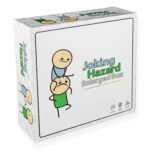
Travel-friendly box — The box is about the size of a paperback novel, thin enough to toss in a backpack. Cards are sturdy cardstock, not flimsy, though you’ll want to keep them away from drinks.
Fit for You
You host game nights where half the people arrived late and you need something that starts immediately.
You already own Cards Against Humanity but wish the jokes were more visual and less reliant on the same five shock topics.
You’re looking for best party games for adults that don’t require a huge table, long explanations, or a soundtrack.
Your friend group has a mean streak of gallows humor and enjoys things going terribly wrong in a cartoon way.
You’ve seen a Cyanide & Happiness comic and thought “I wish I could play this with my drunk friends.”
Uses
Friday night after work, five people on a couch. You deal six cards each, shuffle the deck, and someone flips a “problem” card — a comic that sets up a bad situation. Everyone picks two cards from their hand to finish the strip. The judge picks the winner, and the winner gets a point. No scoring really matters; the fun is watching people try to out-dark each other.
Another realistic moment: a birthday party where the birthday person loves dark humor. Half the room has never played. You explain the rules in under two minutes, and by the third round even the shyest player is digging through their hand for the angriest teddy bear or the guy on fire. It breaks ice faster than any “two truths and a lie.”
It also works as a drinking game if that’s your crowd — loser drinks, winner assigns a sip, whatever floats your boat. The box doesn’t suggest it, but it’s a natural fit.
Experience
Setup takes about as long as it takes to shuffle a deck of cards. No points to track on paper unless you want to. The biggest annoyance: the problem cards (the ones you use to start each round) are slightly different from the hand cards, but not marked clearly enough. New players often mistake a problem card for a hand card and play it by accident. You’ll learn to separate them after a round or two.
The cards themselves are glossy and shuffle okay, but they slide around a lot on a wooden table. A felt mat helps. Storage is simple: everything fits back into the box snugly, though the blank cards tend to slide to the bottom and get missed. Noise level is loud — lots of laughter, swearing, and occasional “oh no” groans. That’s the point.
A small complaint: the expansion packs (sold separately) add variety, but the base set can start to feel repetitive after six or seven games with the same group. You see the same comics reappear. Swapping in blank cards or a house rule where you combine two problem cards helps. But if your group plays it every week, you’ll want an expansion sooner than later.
Pros and Cons
Pros
Visual humor hits differently — The wordless comics force you to interpret facial expressions and violent slapstick. It’s more universal than a text-based game; someone who doesn’t speak perfect English can play.
Fast rounds keep energy up — No downtime waiting for someone to read a long prompt. Judge picks a winner in seconds. You can play five rounds in 15 minutes if you’re quick.
Blanks allow customisation — The few blank cards let you insert your own running jokes. That personal touch can breathe life into a group that’s played the base deck to death.
Price is fair — At $25, it’s cheaper than many party games that include less content. You get a lot of cards for the cost, and the physical quality is decent.
Cons
Repetition sets in fast — With only 360 cards and no text variety, you’ll see the same comic panels over multiple games. Expansions help, but they cost extra.
Judge can kill the flow — If your judge overthinks, a round takes longer than it should. The rules don’t give the judge a time limit, so a slow player can drag things out.
Problem cards are easy to confuse — The difference in card border is subtle. Unsorted decks cause misplays. You can fix it by marking the problem cards with a dot, but that’s something the publisher should have handled.
Not for large groups — With more than eight players, hand sizes get huge and judging becomes unwieldy. Four to six is the sweet spot. For a big party, look for something else.
Advantages
Joking Hazard vs Cards Against Humanity is the comparison everyone makes. The visual format is the real distinction. CAH relies on your ability to read a prompt and match it with the funniest text card; Joking Hazard forces you to imagine a narrative from two pictures. That makes it fun in a different way — more like collaborative comic creation than a punchline contest. It feels less reliant on the same shock value because the imagery can be interpreted differently each time.
It also wins on portability. The slim box fits in a backpack, while CAH’s main box is huge. For best party games for adults that you can carry to a bar or a picnic, this is one of the better options.
Who Should Buy
Buy it if you have a regular game group that loves Cyanide & Happiness or dark visual comedy. You like games that are easy to teach and play in under an hour.
Buy it if you want a conversation starter at a party where people know each other but need an excuse to be weird.
Skip it if your group is easily offended or prefers cooperative games. This is competitive, mean, and unapologetic.
Skip it if you want a game with deep strategy or high replayability out of the box. This is a light, comedic tool, not a deep board game.
FAQ
Is the Joking Hazard card game worth it?
Yes, if you value fast, visual, adult comedy that’s easy to teach. At $25, it’s a solid purchase for groups that laugh at dark humor. The main risk is repetition after several games; expansions mitigate that.
How long does a typical game last?
Most games run about 30 to 45 minutes for a full set of rounds. You can shorten it by playing to fewer points, or stretch it by adding expansion cards. A single round takes about 60 seconds.
Is Joking Hazard suitable for family game night?
No. The humor is intentionally inappropriate, featuring death, violence, sex, and general cynicism. It is rated for adults (17+). For a family with teenagers, you might still encounter content that makes parents uncomfortable.
Can you play Joking Hazard with two players?
The rules say three is the minimum, and two doesn’t work well because the judge role combined with a single opponent makes the humor fall flat. For two players, look at a different game — this one needs a group.
What are the Joking Hazard card game rules in one sentence?
Each round, one player draws a problem card, everyone else plays two comic cards from their hand to make a story, and the problem player picks the funniest combination.
Is there a Cyanide & Happiness game expansion?
Yes, several expansions exist, including “Happy Holidays” and “Joking Hazard: Deck 2.” They add new comic panels and problem cards. You can mix them with the base set for more variety. They cost about $15 each.
Final Verdict
For a group that enjoys dark, visual comedy and wants a party game that plays fast and fits in a coat pocket, Joking Hazard is a reliable choice. It does one thing — make you laugh at terrible things happening to cartoon stick figures — and does it well. The catch is its limited longevity without expansions. If you play board games twice a year, the base box is plenty. If your group meets weekly and blasts through content, budget for a deck refill. Either way, at $25, the first few nights will pay for themselves in laughs alone.
Joking Hazard card game vs the Competition: The Real Comparison for 2026
The party game aisle is full of big boxes and bigger promises. Joking Hazard holds its own by carving out a specific niche: hand-drawn, webcomic-driven, and creatively chaotic. It’s not the cheapest option, and it’s not the simplest to explain. But for the right group of friends, it’s easily the funniest. Here’s how it stacks up against the heavyweights.
Product
Price Range
Key Strength
Key Weakness
Best For
Joking Hazard
Mid ($20-$30)
Unique comic panel mechanic; original hand-drawn art
Some cards rely on specific webcomic deep cuts
Creative groups of 4-6 who love dark, drawn humor
Cards Against Humanity
Mid/High ($25-$40)
Massive card count & tons of expansions; shock value
Relies entirely on pre-written text; can feel repetitive
Large parties (8+) where offensive text is the goal
What Do You Meme?
Mid ($25-$35)
Photo-based, very easy to grasp for non-gamers
Memes date quickly; needs new decks to stay fresh
Casual groups who scroll memes on their phones
Apples to Apples
Low ($15-$20)
Simple, clean, family-friendly rules
Way too tame for adult groups; zero visual element
Family rèunions or mixed-age gatherings
Joking Hazard card game vs Cards Against Humanity
Cards Against Humanity is the 800-pound gorilla. Joking Hazard is the scrappy artist who hit a homerun on Kickstarter. The real difference is active vs passive creation. In CAH, you match a text prompt to a text answer. In Joking Hazard, you’re building a three-panel narrative. You have to think about sequence, pacing, and a punchline. It’s slower than CAH, but the laughs are way more specific. CAH works best with 8+ drunk people who just want to be shocking. Joking Hazard shines with 4-6 friends who are actually paying attention. Build quality is similar—decent cardstock, sturdy enough boxes—but Joking Hazard runs cheaper at $24.95 compared to CAH’s $30-to-$40 base price. If your group just wans to be offensive without thinking, grab CAH. If they want to create something stupid and brilliant together, get Joking Hazard.
Joking Hazard card game vs What Do You Meme?
Both rely on pictures, but one ages gracefully while the other expires. What Do You Meme? is a single-frame caption contest. Joking Hazard is a three-act comedy structure. The problem with What Do You Meme? is that memes go stale. A card referencing a 2018 viral tweet will get you crickets in 2026. Joking Hazard’s art is hand-drawn and timelessly awkward—a guy falling down stairs, a bomb with a lit fuse, a nervous smile. Those situations don’t age. That gives Joking Hazard a major edge in longevty. The downside? Joking Hazard’s rules have one more step. You don’t just play a card; you sequence it into a comic. If your group has a low tolerane for rules, or just wants to caption a funny photo, stick with What Do You Meme? But if you want a game that feels like collabaratively writing a comic strip, Joking Hazard wins without much effort.
Is Joking Hazard worth it for serious card game people?
Let’s talk about the actual Joking Hazard card game rules and the physical product itself. The rulebook is thin—deal cards, play beginning/middle/end, judge picks the funniest combo. You’ll learn it in two minutes. The cards themselves are stiff and glossy. They’ll survive spills better than Apples to Apples, but not quite as well as CAH’s linen finish. My box arrived with a crushed corner, which was annoying. The game inside makes up for it. The “add your own words” cards are a smart touch; they let you drag your friend’s personal failures directly into the strip. For the best party games for adults in 2026, Joking Hazard is a top contender because it rewards timing, creativity, and knowing exactly what embarraasses your specific friend group.
So who should actually buy Joking Hazard? You should buy it if your group includes at least one person who regularly sends you Cyanide & Happiness comics. You should buy it if you’re tired of reading the same Cards Against Humanity answers every single party. You should buy it if you want a game that makes you feel clever, not just crude. But if your parties are big, loud, and full of strangers, get Cards Against Humanity. If your group needs a photo cue every single round to stay focused, get What Do You Meme? Is Joking Hazard worth it? Yes—for the right table. For the wrong one, you’ll play it once and shelf it.
Ready to decide on the Joking Hazard card game?
See today’s price, stock and delivery options on Amazon.