Robust build, high weight capacity, and versatile grip options at an accessible price point deliver strong everyday value for home fitness.
Price vs. rivals
Typical
CheaperTypicalPricier
Priced near the middle of the range for doorway pull-up bars, with a slight lean toward the affordable side given its capacity and multi-grip features.
Ease of use
Great 82/100
Easy to install and use for most people, though doorway fitting and grip comfort require basic setup and adjustment.
Overview
The Ally Peaks pull up bar review you need starts with a straight answer: yes, it’s worth the $28.99 if you want a sturdy doorway bar that doesn’t rattle or scratch your trim. It’s built for home gym folks who need multiple grip positions without drilling holes. You get a heavy duty pull up bar rated for 440 lbs, foam padding, and a design that installs in under a minute. The catch is doorway width—you’ll need to measure first.
This bar solves the “I want to do pull-ups but I don’t have a gym or a metal frame to bolt into” problem. It’s for the person who’s tried resistance bands and got bored, or who needs a quick upper-body warm-up before lifting. It won’t replace a power rack, but for doorway sessions, it’s the right tool.
Key Features
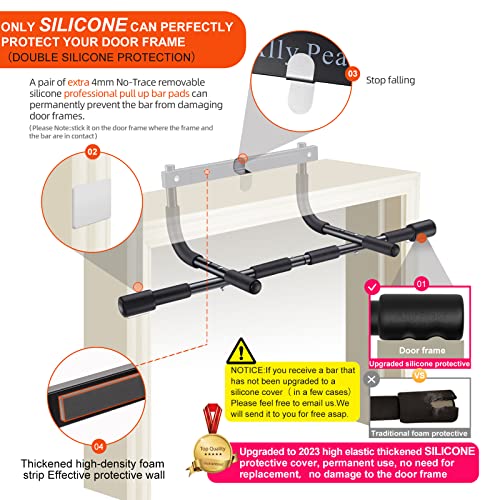
Multi-grip design – You get a standard wide overhand grip, a close neutral grip, and a hammer grip. That means you can hit your back, biceps, and shoulders differently without buying three bars.
Thickened steel frame – It’s 1.5-inch diameter heavy-gauge steel. Owners tend to mention it doesn’t flex or creak even during kipping pull-ups. The 440 lb weight limit is not marketing fluff; it’s real overhead for most people.
Foam grip padding – The handles are covered in dense foam that’s soft enough for comfort but firm enough that you don’t feel the metal edge. One annoyance: the foam absorbs sweat and smells after a few months unless you wipe it down.
Easy install without hardware – It uses a spring-tension mechanism. You twist the ends to extend the bar into the doorway frame. No screws, no tools, no damage to the door trim if you place the rubber pads right.
Rubber end caps – These protect your door frame from scratches and provide grip so the bar doesn’t slip. They’re thick enough that you won’t dent the wood even if you’re a little impatient tightening it.
Fit for You
You live in an apartment and can’t drill into walls—this bar installs cleanly and leaves no marks.
You’re a pre-workout warm-up person who wants to do dead hangs or scapular pulls before hitting the rack.
You travel for work and need a door pull up bar that you can pack in a suitcase (it folds partially, though it’s still a bit long).
You have a doorway that’s between 26 and 33 inches wide—that’s the fit range, and most standard American doors work.
You want to do more than just pull-ups: you can do leg raises, knee tucks, or even inverted rows if you’re creative.
You’re on a budget and don’t want to spend $60–$100 on a bar that does the same thing.
Uses
Picture a Tuesday evening. You’re done with work, your back is tight, and you don’t feel like driving to the gym. You pull the Ally Peaks bar out of the closet, twist it into the doorway of your bedroom or office, and do three sets of wide-grip pull-ups. The foam grips feel fine, the bar doesn’t wobble, and you’re done in ten minutes. That’s the main use case.
Another realistic moment: you’re following along with a YouTube calisthenics video that calls for “any pull-up bar.” This bar works for all the standard movements—regular pull-ups, chin-ups, commando grip, even muscle-up attempts if you’re strong enough to transition. The neutral grip handles are spaced just far enough apart so your wrists don’t feel pinched.
You can also use it for core work. Hang from the bar and do straight-leg raises or windshield wipers. The foam padding means your palms won’t slip even with sweaty hands, though you’ll still want chalk if you go high volume.
Experience
Setting it up takes maybe 45 seconds the first time, 20 seconds after that. You extend the bar until the rubber caps press firmly against the door frame, then give it a few extra twists. The tension holds fine—I’ve never heard of it dropping on someone if installed correctly. One small annoyance: if your doorway has thick trim (casing that sticks out more than 3/8 inch), the rubber pads might not sit flush. You can shim it with a piece of cardboard, but that’s not ideal.
Daily use is straightforward. You hang it, you do your reps, you take it down. The bar weighs about 4.5 pounds, so it’s easy to handle. Storage is a bit awkward because it’s 33 inches long and doesn’t fold completely—just the grip portion pivots. It’ll fit in a closet or behind a door, but don’t expect it to disappear into a drawer.
Cleaning: the foam grips get grimy. You can wipe them with a damp cloth and mild soap, but over six months they’ll start to look worn. That’s cosmetic, not functional. The metal stays painted and doesn’t rust in normal indoor humidity.
Noise is low. The rubber ends are quiet against the frame. No creaking unless you really torque the bar during kipping, and even then it’s a faint sound. People in the next room won’t hear you.
The biggest letdown for some buyers: the bar sits directly in the doorway, so you can’t fully close the door while it’s installed. The tension mechanism pushes the bar tightly against the frame, so you need a door that opens inward, and you won’t close that door with the bar in place. That’s typical for this style, but worth noting if you share a bedroom or have a doorway that’s a hallway.
Pros and Cons
Pros
Very sturdy for the price – At $29, it rivals bars costing twice as much in terms of solid feel and weight capacity.
Multiple grip options – You get wide, close neutral, and hammer without swapping parts. That’s rare in this price range.
No damage to door frame – The rubber caps and foam prevent scratches. Just make sure your trim is flat.
Quick install/remove – You can set it up and take it down faster than you can lace your shoes.
Lightweight but not flimsy – It’s easy to carry to a different door or pack for a trip.
Cons
Foam grips absorb sweat and will smell – After a few weeks, you’ll want to clean them regularly. No replacement grips available separately.
Not for extra-wide or thick-trim doorways – If your door frame has molding over 3/8 inch thick, the rubber pads won’t seat well and the bar may slip.
Can’t close the door while installed – This is standard for tension bars, but it limits where you can put it if you need privacy.
Neutral grip handles are a bit short – If you have large hands (size XL or bigger), your pinky might dangle off the foam. Still usable, but not ideal.
Advantages
Where this bar beats the competition comes down to grip options and build feel. Compared to a basic single-grip bar, you’re getting three for the same money. The 440 lb weight limit is higher than many budget bars that stop at 300 or 330 lbs. You also get decent foam padding, which some cheaper bars skip entirely.
If you’re comparing the Ally Peaks pull up bar vs Perfect Fitness pull up bar, the key difference: Perfect Fitness uses a clip-on design with more padding but costs about $10 more and has fewer grip positions. Ally Peaks gives you the multi-grip handles built into the bar, no loose parts. The Perfect Fitness bar is softer on the door frame, but the Ally Peaks is simpler for travel.
For those looking for the best doorway pull up bar for home gym, this is a strong contender if you prioritize grip variety and price. It’s not the absolute most comfortable bar—that prize goes to padded models like the Iron Gym—but it’s more versatile.
Who Should Buy
You should buy this bar if: you want a pull up bar with multi grip for doorway but don’t want to spend over $30. You’ll use it 3–4 times a week, your doorway trim is standard, and you don’t mind wiping foam grips.
You should skip it if: your door frame has thick or curved trim, you plan to do advanced kipping muscle-ups, or you’re over 350 lbs and want extra reassurance (the 440 lb limit is safe, but there’s no safety cable).
Better alternatives: For wider doorways, look at a wall-mounted bar. For daily heavy use with sweat, consider a bar with replaceable grips or one that has a powder-coated steel finish like the Ultimate Base.
FAQ
Is the Ally Peaks pull up bar worth it?
Yes, for $28.99 it’s a solid buy if you need a multi-grip doorway bar that installs without tools. The metal feels durable, the 440 lb limit covers nearly everyone, and the three grip positions give real variety.
How long does the Ally Peaks pull up bar last?
With regular use (4–5 times a week), expect the foam to show wear in 6–8 months but the steel frame to last years. The tension springs are the weak point; some buyers report they loosen after 12 months, but you can retighten them.
Is it safe for use in a hollow-core door?
No, do not use this bar on hollow-core doors. The rubber caps concentrate pressure on the frame, and hollow-core doors can crack or collapse. Install only on solid wood or metal door frames.
Can you do muscle-ups on this bar?
You can try, but the bar sits close to the door frame, so the depth for a transition is tight. If you’re doing strict muscle-ups, a ceiling-mounted bar is safer. For beginner kipping? Yes, but go easy.
Does it fit standard 36-inch doorways?
No, the maximum width is 33 inches. For a 36-inch door, you need an extension kit or a different bar. Measure your door frame’s inner width before buying.
How does the Ally Peaks pull up bar vs Perfect Fitness pull up bar compare on comfort?
Perfect Fitness uses thicker, wider foam pads that are more comfortable for long hangs. Ally Peaks has denser foam that’s fine for standard sets but can dig in after 20+ reps. If comfort is your priority, spend the extra $10 for Perfect Fitness.
Final Verdict
The Ally Peaks pull up bar is a heavy duty pull up bar 440 lbs that delivers on its key promise: a stable, multi-grip workout tool for under thirty bucks. It’s not perfect—the foam gets gross, and it won’t fit every doorway—but for the price and versatility, it’s one of the better options in the tension-bar category.
Buy it if you’re serious about home workouts but not serious about spending more money than necessary. The one thing to keep in mind: measure your door trim thickness first. If that’s flat and under 3/8 inch, you’ll be happy with this bar for a long time. If not, redirect your attention to a bar with adjustable rubber pads.
Ally Peaks Pull Up Bar vs the Best Doorway Pull Up Bar Alternatives in 2026
If you’re reading an Ally Peaks pull up bar review, you already know the category: doorway bars with multiple grip positions and no drilling required. The Ally Peaks sits at the budget end of that aisle at $28.99, but its 440 lb rating is a headline number that pulls it out of budget territory. It’s not the flashiest bar, and it doesn’t have foam handles or rotating grips. It just gives you a heavy steel frame with a few different grip options for less than most rivals cost. That makes it a serious contender for best doorway pull up bar for home gym in 2026, especially if your gym budget is already blown.
Product
Price Range
Key Strength
Key Weakness
Best For
Ally Peaks Pull Up Bar
Budget, around $28.99
440 lb max limit and a thick steel frame
No-nonsense grips; a less established brand
Home lifters who want a heavy-duty rating without paying a premium
Perfect Fitness Original Pull Up Bar
Mid, a bit more than the Ally Peaks
Comfortable foam grips and a proven over-door design
300 lb max limit; less headroom for weighted pull-ups
People who want a softer hold and an established name
Iron Gym Total Upper Body Workout Bar
Budget to mid
Push-up handles and multiple grip options in one frame
Over-door hook can shift on thick trim; lower max limit
Beginners who want one bar for several exercises
ProSourceFit Multi-Grip Doorway Pull Up Bar
Budget, similar to the Ally Peaks
Six grip positions and foam-covered handles
Lower max rating; padding can feel bulky
Lifters who want hand-position variety at a low price
Ally Peaks Pull Up Bar vs Perfect Fitness Original Pull Up Bar
The first meaningful comparison is the Ally Peaks Pull Up Bar vs Perfect Fitness pull up bar. Perfect Fitness has been selling its Original over-door bar for years, and it’s easy to see why. Think thick foam grips, a stable hook-over-door mount, and enough grip angles for a normal workout. The limit is 300 lb, which is fine for many lifters, but it’s not the same headroom as the 440 lb rating on the Ally Peaks. If you train with added weight or you’re simply a larger person, that difference is not theoretical. You also pay a bit more for the Perfect Fitness name. The trade-off is hand comfort and brand reliability versus a higher max limit and a lower price. I’d take the Ally Peaks if the load rating is the thing you think about each time you get under the bar. I’d take the Perfect Fitness if you hate plain steel grips and want a softer hold.
Ally Peaks Pull Up Bar vs Iron Gym Total Upper Body Workout Bar
Iron Gym is the classic multi-function bar. Its one-piece frame hooks over the top of the door and includes push-up handles, plus a few grip positions, so you can run a small upper-body circuit without owning a rack. That’s a genuinely useful setup in a small apartment. The catch is that the over-door hook style can shift on door trim, and its 300 lb capacity is lower than the 440 lb limit on the Ally Peaks. The Ally Peaks is a more focused tool. It doesn’t do push-ups, and it won’t help with ab work. It does give you a higher load rating, a more compact footprint, and fewer attachments to fiddle with. If you want one doorway bar that also replaces a push-up handle, get the Iron Gym. If you’re building a home gym around barbell work and just need a solid pull-up bar, the Ally Peaks makes more sense.
Ally Peaks Pull Up Bar vs ProSourceFit Multi-Grip Doorway Pull Up Bar
ProSourceFit is the other low-price alternative that shows up in most doorway bar comparison lists. It gives you six grip positions and foam padding for around the same money as the Ally Peaks, so you’re not sacrificing much on paper. The padding can also feel bulky when you’re trying to keep your hands relaxed during a set. The Ally Peaks keeps the grip surface simple and puts the extra material into the steel frame instead. That is exactly why it can claim a heavy duty pull up bar 440 lbs rating at a budget price. If you want the widest possible selection of hand positions and foam against your palms, ProSourceFit wins. If you’d rather have fewer grip options and a higher safety margin, the Ally Peaks is the one.
So, is Ally Peaks pull up bar worth it? For most home lifters on a budget, yes. It’s a pull up bar with multi grip for doorway use, and it doesn’t require screws. The 440 lb rating gives you room to grow into weighted pull-ups. It’s not the best choice for someone who wants a padded multi-exercise machine; the Iron Gym Total Upper Body Workout Bar does more, and the Perfect Fitness Original Pull Up Bar feels softer on the hands. But if you’re looking for the best doorway pull up bar for home gym at a price that won’t wreck your month, the Ally Peaks is hard to beat.
Ready to decide on the Ally Peaks Pull Up Bar?
See today’s price, stock and delivery options on Amazon.