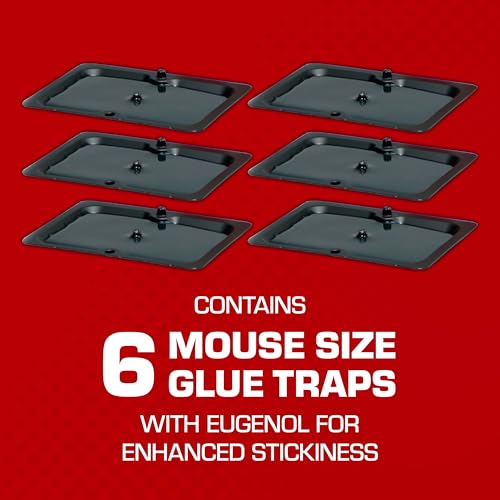
This tomcat glue traps review cuts to the chase: for around five dollars for a six pack, these are about as practical as mouse control gets. The eugenol lure (clove scent) actively brings mice in. Are they worth it? For cheap, fast results, yes—but only if you accept what a glue trap really does.
Offers effective pest control at an affordable price, with strong user satisfaction and enhanced stickiness feature.
Price vs. rivals
Typical
CheaperTypicalPricier
This six-count glue trap kit sits close to the typical price range for comparable mouse glue traps, with the brand-name formulation and added eugenol placing it at a mid-market position.
Ease of use
Excellent 85/100
These glue traps are very easy to use—just peel and place—though handling the sticky surface requires some care to avoid accidental contact.
Overview
This tomcat glue traps review covers a straightforward product: a shallow plastic tray filled with super sticky glue. Tomcat mixes a clove-scented attractant called eugenol into the glue, which sets them apart from cheap boards. It works better because mice come looking for the smell.
It is one of the best mouse glue traps for home use if you want a non-toxic, set-and-forget method. They are designed for the common house mouse, not rats. You peel, place, and wait.
Key Features
Eugenol Lure – This is the detail that separates them from generic boards. The clove oil derivative actively attracts mice to the trap rather than hoping they wander onto it.
Rigid Plastic Tray – Unlike cardboard traps that can buckle or leak adhesive, this tray holds firm. It slides easily under tight spaces without collapsing.
No Baiting Required – You don’t need to add peanut butter or cheese. The glue and the scent do all the work from the moment you open the pack.
Non-Toxic – No poison means no risk of a hidden dead mouse smell in your walls. What you catch, you see and dispose of directly.
Low Profile – It is thin enough to fit under a fridge, stove, or baseboard heater, which is exactly where mice travel.
Fit for You
You keep finding droppings in the pantry and want an immediate solution without poison.
You are a renter who can’t block every entry hole, so you need a quick trapping method instead of exclusion.
You want the best mouse glue traps for home safety because you have small kids touching things.
You are squeamish about snap traps and want to avoid the loud snap and cleanup.
You only need a temporary fix for a suspected mouse that came in with groceries or firewood.
Uses
These traps shine against a garage wall where you see droppings. Under the kitchen sink. Behind the refrigerator. Along the baseboard in the basement. They are also great for a seasonal cabin or a storage unit you visit monthly.
The key is placing them along walls. Mice follow edges. If you see a run, put the trap perpendicular to the wall with the sticky side facing the travel lane. Don’t put them in the middle of a room.
Experience
Setting them up is dead simple. You peel back the paper cover, toss it, and place the tray. The scent is noticeable when you open the pack—a strong clove smell. It fades after a few hours. Most owners find it tolerable.
Now, the part of this tomcat glue traps review most people care about: the catch. When a mouse steps on a Tomcat glue trap with eugenol, it gets held fast. It is not instant death. Do Tomcat glue traps catch mice fast? Yes, usually overnight. The tray contains the mess well, no leaking glue. If dealing with a live mouse bothers you, look at a humane live trap instead. If you can handle it, the trap itself works every time.
Pros and Cons
Pros
Extremely Affordable – At roughly $0.88 per trap, you can lay out a dozen without feeling the cost.
No Waiting – No bait prep, no trigger testing. Just peel and place.
Works Fast – Most catches happen within 24 hours if the spot is right.
Safe Around Food Storage – No poison, so even if you find one near cereal boxes, there is no chemical contamination.
Tough Plastic – The tray is sturdy and won’t fold over on itself in humid areas like cardboard boards do.
Cons
Ethical Downside – This is the main trade-off. It is a slow death. You have to be okay with that or find a different method.
Non-Target Risks – Insects, small reptiles, or a curious pet paw can get stuck. It requires careful, strategic placement.
Weather Sensitivity – Dust kills the stickiness. A dusty garage or muddy floor will render a trap useless in a week.
One Time Use – Once a mouse is on it, the trap is done. You throw the whole thing away.
Gross Cleanup – Prying a glued mouse off to dispose of it is not fun. Usually you just wrap the whole tray and toss it.
Advantages
How does it hold up against the alternative? In the tomcat glue traps vs victor mouse traps comparison, the big win for Tomcat is the plastic base and the lure. Victor makes excellent snap traps, but their glue boards are often cardboard. Cardboard can warp when the glue gets warm, letting a mouse escape. Tomcat’s rigid plastic tray and eugenol attractant give it an advantage over plain glue boards. The price is the same. If you are picking between glue traps, Tomcat is the better engineered product for reliability.
Who Should Buy
Buy them if: You want the cheapest, fastest way to catch a mouse. The trouble-free setup and lack of poison make them a good first try.
Skip them if: You want a humane kill method. A snap trap kills instantly. These do not. That matters for many people.
Buy them if: You are dealing with a mouse, not a rat. These are sized perfectly for mice. Using them for rats is pointless.
Skip them if: You have free-roaming pets. Even under the fridge is a risk if a toy rolls under. Consider Tomcat’s covered station or a snap trap instead.
FAQ
Are Tomcat glue traps worth it?
Yes, they are absolutely worth it for the cheap price and fast performance. At roughly five dollars for six traps, they solve a mouse problem immediately without poison or complex setup. Just go in knowing the ethical restrictions of glue before you buy them.
How long does a Tomcat glue trap last?
In a clean, dry spot out of direct dust and moisture, a trap stays sticky for around two to three weeks. Dust and debris are the real enemy here. Once a mouse is caught, the trap is finished and must be thrown away.
Is the Tomcat glue trap with eugenol safe for pets?
Not entirely. A paw or nose can get stuck, causing injury to a pet. Vegetable oil can free a stuck animal, but it is better to place traps where pets absolutely cannot reach them, like inside a locked cabinet.
Do Tomcat glue traps catch mice fast?
They usually catch a mouse within the first 24 hours if placed correctly along a wall. The eugenol lure speeds up the process by actively attracting the mouse to the trap instead of waiting for luck.
Does the eugenol smell bother humans?
The clove smell is strong when the pack is first opened, but it fades significantly within a day. Most people find it tolerable or cannot smell it at all after a few hours. It is not an overwhelming odor.
Can I reuse a glue trap?
No. These are strictly single-use. Once a mouse or insect is stuck, the glue loses its holding strength. You throw the entire tray away and open a fresh one for the next catch.
Final Verdict
Closing out this tomcat glue traps review, the verdict is simple. If you need a cheap, highly effective solution for a household mouse, these are a solid choice. They work, they are simple, and the eugenol lure genuinely attracts. The one thing to keep in mind is the ethical reality of glue. It is not humane, and the cleanup is the price you pay for that convenience. If you accept that, these are the best basic glue traps you can buy today. If you do not, look at snap traps instead.
Tomcat Mouse Glue Traps vs the Competition: Best Mouse Glue Traps for Home 2026
Tomcat sits in an awkward, honest spot in the mouse-killing aisle. It is not a tool you boast about, but it is the one you grab when you just want the scratching to stop without reading instructions. The key differentiator is the Eugenol scent – a clove oil derivative that smells like food to a rodent, not like a spring trap. This puts it in a direct comparison against other sticky traps and the mechanical precision of a Victor snap trap. The best mouse glue traps for home usually compete on stickiness; Tomcat competes on chemistry.
Product
Price Range
Key Strength
Key Weakness
Best For
Tomcat Glue Traps (Eugenol)
Budget ($5.28 for 6)
Attractive scent lure, instant deployment
Messy disposal; glue degrades in cold or dust
Quick knockdown in warm indoor spaces
Victor M1 Mouse Trap
Standard ($)
Reusable, no-touch setting, clean kill
Smart mice can avoid it; need to set it right
Eco-conscious users wanting a clean, instant catch
Catchmaster 72MAX
Budget ($$ per sheet)
Massive surface for many pests
Too large for tight placements; upsetting to clear
Infestations in garages, basements, or sheds
Terro Glue Traps
Budget ($)
Sturdy tray, simple design
No active lure; purely passive trap
Placing in tight spots where scent isn’t needed
Tomcat Mouse Glue Traps vs Victor Mouse Traps: The Clean versus the Easy
This is the philosophical fork in the road. A Victor M1 is a precision tool. You place the bait just right, arm the bar, and hope the mouse triggers it cleanly. A Tomcat glue trap is a blunt instrument. You open the box, peel the paper, and stick it down. Do Tomcat glue traps catch mice fast? The first mouse that steps on the glue is caught instantly, but the trap is a one-and-done deal. The Victor is faster to kill and can be reset a hundred times. The Tomcat is faster to deploy and requires no learning curve. If you want a trap that asks nothing of you but placement, Tomcat wins. If you want a tool you can trust for years, it’s the Victor.
Tomcat Glue Traps vs Catchmaster: When Size Beats Chemistry
Pitting Tomcat against Catchmaster is like comparing a hand trowel to a shovel. Tomcat makes a precise 4×5 inch tray for the baseboard. Catchmaster makes a 1×2 foot sheet for the whole barn. The Tomcat relies heavily on its Eugenol lure to pull the mouse to the exact spot the trap sits. The Catchmaster just covers every possible path in a 2-foot radius. For a single mouse in a clean apartment, the Tomcat is the best mouse glue trap for home. Its scent lure works better in a smaller, warmer space. For a family of mice in a dusty basement, a Catchmaster sheet catches more bodies with less effort because the mouse doesn’t need to smell it—it just needs to walk.
Are Tomcat Glue Traps Worth It Compared to a Cheaper Sticky Pad?
The extra dollar you spend on Tomcat pays for the Eugenol. A standard Terro glue trap or a generic board is just a passive pool of adhesive. It sits there and hopes a mouse steps in it. Tomcat’s glue infuses an active attractant. It turns the trap into a target. In a warm, dry room, the scent is effective enough to pull a mouse off its usual path. In a cold garage or a dusty crawlspace, the glue stiffens and the lure gets covered. Are they worth it? Only if you place them where the chemistry can actually do its job. Otherwise, you are paying a premium for a feature that never gets to fire.
You should choose the Tomcat Mouse Glue Traps if you want the lowest possible effort and trust an active scent lure to make up for the lack of a spring. You should consider the Victor M1 instead if you want a clean kill and a reusable trap, or the Catchmaster 72MAX if surface area matters more than lure precision.
Ready to decide on the Tomcat Mouse Glue Traps?
See today’s price, stock and delivery options on Amazon.