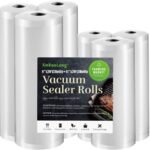
This FoodSaver vacuum sealer bags review gets straight to it: the FoodSaver Custom Length Bags are worth the money if you already own a vacuum sealer. The material is thicker than most generic rolls, they seal reliably every time, and the custom-length format means you’re not wasting bag material on awkwardly sized portions. At $29.99 for five rolls, you pay more than you would for off-brand, but you get consistency that matters for long-term freezer storage and sous vide cooking.
Excellent customer rating and brand reliability justify the price for consistent performance.
Price vs. rivals
Cheaper
CheaperTypicalPricier
Priced competitively below many single-roll alternatives, offering value for a multipack.
Ease of use
Excellent 95/100
These pre-cut rolls are very easy to use for anyone with a compatible vacuum sealer, as they simply require cutting to length and sealing.
Overview of the FoodSaver Vacuum Sealer Bags Review
What you’re looking at is a multipack of five rolls: two 8-inch rolls and three 11-inch rolls. That mix covers most everyday needs, from small cheese blocks to full briskets. The bags work with any FoodSaver machine and most chamber-style sealers that accept textured bags.
The problem these solve is simple: air is the enemy of food. Freezer burn, stale coffee, soggy chips, sous vide bags that leak. These bags create an airtight seal that keeps oxygen out and moisture in. They’re designed for people who buy in bulk, meal prep on weekends, or cook sous vide more than once a month.
Key Features
Custom-length rolls – You cut exactly what you need. A single 20-inch bag for a whole brisket, or a 6-inch bag for a single chicken thigh. No more wasting a full quart bag on half a cucumber.
Thicker material than generic bags – The film is noticeably more rigid than the cheap rolls you find at discount stores. It resists punctures from sharp bones and doesn’t stretch thin at the seal point.
Textured surface for proper vacuum – The raised pattern creates channels that let air escape evenly. Smooth bags trap air pockets, which ruins seals and leaves you with a bag that floats in the sous vide bath.
BPA-free – Important if you’re boiling or simmering them for sous vide. The plastic is food-grade and doesn’t leach into your 48-hour short rib.
Multipack with two sizes – You get both 8-inch and 11-inch rolls in one box. That saves you from having to buy two separate packages and guessing which one you’ll need more of.
Compatible with all FoodSaver machines – Works with every model from the basic to the pro-grade ones. Also works with some third-party machines, but check your manual for bag texture requirements.
Fit for You
You buy meat in bulk from Costco or a local butcher and want to portion it before freezing.
You cook sous vide regularly and need bags that can handle 140-degree water for 36 hours without leaking.
You’re tired of finding half-eaten bags of nuts or chips that went stale because the original packaging wasn’t resealable.
You meal prep on Sundays and want to store pre-chopped vegetables, marinated proteins, or cooked grains without freezer burn.
You’ve tried cheap vacuum sealer bags and got frustrated with failed seals or bags that punctured when you touched a corner.
You want to store cheese, dry goods, or leftovers in the fridge for more than a week without them drying out or picking up fridge odors.
Uses for These Bags
Freezer storage. This is the main event. You buy a pork shoulder on sale, cut it into 2-pound chunks, seal each one, and stack them in the freezer. Six months later, you take one out and it’s as fresh as the day you bought it. No ice crystals, no gray discoloration, no off odors.
Sous vide cooking. If you’re looking for the best vacuum sealer bags for sous vide, these are a strong candidate. The textured surface prevents air pockets that cause floating bags, and the material holds up at 185 degrees for long cooks. You’ll want to double-seal the top for anything over 12 hours, but that’s standard advice for any bag.
Pantry organization. Open a bag of flour, sugar, or coffee, and it starts losing freshness the moment you break the seal. Transfer those into a vacuum bag, seal it, and they stay good for months. Works great for brown sugar that always turns into a brick.
Marinating in a hurry. Toss a steak or chicken breast into a bag with your marinade, seal it, and let the vacuum pressure pull the liquid into the meat. You cut marinating time from hours to about 30 minutes. Not a gimmick, it actually works.
Experience Living with the FoodSaver Custom Length Bags
Setting up a roll is straightforward. You open the box, pull out a roll, and load it into the bag cutter on your FoodSaver machine. The cutter has a blade that slides across, and you pull the bag to the length you want. The first few times you’ll probably cut a bag too long or too short, but you get a feel for it after a handful of uses.
The 8-inch rolls are what you’ll reach for most often. A single chicken breast, half a block of cheese, a portion of leftover chili, a small bag of nuts. The 11-inch rolls handle the bigger jobs: a whole pack of pork chops, a full tri-tip, a bag of flour for the pantry.
One thing you’ll notice: the material is stiff when it’s cold. If you keep your rolls in a cold pantry, the plastic doesn’t feed as smoothly through the cutter. Let it warm up to room temperature for a few minutes before cutting. Small thing, but it saves a frustrating moment.
The seal is the part that matters most, and it’s consistent. The machine heats the bag, presses it shut, and cools it. With these FoodSaver bags, the seal is uniform across the entire width, no weak spots at the edges. With cheap generic bags, you sometimes get a seal that holds for a day then pops open in the fridge. That doesn’t happen here.
Cleaning is nothing. The bags are disposable, so you toss them when you open them. The only thing you clean is the drip tray on the machine, which catches any liquid that gets pulled into the vacuum channel. That’s a machine maintenance thing, not a bag thing.
Storage of the rolls is easy. They’re long cardboard tubes that fit in a drawer or on a shelf. The 11-inch rolls are bulky enough that you won’t want to cram them into a small cabinet, but they fit fine in a standard pantry shelf.
Noise level is the machine’s doing, not the bag’s, but you should know that vacuum sealers are loud. You won’t want to run it while someone in the next room is on the phone. The actual bag doesn’t make noise, but the machine does its roaring thing for 20–30 seconds per seal.
The small annoyance: the rolls have a crimped edge on one side that you need to seal before you use the bag. You cut a bag, then you seal the bottom edge before you fill it. That’s normal for any roll bag, but if you’re used to pre-made bags that are sealed on both ends, it’s an extra step. You get fast at it after the third bag.
Pros and Cons
Pros
Consistent, strong seals every time – The bag material bonds cleanly with the machine’s heating strip. No weak corners, no partial seals that fail later.
No waste with custom lengths – You cut exactly what you need. A 4-inch bag for a single garlic clove? You can do that. A 30-inch bag for a whole salmon? Also doable.
Thick enough for sous vide – Many generic bags are too thin for extended sous vide cooks. These hold up at high temperatures for long periods.
Multipack gives you both sizes – You don’t have to guess which roll width you’ll need. You get both, and you’ll use both.
Cons
More expensive than generic rolls – You pay a premium for the FoodSaver name. Off-brand rolls cost roughly half as much, and some work perfectly fine for standard freezer use.
Rolls require an extra sealing step – If you want grab-and-go convenience, pre-cut bags exist. The roll format means you cut and seal one end yourself before filling.
Can’t reuse them easily – Once you open a vacuum bag, you cut the seal to get the food out. You can wash and reuse the bag if you cut high enough, but the material isn’t designed for repeated use. Disposable by nature.
11-inch rolls are bulky – The 11-inch rolls are wide and take up space in a kitchen drawer. If you have a tight kitchen, storing them can be a minor hassle.
Advantages Over the Alternatives
The biggest difference in the FoodSaver vs generic vacuum sealer bags conversation comes down to reliability. Generic bags can work fine for the first few seals, but you’ll sometimes get a roll where the texture is uneven, the film has thin spots, or the seal doesn’t bond properly with your machine. With FoodSaver’s own bags, you know the material is engineered for their machines, and the consistency is there from roll to roll.
Stronger seals under heat – The melting point of the bag material matches the machine’s heat profile. Generic bags can melt unevenly or fail to bond if they’re made from a different plastic blend.
Better puncture resistance – The thicker film means sharp edges like bone-in chicken or dehydrated fruit won’t punch through as easily. That matters when you’re freezing something for six months and don’t want to find a leak.
More consistent texture – The raised channels on FoodSaver bags are uniform across the entire roll. Some generic brands have channels that are too shallow or uneven, which means the vacuum doesn’t pull all the air out and you end up with a bag that’s still partly inflated.
Who Should Buy This
Buy it if you use your vacuum sealer at least once a week and want bags you can trust every time.
Buy it if you cook sous vide often and need bags that won’t fail at 180 degrees after 24 hours.
Buy it if you’re tired of throwing away meat that got freezer burn because the cheap bag had a slow leak.
Skip it if you only seal a bag every few months. The multipack is five rolls, and if you’re not going to use them within a reasonable time, you’re better off with a smaller pack or pre-cut bags.
Skip it if you’re on a tight budget and you’re willing to test a few generic brands to find one that works with your machine. Some people get great results with off-brand rolls at half the price.
Skip it if you want reusability. These are single-use bags. If you want something you can wash and reuse, look for thicker chamber-style bags that are designed for multiple cycles.
FAQ
Is FoodSaver vacuum sealer bags worth it?
Yes, if you use your vacuum sealer regularly. The build quality, seal reliability, and material thickness justify the higher cost for frequent users. For occasional use, you might be fine with cheaper generic bags.
How long does food last in FoodSaver vacuum bags?
In the freezer, vacuum-sealed food stays fresh 3 to 5 times longer than food stored in regular freezer bags. Meat can last 2 to 3 years without freezer burn, and dry goods like nuts or coffee stay fresh for 6 to 12 months.
Can you reuse the FoodSaver Custom Length Bags?
Technically yes, but they’re designed as single-use bags. If you cut the seal off high enough to leave a clean edge, you can wash and reuse a bag a few times. Just know the material gets weaker each time you heat-seal it.
Are these bags safe for sous vide cooking?
Yes. The bags are BPA-free and designed to handle the temperatures used in sous vide cooking, typically 130 to 185 degrees Fahrenheit. For extra safety on long cooks, double-seal the top of the bag to prevent leaks.
Can you use generic vacuum sealer bags in a FoodSaver machine?
Many generic bags work, but you have to check that they have the textured channel surface that matches your machine’s vacuum nozzle. Smooth bags won’t seal properly. Even with textured generic bags, the seal quality varies by brand.
How do you use the FoodSaver custom length bag roll?
Pull the roll out to your desired length, cut it with the built-in cutter on your machine, then seal one end of the bag before filling it. Fill the bag, place the open end into the vacuum channel, and press the button. The machine does the rest.
Final Verdict on the FoodSaver Vacuum Sealer Bags Review
If you own a FoodSaver machine and use it with any regularity, these bags are the safe bet. They cost more than the no-name rolls, but they eliminate the gamble of whether a seal will hold or a bag will puncture. For sous vide cooking, they’re genuinely the best vacuum sealer bags for sous vide that work hassle-free.
The one thing to keep in mind: don’t buy the multipack if you’re only going to use a roll once every three months. That’s too much bag inventory sitting around. But if you’re sealing weekly, this is the easiest way to stock both widths and forget about bags for the next six months. They work, they last, and they keep your food from turning into freezer-burned disappointment.
FoodSaver Custom Length Bags vs the Competition in 2026
FoodSaver’s Custom Length Bags have dominated the home vacuum-sealer scene for years, and this five-roll multipack (two 8-inch rolls and three 11-inch rolls) covers almost any kitchen job. But alternatives from Anova, Weston, and Nesco fight for your counter space. The honest truth: which one you should buy depends on whether you prioritize sous vide performance, cost per foot, or sheer durability.
Product
Price Range
Key Strength
Key Weakness
Best For
FoodSaver Custom Length Bags (5-Roll Multipack)
Mid
Perfect compatibility with FoodSaver machines; two width options in one box
Slightly thinner film than premium competitors; can pinhole on sharp bones
Everyday freezer storage and casual sous vide
Anova Vacuum Sealer Bags (Pre-Cut or Rolls)
Mid
Excellent water resistance and sealing for sous vide; no BPA claim
Fewer width options; precut bags are shorter than expected for large roasts
Dedicated sous vide cooks who want bags that stay sealed under long baths
Weston Pro-2300 Vacuum Sealer Bag Rolls
Premium
Thicker, textured film that resists punctures and freezer burn
Expensive per foot; rolls are heavy and don’t fit standard FoodSaver cutter bars
Heavy-duty bulk freezing of meats with bones or sharp edges
Nesco VS-02 Vacuum Sealer Bags
Budget
Cheapest per foot among named brands; works with most external machines
Thinner bags that can fail under high heat in sous vide; inconsistent seal width
Cost-conscious shoppers sealing dry goods or short-term freezer use
FoodSaver Custom Length Bags vs Anova Vacuum Sealer Bags
Anova’s bags are the sous vide specialist’s pick. They’re made from a slightly thicker poly film that stands up to 12-hour cooks at 185°F without leaking—where FoodSaver’s standard rolls can develop a tiny gap at the seal if you aren’t careful to double-seal on the first pass. The trade-off? Anova primarily sells pre-cut bags and only one roll size (11-inch wide), so you can’t trim to fit a single chicken leg without wasting plastic. The FoodSaver Custom Length Bags, with two 8-inch rolls and three 11-inch rolls, let you cut exactly what you need. So if you’re cooking for one and hate waste, stick with FoodSaver. If you sous vide a whole brisket every weekend, Anova’s precut quart and gallon bags might actually be faster.
FoodSaver Custom Length Bags vs Weston Pro-2300 Rolls
Weston’s Pro-2300 rolls are absolute tanks. The film is almost double the thickness of FoodSaver’s—it feels like a stiff garbage bag rather than a cling wrap. That matters when you stuff a bag with pork ribs or lamb chops that have exposed bone tips. I’ve had FoodSaver bags puncture on a sharp T-bone and ruin a freezer drawer. Weston bags won’t. But here’s the kicker: Weston rolls are 11 inches wide and 50 feet long, and they cost about the same per roll as an entire FoodSaver multipack. You’re paying for durability, not versatility. If you only seal large, pointy cuts, buy Weston. For anyone who also seals cheese, cookies, or individual chicken breasts, the FoodSaver Custom Length Bags are a much better fit because you can switch between the smaller 8-inch roll and the wider one without wrestling a giant roll for a tiny bag.
FoodSaver Custom Length Bags vs Nesco VS-02 Bags
Nesco bags are the budget alternative that gets the job done—sometimes. At roughly half the cost per foot of FoodSaver, they’re tempting. But the film is noticeably thinner, and the seal width can vary from batch to batch. I’ve had a Nesco bag blow a seal in a sous vide bath after three hours, flooding the water with chicken juice. Not a huge loss, but not something you want to risk with an expensive cut of beef. For dry pantry items—pasta, rice, coffee—they’re perfectly fine. For sous vide or long-term freezer storage, the FoodSaver Custom Length Bags are the smarter middle ground. The price gap between Nesco and FoodSaver is narrow enough that you’re not saving enough to justify the frustration of a failed seal.
So, is FoodSaver vacuum sealer bags worth it? For most people, yes. This multipack gives you two widths in a single box, reliable seals with any FoodSaver machine, and decent puncture resistance for everyday use. Skip it only if you do all your sealing with a commercial-style chamber machine (then get Weston) or if you only ever sous vide and want Anova’s extra heat tolerance. Otherwise, the FoodSaver Custom Length Bags are the best vacuum sealer bags in 2026 for the home cook who wants one box to handle both a half-pound of walnuts and a whole pork shoulder.
Ready to decide on the FoodSaver Custom Length Bags?
See today’s price, stock and delivery options on Amazon.